Showing posts with label meaning. Show all posts

Sunday, March 29, 2026

Palm Sunday 2026 - Unique perspectives of the Passion

We just heard the great Passion according to St. Matthew. All four Gospels contain an account of the passion of Jesus –the events leading up to and including his suffering and death on the Cross. There are similarities between each of the Gospel accounts. But like any event described by different authors, each Passion account contains the evangelists' unique perspective.

St. Mark’s passion, is the shortest. It is fast-paced and concise, written for the Roman Christians already being persecuted by an empire working to destroy the Church. Mark emphasizes Jesus’ suffering, his agony, likely to embolden the Christians who were already being persecuted for his name.

St. Luke’s Passion highlights the Lord’s compassion, forgiveness, and universal love. St. Luke recorded the merciful words of Jesus on the Cross: “Father, forgive them, they know not what they do.”

We read St. John’s Passion every year on Good Friday, which focuses on Jesus’ divine nature, his fulfillment of His Father’s plan. “It is finished”, the Lord says, as he accomplishes the salivific mission for which he was sent.

St. Matthew’s original audience were the Jewish converts—those who came to believe that Jesus was the long-awaited Messiah. And so, Matthew’s Passion, as we heard contained explanations of how Jesus fulfilled the Old Testament Messianic prophecies. St. Matthew even recorded Jesus from the cross quoting one of the Psalms in Hebrew: “"Eli, Eli, lema sabachthani?"which means, "My God, my God, why have you forsaken me?"

To quote the famous biblical scholar Raymond Brown: “Matthew emphasizes Jesus as the fulfiller of Old Testament prophecies, Mark emphasizes Jesus’ abandonment and the scandal of the cross, Luke emphasizes Jesus’ compassion, and John emphasizes Jesus’ sovereignty and control over events.”

Again, each of the Gospel writers narrate the Passion from unique perspectives. What about yours? What does the Passion of the Lord mean to you, at this particular moment in your life, at the beginning of Holy Week 2026.

For our Catechumens, perhaps this is the first time they’ve ever heard the entire Passion. Christ’s journey to the cross parallels their own journey to the Sacraments at Easter. As they prepare to die and rise with Christ in Baptism, they are reminded that to belong to Jesus is not simply to admire him, but to follow him—to pass with him through suffering, surrender, and death into new life.

But what about the rest of us? What does the Passion mean to us?

For those who are undergoing illness and suffering, the Passion means that suffering is no longer meaningless. The Son of God has entered into pain, weakness, humiliation, and agony. He knows what it is to suffer in the body, to feel abandoned, to endure suffering patiently and out of love. And so your suffering, united to his, can become a participation in his redeeming love—in God’s very life.

For those who are struggling with faith, the Passion shows us, what? That even in darkness, confusion, and fear, God is present. Jesus, united even to the portion of humanity which feels forsaken by God, showed us the importance of persevering in crying out to God, having faith even when God is difficult to see.  If your faith feels weak, if prayer feels dry, if God seems silent, look at the crucified Jesus and know that he has entered even that darkness, and he has not abandoned you.

What does the Passion mean, for young people discerning what God is calling them to do with their life? The Passion reveals that the purpose of our life is discovered not in seeking our own will, but God’s. Jesus embraces the will of the Father, even when it is costly—and teaches us to seek how God is calling us to love, to sacrifice, to trust, and give of ourselves for the kingdom. 

What does the Passion mean for married people raising a family? The Passion reveals the shape of authentic love. Love is not merely a feeling; it is sacrifice, perseverance, forgiveness, patience, and fidelity. To love your spouse, to care for your children, to provide, to endure the daily dying to self that family life requires—this too, when done with faith, is a sharing in the cross of Christ, and therefore in its fruitfulness.

What does the Passion mean for those who are advanced in the Spiritual life? The Passion is an invitation to accompany Jesus not only in consolation but in desolation. Deep prayer always draws us more deeply into the mystery of Christ crucified.

What about those struggling to overcome sin? The Passion reveals both the seriousness of sin and God’s mercy—sins remedy. Our sins are not small things; they led to the crucifixion of the innocent Lamb. And yet Christ’s response is not vengeance, but love poured out to the end. Holy Week is the time not to hide our sins like Adam and Eve hiding in the Garden, but to humbly repent of them, bringing them to the crucified Lord who blood is our deliverance from sin.

What about those who like the Lord betrayed by Judas have been betrayed by a trusted friend or family member? The Passion reminds you that Jesus knows that pain, too. He knows what it is to be wounded not just by enemies, but by one close to him. If your heart has been pierced by betrayal, bring that wound to the Lord, who will help you to forgive and to know peace.

Maybe the Passion is a reminder to some of us, who acted like the chief priests with the scribes and elders mocked Jesus, or like Peter denied Jesus before others. For us the Passion is humbling, but also cause for such great gratitude, that contempt and cowardice have been replaced with faith and Love. 

The Passion means something a little different to each of us, depending on where we are standing at this moment in our life. And yet in every case, it means this: that Jesus Christ loved us to the end. He entered suffering, betrayal, injustice, humiliation, and death itself in order to save us. And so, whatever our particular walk of life may be at the beginning of this Holy Week, we do not stand outside this story. We are somewhere in it. 

I invite you to read through the various Passion stories this week—and to consider what the Lord is saying to you at this moment in your life—in the concrete details of your life. How is the Lord calling you to follow Him more faithfully, with greater gratitude for his self-sacrifice, with greater faith, hope, and love for the glory of God and the salvation of souls.


Sunday, February 4, 2024

5th Sunday of Ordinary Time 2024 - Life is worth living

Have you ever been deeply brokenhearted and felt you couldn’t go on? Have you ever felt that life is just one series of miserable occurrences after the next? Have you ever had an existential crisis, a moment in your life where you wonder “what is the point of it all?”

Such experiences are not uncommon. Job in our first reading this weekend is at a real low point in his life. He says to himself, “Is not man's life on earth a drudgery? Isn’t life just endless servitude where you are just waiting to die? Kind of dark. But also reassuring that scripture is honest about the miseries we face. That sometimes you begin to question, what is up with all this suffering?

And this is an important question. There is a whole branch of philosophy called existentialism which grapples and wrestles with the universal human experience of figuring out the meaning of life and enduring suffering with purpose. The existential philosopher Albert Camus claimed, that “Deciding whether or not life is worth living” is “the fundamental question in philosophy. All other questions follow from that.”

Now, Albert Camus was pretty critical of religion most of the time, but he’s certainly on to something. Archbishop Fulton J. Sheen launched a radio show back in the 1950s and television show, called “Life is Worth Living.” And that television show was on primetime, on a major network, and had the highest rating of any show at the time. 

Now Job really grappled with this question. And Job really knew what it meant to suffer. Job, initially, was a wealthy man with a large family, significant livestock, and many servants. In a series of calamities, he lost his possessions and wealth, including his livestock and property. Tragically, Job suffered the loss of his ten children when a great wind collapsed the house where they were gathered, leading to their deaths. Job experienced a debilitating illness: painful sores from the soles of his feet to the top of his head. His physical suffering was intense. Job faced additional hardships in the form of isolation and rejection. His friends, who came to comfort him, suggested that his suffering was his own fault. 

But Job was a man of deep faith, and ultimately concludes that the man of faith is called to trust in God always: “the Lord giveth and the Lord taketh away; blessed be the name of the Lord.” And that life is worth living even when we suffer tragedy. 

The book of Job, read the whole thing some time. It’ll help you grow in spiritual maturity. 

“Life is worth living”. How can we say that?

When Christians say that life is worth living, this belief is grounded in scripture, theology and reason.

Scripture in its earliest pages reveals that humans are created in the image of God. God is good, therefore human life is good. Human life is good and sacred, therefore every human life has dignity and worth, and our dignity is not dependent on external factors such as achievements, status, wealth or abilities but is intrinsic to being a human being. 

Life is worth living because every life has a purpose. Often people begin to question whether their life is worth living because they see no purpose to their life. This is why deep mature faith in God is so important to the human experience, for living a life aligned with divine principles and guided by faith helps us experience the purpose for which we were made—to know our purpose even as we suffer. With faith, Our challenges and sufferings, even our setbacks and sins, become opportunities for growth and transformation, the cultivation of virtue and the sanctification of our eternal souls.

Life is worth living because the time we have been given in this earthly life is for the purpose of preparing for eternity. 

Now, again, most of us, at some point, have moments, even perhaps long periods of life, where we feel like Job in our first reading. And so it is important to fight these negative feelings with Truth. We must remind ourselves of our worth as human beings. We have a responsibility to preserve and nurture life and that includes our own physical, mental, and spiritual health. We need to eat right and avoid activities and substances that bring us depression and meaninglessness, and strengthen our faith when it is wavering.

I can’t remember who said it, but it’s great advice. Whenever you are feeling down or lost, look at the crucifix. Remind yourself, that the one nailed to the cross embraced that cross for you out of love for you. No matter your sins, no matter your past. He loves you. Your life is worth living because God loves you. He loved you into existence, knowing what your sins would be, knowing the suffering you would have to endure. And he gives you the knowledge that he loves you so that you do not despair. 


In today’s Gospel, people came from throughout capernaum to be healed by Jesus—to be delivered from their earthly miseries and bodily pains and their demons. And the Lord certainly, certainly wishes to bring us wholeness and peace and healing, just like he did for the citizens of Capernaum. But you must go to him with the desire to be healed. When you come to mass, have you identified what needs healing? Have you identified the broken parts of your life that need wholeness? The stagnate part of your lives that could use transformation.

To those who say, I don’t need to come to church, I can approach God at own home. How’s that working out ? We don’t have a lot of Gospel stories of people being healed just by sitting at home. Even with the case of Peter’s mother-in-law, Jesus is welcomed and brought into the home, by the sons of Zebedee and Alphaeus, and the healing comes through the actual encounter.

We need to come to mass, sometimes more than just once a week, when we are downtrodden. You know every week we have holy hour, when the Eucharist is placed in the monstrance for you to come and kneel and pray. Every first Friday as well. Jesus waits for us to visit him in the monstrances and tabernacles and confessionals. 

We can be pretty foolish about the spiritual life, sometimes, thinking that our problems will just go away in time, without any real effort on our part, without putting in the work, and bringing our sufferings to Jesus with persistence. And the unwillingness to do the work, the unwillingness to confess our sins is the cause of immeasurable misery. Faith involves doing the work, approaching Jesus, laying our life bare to him for healing.

Job suffered, but in the end, he kept the faith. And doing so resulted in a powerful experience of God. Keeping the faith, in the end, will result in the eternal experience of God’s goodness in heaven. So when our crosses grow heavy, we must go to Jesus, and learn to rely on Jesus to be our strength. If you haven’t received the strength you need, you need to keep going back to Jesus. 

May the Lord sustain us in our works and in our sufferings, reveal to us our purpose, and deliver us from our sins for the glory of God and the salvation of souls.


Monday, July 10, 2023

14th Week of Ordinary Time 2023 - Monday - Places of Divine Encounter


The places where we encounter God are holy to us, aren’t they? Our childhood church, a holy shrine, the parish church where we attended with our family, the tomb of a patron saint, maybe a chapel in which important spiritual growth occurred during a particularly trying time.

For Jacob, in our first reading, the place of divine encounter was a mountain-top at a place which came to be known as Bethel: Beth-el, the house of God. At Bethel, Jacob had a particularly vivid dream in which heaven opened and he encountered the Divine, the God of Abraham and his father Isaac. 

And this encounter with God gave his life purpose; he knew that God would be with him always, that God was directing his life, and would direct his family for generations to come.

This sort of encounter with God is not unique to Jacob. Perhaps you have had a similar encounter with God. I have. An encounter, an experience with God that deepens faith—an encounter that helps you to know that God is with you—an encounter that gives you a sense that God is bigger than your trials and troubles and fears.

The daughter of the royal official and the woman with the hemorrhage in the Gospel today, had similar encounters with God, in the person of Jesus Christ. These encounters were healing and life-giving. Wounds, physical, emotional, and spiritual are healed when God is encountered. 

In commemoration of his encounter with the Divine, Jacob constructed a stone pillar to thank God for the blessing he received. Christians return to the stone table—the altar—week after week in order to thank God for the blessings we’ve received through Jesus Christ. For Christians, in fact, the altar is the very place where we encounter God. The altar is a place of continual encounter that brings healing and meaning to our life. And we lose touch with reality when we distance ourselves from the altar. The altar is an anchor as it is a window and a doorway. 

And, it is where we receive our mission. As we have encounter God, in the sacrament of the altar, we are sent out to gather others in—that lost souls, searching souls, saddened souls, wounded souls, may encounter Jesus here too, and experience his healing, his forgiveness, his blessing, for the glory of God and the salvation of souls.

That the wounded and lost may discover the love and life of Jesus Christ in Catholic Church. We pray.

For spiritual healing and mercy upon those who have fallen into mortal sin and fallen away from the Church. For the conversion of atheists and non-believers. We pray. 

For a healing of all the wounds of division afflicting the Church, for an end to heresy, schism and doctrinal error, for healing from scandal. We pray. 

For the healing of all those afflicted with physical, mental, emotional illness, for those in hospitals, nursing homes, hospice care, those struggling with addictions, for those who grieve the loss of a loved one, and those who will die today.

For the repose of the souls of our beloved dead, for all of the poor souls in purgatory, for the deceased members of our families, friends, and parish, for deceased priests and religious, for those who have fought and died for our freedom, we pray to the Lord.

Heavenly Father, hear our prayers. May the grace of Christ Your Son, the Divine Physician, bring healing of our sinfulness, and make us worthy of the kingdom of heaven, through the same Christ our Lord.


Tuesday, August 10, 2021

August 9 2021 - St. Edith Stein - Seeker of Truth

 On August 9 on the new calendar, is celebrated St. Teresa Benedicta of the Cross, also known as St. Edith Stein who converted from Judaism to Catholicism in the course of her work as a philosopher. 

As a young girl, Edith’s intellectual gifts were quite evident, but by her teenage years, she became a self-proclaimed agnostic. Maybe some of you here can relate. Critical thinking and the desire for the truth led Edith to study philosophy. She became a pupil and assistant of the renowned philosopher Edmund Husserl. In the course of her studies Edith met several Catholics whose intellectual and spiritual lives she admired.

In 1921, while visiting friends, Edith spent an entire night reading the autobiography of the 16th century Carmelite nun St. Teresa of Avila. “When I had finished the book,” she later recalled, “I said to myself: This is the truth.” She was baptized into the Catholic Church on the first day of January, 1922. 10 years later, she entered the Carmelite Convent. 1932. Adolf Hitler is named Chancellor of Germany.

Though the Jews were the principle victims of the Nazi’s in World War II, millions of Catholics, including bishops, priests, and nuns were murdered in the concentration camps.  In 1942, the Nazi’s arrested Sister Teresa Benedicta.  She and her sister Rosa, also a Catholic, were transported to Auschwitz in Poland by boxcar.  One week later, Sister was murdered in a gas chamber. She is celebrated as a virgin martyr.

In 1998, the german nun was canonized by the Polish Pope Saint John Paul II, who also proclaimed her a co-patroness of Europe the following year.

At her canonization, Saint John Paul said, “For a long time Edith Stein was a seeker. Her mind never tired of searching and her heart always yearned for hope. She traveled the arduous path of philosophy with passionate enthusiasm. Eventually she was rewarded: she seized the truth. Or better: she was seized by it. Then she discovered that truth had a name: Jesus Christ. From that moment on, the incarnate Word was her One and All.”

I think these words of holy Father Pope St. John Paul give us great hope. Like young Edith Stein, so many young people are searching for the truth. They want lives full of meaning—more than their parents in some respects. They are rejecting the rampant materialism and perversion and promiscuity of the sexual revolution and banal emptiness offered by the internet culture. Like so many of you, they are turning to the true, good, and beautiful of our Catholic faith.

St. John Paul named St. Theresa Benedicta co-patroness of Europe because she is a needed example for the young people of Europe, as a model to emulate in always remaining a seeker of the Truth. She, no doubt, should be invoked for our own nation, our own people, for the same purpose. That new generations may hunger for something more than the emptiness offered by the culture of death, and seek truth, goodness, and beauty in Christ for the glory of God and salvation of souls. 

For all those who wander in atheism, agnosticism, those who are cynical towards Catholicism, for moral relativists, and those who reject the Faith, and all lapsed Catholics, that the Holy Spirit will help them discover the Truth of Christ. 

- - - - - - 

That the Holy Father, the Bishops and all Clergy and Religious will be shining examples of fidelity to the Truth.

That the love of Christ, the divine physician, may bring healing to the sick and comfort to all the suffering.

For the deceased members of our families, friends, and parish, and all the poor souls in purgatory, for deceased priests and religious, and for those who have fought and died for our freedom. We pray.

O God, who know that our life in this present age is subject to suffering and need, hear the prayers of those who cry to you and receive the prayers of those who believe in you. Through Christ our Lord.


Wednesday, May 1, 2019

May 01 2019 - St. Joseph the Worker - Work and the Meaning of Life

For many years, the Soviet Union and other Communist Eastern Bloc countries held massive rallies and marches on the first day of May, which they called May Day,  to celebrate the contribution of workers to the Communist State. “Celebrating the dignity of work”, sounds like a noble ideal.  In fact, in our own country, we celebrate Labor Day on the 1st Monday of September, as a national tribute to the contributions workers have made to the strength, prosperity, and well-being of our country.

In 1955, Pope Pius XII instituted this feast of St. Joseph the Worker, as a sort of liturgical labor day. And, he did so, partially, to counter Communist error. Remember, that Communism is essentially atheistic. The highest good is not to serve God, but to serve the state. Communism strips the individual of his God-given dignity, and treats him as a cog in the wheel for the prosperity of the State. 

When Pope Pius XII instituted this Feast of Saint Joseph the Worker in 1955, he wished to remind the world that all of our Human Labor should be aimed, not merely at the prosperity of the state or even the individual, but God. 

The Psalmist says, “Unless God is the builder, our building is in vain.”  Saint Paul says, “whatever you do, in word or in deed, do everything in the name of the Lord Jesus, giving thanks to God the Father through him”. 

Our society is in danger of falling into the communist error again.  When a society or an individual removes all reference of God from life, we end up, as Pope Francis stated in his first encyclical “worshiping the work of our own hands”.  Pope Francis called this sort of idolatry, “an aimless passing from one lord to another…a plethora of paths leading nowhere.” 

And St. Joseph is such a wonderful example and model for us. Think of how Joseph offered to God with patience and joy, the daily labor of his carpenter’s shop, and provided for the necessities of his holy spouse and the Incarnate Son of God. His labor was at the service of helping his family be at the service of God. When God is removed from the equation, our earthly realities are transformed into idols and our labors are stripped of meaning.

When our labors are begun with faith, and carried out with faith, as it is in the example of St. Joseph, labor can become an opportunity for an encounter with God and imitation of God, who Himself is depicted in Scripture as a worker—a shepherd, a tender of vineyards, a gardener, a creator.

May God bless the work of our hands today, begun in faith, carried out in faith. Whatever we do, may we do in the name of the Lord Jesus, for the glory of God and salvation of souls.

- - - - - - -

That the Holy Catholic Church, entrusted to the protection of Saint Joseph, may continue to labor faithfully for the salvation of souls.

That our young people, especially those at risk of disengaging from society, may come to discover the fulfillment found in work and self-sacrifice.

For the unemployed and underemployed, and that all who work may receive a just reward for their labors.

That St. Joseph patron of the dying may help all those who will die today to know repentance of their sins and the grace of a peaceful death.

For the repose of the souls of our beloved dead, those who have supported us by their work, those who fought and died for our freedom, for all of the souls in purgatory and for X, for whom this mass is offered.

Gracious Father, you created us in your divine image, hear our prayers, and grant us the help we need to work always for your Holy Will, through Christ Our Lord. 

Tuesday, April 9, 2019

5th Week of Lent 2019 - Tuesday - Jesus reveals God's love

"When you lift up the Son of Man, then you will realize that I AM”

Like the bronze serpent which was salvation for those who looked on it in that first reading, Jesus lifted up on the cross becomes salvation for all who look on him in faith.

What a strange utterance by Jesus, though. Upon the cross, we will realize that Jesus is God. To the ancient sentimentality and to ours, the cross was a sign of defeat. To the worldly minded, what better sign to prove that Jesus is not God. Look at his blood. Look at his suffering. Look at his death. How is that Godlike? How is a man, bloodied, beaten, and crucified, a sign of God, and not just a sign, but the sign par excellence.

Why does the cross, more than any of Jesus’ miracles, more than any of his teachings, show us God? Because it is upon the cross that Jesus shows us that God is radical self-giving love. He is not simply a God of strength who has the power to crush his enemies with brute strength.  He is not simply a God of wisdom who can outsmart his opponents. He’s not like the Gods of the Romans and the Greeks are essentially unconcerned with the affairs of mortals. God is Love, St. John says. And not love in the human erotic sense, or even the strong emotional bonds of family or country.

God is self-giving love. And it is upon the cross where that is most evident in the life of Jesus. “There is no greater love than one who lays down his life for his friends”.

And this is what Lent has been preparing us for: All the Lenten practices of helping us to be attentive to the needs of others, willingly undergoing penances so that we are not so afraid of suffering. So that we, like Him, can give away our lives in self-giving. The measure of holiness is our willingness to give of ourselves. Meaning in life is discovered, God is discovered, not in gaining possessions, having control over our peers, but in giving of ourselves in self-sacrifice for the good of others. This is a fundamental dimension of human salvation: being saved from selfishness by embracing self-donation.

May we look to Jesus, and so the merciful self-giving face of God, may we see him and believe in him and follow him unto the cross, unto death, for the glory of God and salvation of souls.

- - - - - -

That the Church will experience the graces of profound renewal during this season of Lent.  That we may grow in our eagerness in spreading the Gospel of Christ.

That all Christian families will recommit themselves to putting Christ at the center of their family life, so as to grow in faith, hope, and love.  We pray to the Lord.

For an end to abortion and for the reverence and protection of human life.  We pray to the Lord.
For the young people of our Church. May they be strengthened to be witnesses to the Gospel of mercy and work for a future that embodies a genuine culture of life.

For those preparing to enter the Church at Easter: that they will be profoundly blessed in their preparation for full initiation into the Body of Christ.  We pray to the Lord.

For the needs of the poor, the hungry, the homeless, those who are sick, unemployed, or suffering from addiction, mental, or physical illness, imprisoned, and those most in need: that the Lord in his goodness will be close to them in their trials.  We pray to the Lord.

For all who have died, and for all the poor souls in purgatory, and for X. for whom this Mass is offered.

Mercifully hear, O Lord, the prayers of your Church and turn with compassion to the hearts that bow before you, that those you make sharers in your divine mystery may always benefit from your assistance.

Sunday, September 24, 2017

25th Sunday in OT 2017 - The Mysterious Ways of God


For several weeks, our Gospels have contained some pretty challenging lessons. Where we find forgiving people difficult, Jesus teaches us that God forgives and we ought to forgive without limit. When most people were exalting the flashy faith of the Pharisees, Jesus extols the humble hidden faith of the poor widow, the repentant prostitute, blind beggar. Where most of us run away from crosses, Jesus teaches that his disciples must each take up their own cross.

The New Testament parables challenge us to grow in the practice of our faith, they shake us out of our complacency, and they often show us that God operates in ways quite different from the ways of man. Yes, challenging lessons as of late, yet, today’s parable of the Generous Landowner, is seriously puzzling, if not unnerving and somewhat vexing.

A Landowner goes out to hire workers for his field—a common practice in Jesus’ time, as it is still today. He hires workers in the morning, he hires workers at midday, and then in the evening, he calls more and more people to work in his field. Then the work day ends and he calls the workers together to receive their wages, but strangely those who have been working the least amount of time, he pays first. And he pays these people, who only worked a half-hour, 45 minutes, a full day’s wage. The workers who were there from the beginning of the day are a little upset when they receive the same daily wage.

Most of us hearing this parable would be quite upset if the same thing happened to us. It’s unfair. It seems unjust.

How does the landowner explain this apparent injustice? He says, “Did you not agree with me for the usual daily wage? Take what is yours and go. What if I wish to give this last one the same as you? Or am I not free to do as I wish with my own money? Are you envious because I am generous?'
If you were one of the workers, would you be satisfied with that answer? Who in Jesus’ time or in our time would say, “Oh yeah, that makes sense.” No, there is still something unresolved. One person worked nine hours, the other worked nine minutes. Like a little kid who gets the smaller piece of dessert than his sibling: “Not Fair!” It doesn’t compute, it doesn’t make sense.

And that’s one of the points of the parables: to find that place that doesn’t quite make sense. To help us understand things not from an earthly point of view, but from a heavenly point of view. What did we hear in the first reading from the Prophet Isaiah? “For my thoughts are not your thoughts, nor are your ways my ways, says the LORD. As high as the heavens are above the earth, so high are my ways above your ways and my thoughts above your thoughts.”

Is God’s Wisdom, similar to human wisdom or different? Simply judging by the number of people who do not learn from their mistakes, God’s wisdom is far greater. Is God’s love, similar to human ways of showing affection or is it on a whole different level? The cross shows us, God’s love is greater.

The ways of God are often mysterious for the same reason the ways of parents seem so strange and unfair to their children. The parents sees so much more, they see how the piece of candy will spoil the child’s dinner, they see how a late bedtime will make the child cranky the next morning, they see how failing to discipline the toddler will lead to a spoiled teenager. The child sees from a very narrow point of view and often sees their parents actions as unjust, unfair.

 Analogously, we see from a very narrow perspective, a small point in time. So it is possible that things we see as unjust, aren’t from God’s perspective, who sees the whole of space and the whole of time, who sees all that is, and all that can possible be.

Just in the last month, we live in the wake of multiple hurricanes, earth quakes, floods, innocent people dying at the hands of terrorists. We see the wicked prospering, as the poor grow hungrier.
Today’s parable, challenges us to see even these tragedies from the divine perspective. Why does God allow these things to happen? God’s ways are not our ways. Perhaps all these events are opportunities for faith. Perhaps they are opportunities for the Church to reach out to the hungry with the food they need, to comfort the suffering with Gospel charity.

We may be quick to question the motive and wisdom of the Landowner, but likely knew some things that the indignant workers did not. What if he saw in his compassion that those who waited all day needed to feed their families; as they stood in the hot sun, anxiously, worrying about paying their bills, their debts, they began to be overwhelmed by a sense of failure. Yes they only worked for a half-hour, but doesn’t the landowner, God, see the suffering of the whole day. Who are we to be passing judgment on the mysterious ways of God.

I think that’s one of the problems of our age: it’s very judgmental toward God. Many, who claim to be unjudgmental, are actually quite judgmental toward the rules of the church, the commandments of the bible. They judge the moral teachings of the Church to be wrong, outdated, antiquated or backward. But making such judgments doesn’t make them so.

Our faith is mysterious. As Pope Benedict said, you can only see the beauty of the stained glass, from the inside.

Though his ways are difficult to understand. God promises understanding to those who seek it. He promises peace to those who pursue it, in Him.

When we come to Mass, we open our hearts to listen to God’s word speaking to us in the confusing events of our life. We hear him inviting us to trust in him, to unite our sufferings to him. Whether good or bad things happen around us, we are called to trust, whether certain commandments are easy or hard, whether we understand them or not, we are called to be faithful. Whether we are blessed with abundance, or receive much less than we think we deserve, we are called to give thanks.
Let us resound with the words of the Psalm: The LORD is just in all his ways and holy in all his works. The LORD is near to all who call upon him, to all who call upon him in truth”  for the glory of God and salvation of souls.


Monday, September 11, 2017

Monday - 23rd Week of OT 2017 - 9/11 and discovering meaning in suffering

In the aftermath of those killed in the September 11, 2001 terrorist attacks, congress passed a bill requesting that the President designate September 11 of each year as Patriot Day. The U.S. flag is flown at half-staff at the White House and on all U.S. government buildings and establishments throughout the world; flags are also encouraged to be displayed on individual American homes. Additionally, a moment of silence is observed to correspond with the attacks, beginning at 8:46 a.m., the time the first plane, American Airlines Flight 11, struck the North Tower of the World Trade Center.
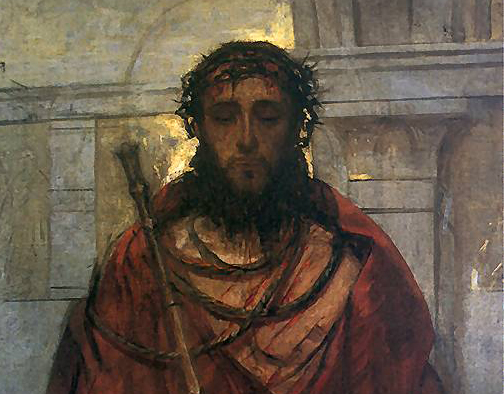
Ecce Homo by St. Adam Chmielowski (1881)

This year, Patriot Day is observed as our southern-most state is being ravaged by Hurricane Irma, the people of Houston struggle to rebuild their lives after Hurricane Harvey. These events cause us to reflect upon the presence of evil in the world, the chaos of Mother Nature which displaces families and disrupts life, and the evil in men’s hearts which lead to terrorism and war.

St. Paul wrote about suffering in our reading from his letter to the Colossians today. But his response to suffering is surprising. He doesn’t curse God, as Job did. Rather, he claims to rejoice in his sufferings. Paul suffered prison, shipwreck, beatings, starvation, and exhaustion, and ultimately death for the sake of the Gospel of Jesus Christ. And he saw his sufferings as gifts from God because they enabled him to understand more deeply the salvific meaning of suffering, they enabled him to understand more deeply the love of Christ.

Fulton Sheen was fond of saying that, the great tragedy in life is not suffering, but suffering that goes wasted, suffering that we do not allow to bring us closer to God.

Following the September 11 attacks the churches were packed. Our nation rightly responded to evil by falling to our knees, not simply praying to God to alleviate our suffering, but to help us to learn, so that evil may not be repeated.

And yet the lesson of suffering was only headed by some. Instead of drawing closer to God, repenting of sin, uniting to Christ through his Church, many dug in their heels to building a culture of death. Instead of stretching out the withered hand, they clutched all the tighter at perversion, greed, and power.

May God have mercy on all those who suffer, may He have mercy on our nation, which often seems hell bent on self-destruction, may faith increase and evil be renounced for the glory of God and salvation of souls.

- - - - - - -

That through Our Lady, Queen of Peace, terrorism and war, and the cheapening of human life may be brought to an end.

For all those who harden their hearts toward God, for those who have left the Church, for all those in serious sin, for their conversion and the conversion of all hearts.

That our civil representatives may use their authority to lead and build our nation in godly ways.
For Pope Francis’ prayer intention for the month of September: “That our parishes, animated by a missionary spirit, may be places where faith is communicated and charity is seen.”

For the sick and afflicted, the homebound, those in nursing homes and hospitals, for victims of natural disaster and inclement weather, those who suffer from war, violence, and terrorism, for the mentally ill, those with addictions, the imprisoned, the unchaste, for the comfort of the dying and the consolation of their families.

For the deceased members of our families, friends, and parish and all the poor souls in purgatory, for deceased priests and religious, and for those who have fought and died for our freedom. We pray.
Incline your merciful ear to our prayers, we ask, O Lord, and listen in kindness to the supplications of those who call on you. Through Christ our Lord.