Showing posts with label emmaus. Show all posts

Wednesday, April 3, 2024

Easter Octave Wednesday 2024 - Communal Witness, Shared Mission

The end of the Emmaus story, as recounted in the Gospel of Luke, captures a moment of profound revelation and communal joy among the disciples. After recognizing Jesus in the breaking of the bread and realizing He had been with them all along, the two disciples from Emmaus couldn't contain their excitement. Their hearts burning within them was both a metaphor for spiritual awakening but also a visceral, emotional response to encountering the Risen Lord.

Imagine their hurried journey back to Jerusalem, fueled by an urgency to share their experience. The roads that seemed so long and desolate before were now pathways of purpose and hope. Upon arriving, they find the Eleven and others gathered—sharing how the Lord appeared to Simon. Hearing this confirmation, coming from such a trusted source within their community, would only amplify their joy and astonishment.

Imagine how they were encouraged to share their own account—words tumbling over each other, hands gesturing vividly, their faces alight with awe—their excitement would be infectious. They recount every detail: their initial failure to recognize Jesus, His explanation of the Scriptures, and the moment of revelation at the dinner table. Each word would add to the growing sense of amazement and joy among the listeners.

The shared experiences of encountering the Risen Christ would forge a deep, communal bond among the disciples, uniting them in a shared mission and a renewed sense of purpose.

This Gospel is not simply about individual encounters with the Risen Christ but also about the formation of a community of believers, transformed by their experiences of the Resurrection. 

This narrative illustrates how individual faith journeys are enriched and given meaning within the context of communal belief and shared mission.

Each of us have our own faith journeys, but they are inextricably linked to each other’s. Easter is not just about my faith, but our faith—not just about my mission to witness, but our mission to witness. The Church is stronger when we are encouraging one another, praying with one another, sharing our faith with one another, and helping each other identify and strengthen our spiritual gifts.

As members of the Church, Easter invites us to reflect on our role within our communal mission. How do we contribute to the sense of community in our parish? In what ways can we support one another in our journey of faith? 

The Emmaus story reminds us that our faith is not a solitary endeavor but a communal journey towards encountering the living God. It calls us to recognize Jesus in each other, to share our stories of faith--our encounters with the Risen Lord--and to walk together in the mission entrusted to us by the Risen Lord, for the glory of God and the salvation of souls.

- - - -  

Filled with Paschal joy, let us turn earnestly to God, to graciously hear our prayers and supplications.

For the shepherds of our souls, that they may have the strength to govern wisely the flock entrusted to them by the Good Shepherd.

For the whole world, that it may truly know the peace of the Risen Christ. 

For our own community, that it may bear witness with great confidence to the Resurrection of Christ, and that the newly initiated hold fast to the faith they have received. 

For our brothers and sisters who suffer, that their sorrow may be turned to gladness through the Christian faith.

That all of our beloved dead and all the souls in purgatory may come to the glory of the Resurrection.

O God, you know that our life in this present age is subject to suffering and need, hear the desires of those who cry to you and receive the prayers of those who believe in you. Through Christ our lord.


Tuesday, April 25, 2023

3rd Sunday of Easter 2023 - If it's only a symbol, to heck with it

 A little over a year ago, Bishop Malesic was featured in an article in a well-respected National Catholic periodical, the National Catholic Register. The article was titled “Cleveland Bishop: Catechesis About the Eucharist Is a Top Priority”

The article reported a study that should be very concerning to all of us, but especially to the bishops. A 2019 Pew Research study found that just 31% (of the 2,000 U.S. Catholics they surveyed) believe that at at Mass, Bread and Wine are truly transformed into the Body and Blood of Jesus. In fact, nearly seven-in-ten Catholics said they personally believe that the bread and wine are only symbols. Only symbols. Seriously? If they are only symbols, why would anyone take Catholicism seriously?

The Catholic author Flannery O’Connor, was attending a gathering of writers and the conversation turned toward this topic, toward Catholicism and finally to the Eucharist. And one well-known writer commented that the Eucharist was a symbol, and a powerful one at that. To which, Flannery O’Connor stood up, and responded, “Well, if it’s just a symbol, to heck with it!”

It’s hard to not draw a connection between the lack of faith that Jesus’ Body and Blood are really made present here and the drop in Mass attendance. Why would you make the effort to come to Church week after week, year after year, in sleet, snow, rain, and scorching summer heat, just to see me hold up a symbol? Who cares about symbols? Calling the Eucharist merely a symbol is to put it on the level of a hippy peace sign, a yin-yang, an inert, lifeless, impotent, caricature. 

But to quote the current Bishop of Cleveland, ““When Jesus said to his apostles, ‘This is my Body’ and ‘This is my Blood,’ he meant it”

Bishop Malesic remarked, “My ministry, and the role of every bishop, is to teach clearly and authentically what the Church teaches”. And what does the Church teach: that our physical senses fail to detect what really happens to the bread and wine at Mass. Bread and wine are truly transformed into the Body and Blood of Jesus, just as they were at the Last Supper. 

The National Catholic Register article also reported how in response to this mind-blowingly concerning statistic, the bishops of the United States voted to launch a three-year Eucharistic Revival Initiative. And May God help us with that. For how can the Church flourish, how can we succeed in our mission, when we are failing to appreciate this greatest of gifts from God.

The first phase, the first year of the Revival which began last June has been on the diocesan level. So that’s why you haven’t heard too much about it, so far. In this first year, the diocese has been developing resources for priests to share with the people for the second phase, the second year of revival, which begins on Corpus Christi Sunday this June.

I’ll be working with Parish Council, our Synod Group, and our parish staff to implement some of these resources. We’ve been instructed to hold a Eucharistic Procession on Corpus Christi Sunday. We already had our Parish Picnic scheduled for that day. Maybe we can do both. But the Eucharistic Procession must take precedence. So that will be June 11, likely after the 11am Mass. I’d like to process down Lorain to w 105th, then onto Ignatius ave, then up West Blvd, then back into church.

The third phase of the Eucharistic Revival, the third year will lead up to a National Eucharistic Congress in Indianapolis in 2024. When Cleveland hosted the Eucharistic Congress back in 1935, but I’m told, Clevelanders opened up their homes to the thousands and thousands of people who traveled to our diocese, for the Congress which included 50,000 people gathering at Cleveland Municipal Stadium and Catholics standing in the formation of a living monstrance, with the Eucharist at its center. Pope Pius XI even blessed the Catholics gathered here in Cleveland. Perhaps your parents or grandparents were part of that gathering. I would love to bring a group from this parish to Indianapolis. We’ll try to get tickets if that’s how it’ll work. 

Why do I bring this up on the third Sunday of Easter? In the Gospel reading, the Lord Jesus appears to the disciples. For whatever reason they did not recognize it was the Lord. They were certainly shaken by the Lord’s gruesome crucifixion and death. But this failure to recognize the Risen Lord makes me think of the thousands and thousands of Catholics who do not recognize Jesus in the Holy Eucharist. 

But, after walking with them, and talking with them, listening and speaking and explaining the Scriptures to them, Jesus takes bread, says the blessing, breaks it, and gave it to them, the very actions he undertook at the Last Supper, the very actions we undertake at every Mass.

And St. Luke tells us, with that “their eyes were opened and they recognized him”. That is our prayer for the Eucharistic Revival, for all of those Catholics who do not believe that the bread and wine truly become the Lord’s body and blood at Mass. Perhaps they lost their faith, or were improperly taught. Perhaps they bad teachers, or their parents didn’t believe, or they’ve allowed some sophisticated intellectual acrobatics to replace the simple faith of the Church. But for whatever reason, it is our prayer that those who lack faith, come to believe—that the eyes of faith become opened, and souls come to recognize what is really going on here: that Bread and Wine truly, really, substantially become Jesus.

That is the reason for the revival—the revival our bishop believes we need. And I’m with him. 

If you are confused about this teaching. We’ll help you understand. I’ll host evenings, afternoon, or morning catechism lesson for adults if you want. I’ll sit down with you personally and review Church teaching, or whatever arguments you might have.  But belief in the Real Presence, is fundamental to Catholicism. 

You might say, “Oh, well, who cares if we believe this? Isn’t it enough that we’re a good person or committed to the poor or committed to social justice. Isn't that important?" But one Bishop, and I’m right with him, too said "a reduction of religion to morality is repugnant to Catholicism." Catholicism isn’t merely a moral code. It is a religion based on revelation from God Himself. And God Himself said this is my body, this is my blood. To reject that is to reject Jesus, to deny that he is really here, in the flesh. 

And just like he did with the disciples like the disciples in the Gospel today. Through his real presence, Jesus wants to set our hearts on fire. 

Try something today. As you come forward in procession today to receive Communion, repeat over and over, “this is God, I’m receiving God, the Eucharist is my God, my Lord and my God, my savior”. 

If you don’t believe that Jesus is really present in the Eucharist…I’m not sure you should get in the communion line. If you believe that bread remains bread, you have some serious praying to do. Pray, “Lord, help my unbelief. Help me believe this Church teaching which goes back to Jesus Himself” 

Lord, help those who disbelieve, to believe. And help us who believe to live in a manner which reflects our belief that Christ truly feeds us with his Body and Blood, for the glory of God and salvation of souls.


Wednesday, April 12, 2023

Easter Octave 2023 - Wednesday - Emmaus and the Risen Lord's Nearness

 A few years ago, Holy Father Pope Francis reflected upon this morning’s Gospel. He speaks of how Emmaus story contains two journeys. The downhill journey of the disciples leaving Jerusalem in sadness, and then the uphill journey of the disciples having encountered Jesus, back toward Jerusalem, now filled with Joy and enthusiasm. 

“In the first journey, the Lord is walking beside them, but they do not recognize him; in the second one they do not see him anymore, but they feel him near them. In the first they are discouraged and hopeless; in the second they run to bring the good news of the encounter with the Risen Jesus to the others.”

He says sometimes we are like the disciples on the first part of the journey: we allow ourselves to be discouraged by life’s disappointments and proceed sadly. It is important, the Holy Father says, “to stop orbiting around one’s self; [focusing on] the disappointments of the past, the unrealised ideals, the many bad things that have happened in our life. Very often we tend to keep going around and around…” (in our minds…and get nowhere because of it). 

And in those moments we need to leave those disappointments and “go forward looking at the greatest and truest reality of life: Jesus lives, Jesus loves me…This is the turning point”, the Holy Father says to go from thoughts about I to the reality of my God.

A little bit of self-reflectiveness can be helpful. But when we recognize that we are ideating about the same problem, the same hurt, the same sour argument, the same insult, or whatever, we need to go to Jesus—to lift our thoughts, hearts and souls to God. 

The two disciples of Emmaus first open their hearts to Jesus by listening to him explain the Scriptures. This should be a habit and way of life for Christians. When you are feeling lost, disappointed, discouraged, or confused OPEN THE BIBLE. Read a Gospel story or from the Wisdom Books: Wisdom, Proverbs, or Psalms. You might think that the Bible has nothing to say to you, read it anyway. And keep reading until you hear God speaking, with you, in your trials, urging you to open your heart more deeply to Him, allowing Him to set your heart on fire.

In the times of discouragement, be aware that the voice telling you, you don’t need the Bible, you need a drink, a pill, a Netflix binge, a shopping spree, a quart of icecream and a nap, that’s not Jesus. That’s the one that wants to turn your soul away from Jesus. That One doesn’t want you to seek the Wisdom of God, but wants you to rely only on yourself, and wants you to medicate your sorrows with worldly vices. 

Easter helps us grow in the conviction that the Lord offers us another way, of nearness to us throughout all of life, a nearness where the Lord is always longing to speak with us and break bread with us, and set our hearts alite with divine fire, for the glory of God and salvation of souls.

Filled with Paschal joy, let us turn earnestly to God, to graciously hear our prayers and supplications.

For the shepherds of our souls, that they may have the strength to govern wisely the flock entrusted to them by the Good Shepherd.

For the whole world, that it may truly know the peace of the Risen Christ. 

For our own community, that it may bear witness with great confidence to the Resurrection of Christ, and that the newly initiated hold fast to the faith they have received. 

For our brothers and sisters who suffer, that their sorrow may be turned to gladness through the Christian faith.

That all of our beloved dead and all the souls in purgatory may come to the glory of the Resurrection.

O God, you know that our life in this present age is subject to suffering and need, hear the desires of those who cry to you and receive the prayers of those who believe in you. Through Christ our lord.


Wednesday, April 7, 2021

Easter Octave 2021 - Wednesday - Emmaus Word and Sacrament


As I mentioned yesterday, in ancient days the newly initiated would attend daily mass throughout the easter octave. The homilies would have a catechetical tone to help the newly initiated understand the mysterious meaning of easter, the sacraments they received, and apply the scriptures to their new way of life.

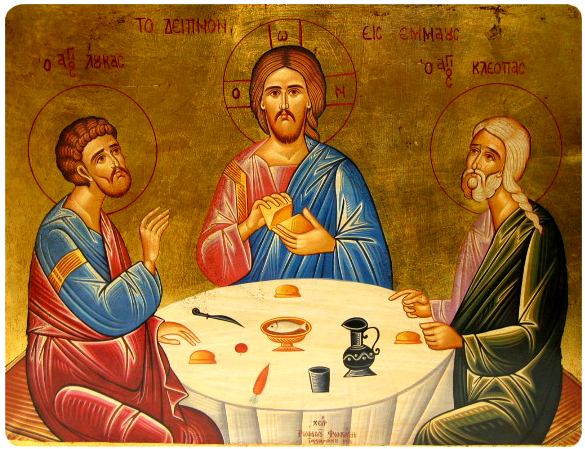
And isn’t that exactly what the Lord does in the Gospel today: shrouded in mystery, he meets a small group of confused disciples, he breaks bread with them in which they recognize his real presence, and he explains the scriptures to them—how what occurred on Good Friday and Easter Sunday was in fulfillment of his Father’s plan of salvation foretold in the Old Testament.

The whole Christian life is like a journey beginning at baptism, in which we encounter the risen Lord, and then subsequently grow in our understanding of discipleship as we walk the Way of Life.

And then like the disciples—hearing the word and breaking the bread—every time we attend Mass, we are encountering the Risen Lord—in the liturgy of the word and the liturgy of the Eucharist. In the liturgy of the Word we encounter the Lord challenging us, inspiring us, enlightening us, correcting us, healing us, deepening our understanding, inviting us, equipping us, and sending us out into the world, like Peter in the first reading, to bring the Lord’s good news and spiritual healing to others. Some people zone out during the liturgy of the word, but this dimension of the mass is of vital importance, and we do well having come to mass already having read a bit and reflecting on the scriptures, so that when they are proclaimed during Mass, we are ready for and receptive to the Lord’s life giving word.

And then as the disciples recognized the Lord in the breaking of the bread, we recognize the real presence of the Lord in the Eucharist—bread and wine changed into his very body and blood. In all of the other sacraments Jesus gives us His grace, says St. Thomas Aquinas, while in the Eucharist, the “sacrament of sacraments,” He gives us His whole self, His divinity and His humanity.

Something happens within us when we encounter Christ in the Mass.  Our hearts do burn within us, as the Emmaus disciples—they are enflamed with love, enlightened with understanding, purified of selfishness, warmed and consoled, and tempered for the work of the Gospel for the glory of God and salvation of souls.
- - - - - - -  

Filled with Paschal joy, let us turn earnestly to God, to graciously hear our prayers and supplications.

For the shepherds of our souls, that they may have the strength to govern wisely the flock entrusted to them by the Good Shepherd.

For the whole world, that it may truly know the peace of the Risen Christ. 

For our own community, that it may bear witness with great confidence to the Resurrection of Christ, and that the newly initiated hold fast to the faith they have received. 

For our brothers and sisters who suffer, that their sorrow may be turned to gladness through the Christian faith.

That all of our beloved dead and all the souls in purgatory may come to the glory of the Resurrection.

O God, you know that our life in this present age is subject to suffering and need, hear the desires of those who cry to you and receive the prayers of those who believe in you. Through Christ our lord.


Tuesday, April 6, 2021

Easter Week 2021 - Monday (EF) - Remain with us, Lord!

 Having encountered the risen Lord on the Road to Emmaus, the two disciple offer that beautiful supplication, “Mane nobiscum”, “Stay with us Lord.” The Carmelite Father Gabriel of St. Mary Magdalen writes, “Stay with us Lord! It is the cry of the soul who has found its God and never again wishes to be separated from Him.” 

The Lord’s appearance on the road was mysterious. The disciples did not immediately perceive him—and for a number of reasons that we can surmise: the lack of understanding concerning his resurrection, their lack of faith that good Friday did not end in defeat, their fear about their own future. 

So too with us. Certainly our weak faith, our fears and anxieties, often keep us from detecting the presence of the Lord. Theologically, we know that God dwells within the soul in a state of grace, and our that the Lord is really and truly present in the Eucharist. The request, “stay with us, Lord” has been answered by God—through sanctifying grace and the gift of the Sacraments. We know this to be true, theologically, intellectually. And yet, we also know there is a difference between knowing something in our heads, and knowing it in our hearts. 

Likely, it is more up to God than our own efforts that the veil of that heart knowledge of the His presence is made known. But when that veil is pulled back, oh boy, we cry out with the disciples, “stay with us”. 

And yet, we know too, that those moments of profound intimate heart knowledge of God are often fleeting, for they are but a foretaste of heaven. God grants these holy moments, these spiritual consolations, to spurn us on in the Christian life. And we do well to recall them in moments of temptation and desolation.

We also do well to dispose our souls to the gift of heavenly consolation, through prayer and charitable works.

In an article for the Universe Bulletin, dear departed Bishop Lennon wrote a powerful description of this powerful spiritual dynamic. He wrote: “ when our life is centered on a false God of prosperity, prestige, or mere pursuit of the good life—one will likely reap a harvest of exhaustion and unhappiness.  But, the person and family, who places Christ at the center of life, including God in  their weekly schedules and activities, meals, chores, conversations, parenting, work, vacations, civic responsibilities, decisions, problems, crises, accomplishments, losses—the whole of their lives become changed and charged with God’s presence.”

Having broke bread with the Lord, the disciples of Emmaus “set out immediately” in order to report what they had seen. The Christian whose life is charged and changed by the Risen Lord becomes an effective instrument of bringing souls to Christ. There are many souls who have not met the Lord, who long to meet him, and often it’s in sharing our encounters with the Lord that will touch them and draw them closer to Him.

May our Easter celebrations help us to put and keep the Lord at the center of our lives, and share our Easter faith with the world, for the glory of God and salvation of souls.


Saturday, April 25, 2020

3rd Sunday of Easter 2020 - Stay with us Lord

Just months before his death, Pope Saint John Paul II issued a beautiful letter to the Church titled, “Mane Nobiscum Domine” quoting words from today’s Gospel--this 3rd Sunday of Easter. Mane Nobiscum Domine, stay with us Lord, are the words the disciples speak to the Lord on the road to Emmaus. There words are a beautiful petition and an urgent plea. The Holy Father writes, Mane Nobiscum Domine, “this was the insistent invitation that the two disciples journeying to Emmaus on the evening of the day of the resurrection addressed to the Wayfarer who had accompanied them on their journey. Weighed down with sadness, they never imagined that this stranger was none other than their Master, risen from the dead. Yet they felt their hearts burning within them as he spoke to them and “explained” the Scriptures….Amid the shadows of the passing day and the darkness that clouded their spirit, the Wayfarer brought a ray of light which rekindled their hope and led their hearts to yearn for the fullness of light. “Stay with us”, they pleaded. And he agreed.”

The Holy Father’s words, written 15 years ago already, are so poignant. For we, like the disciples are on a sort of journey these days, aren’t we.  A journey not of physical distance, but of spiritual depth, a journey, for many of us, made in isolation, at least from first glance.

This beautiful passage urges us to consider, how has the Lord remained with us during these days of quarantine, and how have we sought to remain with him. How has the Lord been journeying with us, breaking the Scriptures open for us, breaking Bread with us? How has he wished to set our hearts afire?

Our Gospel, I believe is quite comforting, because consider the initial experience of these disciples on the road. Notice, there were walking away from Jerusalem. On easter Sunday, they were walking away from the victory, away from the resurrection, away from the Good News, away from the community of Apostles, away from the Church. And they were walking away not because they were these big terrible sinners, either. It’s not like they had fallen to depravity or immorality. They were walking away, they were fleeing Jerusalem because of what happened on Good Friday. They were scared. Their faith was week. They didn’t get it. They couldn’t believe that God could bring victory out of something as tragic as the terrible event on mount calvary. So they gave up. In a sense, they are experiencing hell. The hell of believing that God is dead, that God has not and cannot save them.

But into this sort of hell, Jesus breaks into their lives, the Lord appears as if out of nowhere. Jesus breaks into their lives, just like he broke into locked upper room, as we heard last week.  And the Lord begins to speak Good News to them about, he interprets the Scriptures, and deepens their understanding of what God accomplished on Good Friday, he explains that Good Friday was a victory, not a defeat. And I think this Gospel is so comforting, for it reveals how one does not necessarily need to have perfect faith or perfect understanding in order to encounter Jesus Christ, in order to have him set our hearts on fire. God can break in to confusion and doubt and failure and bring fire and light and truth.

This resonates with us, doesn’t it…that the encounter with Jesus Christ doesn’t always occur in the brightness of day, in the experience of joy and certainty. Rather, the encounter with Jesus often occurs in the experience of darkness and sadness and shadow and fear. The risen Lord is more powerful than these experiences. He is able to meet us where we are in order to lead us to Communion with Him and to Holiness.

And for many of us right now, there is darkness and isolation and fear. We, like the disciples may even be questioning, where is God in all this? How can we believe in God’s victory when the innocent suffer and pestilence spreads? How can we believe in Easter glory when loved ones die and the economy trembles and quakes?

As Christians, we don’t have to pretend that sometimes our faith is not tested. Darkness and shadow will often test our faith. We like the disciples are often poor wayfarers: bewildered and dejected men, sorrowing and not quite knowing what to think, not quite knowing what to do with their lives. But in this experience, we need to turn to the Lord all the more, and pray like the disciples, mane nobiscum, domine, stay with us lord.

This whole encounter on the road to Emmaus gives us a wonderful model for the daily prayer we need during these trying times.

First the disciples encounter Jesus as a stranger. We need to open the scriptures, daily, as strange as they might seem, and begin to read.

Secondly, the disciples listen to Jesus explain the scriptures. As you read the scriptures, ask the Lord to help you understand them, how they apply to his life, and how they can apply to yours.
Next, the disciples share their burdens with Jesus. So too, share with the Lord your fears and temptations, angers and confusion.

But then, listen to the Lord some more, allow him to share his wisdom. Go back to the scriptures, look for guidance, look for hope. Every passage of Scripture in some way points to Him. You don’t have to have a degree in Scripture in order to pray with Scripture and encounter the Lord through the Scriptures. So give it a shot. These days, what do you have better to do?

As you grow in the practice of prayer, you will notice the Lord is with you, His light is shining in your life now, he’s been with you all this time.

So, don’t be afraid, these days of quarantine to seek that encounter with the Lord,  to turn off the television, especially to skip the fearmongering from the mainstream media, to seek that heart changing, faith igniting encounter with the Risen Lord Jesus in prayer, that the light of the Resurrection may banish all sadness and shadow in your life for the glory of God and salvation of souls.

Wednesday, April 24, 2019

Octave of Easter 2019 - Wednesday - Easter Conversion through Word and Sacrament

Pope Benedict XVI wrote that the episode of the disciples on the road to Emmaus, “shows the effects that the Risen Jesus works in two disciples: conversion from despair to hope; conversion from sorrow to joy; and also conversion to community life.”

Pope Benedict continued his homily, explaining what is necessary for the daily conversion of the Christian life. He says, “It is thus necessary for each and every one of us to let ourselves be taught by Jesus, as the two disciples of Emmaus were: first of all by listening to and loving the word of God read in the light of the Paschal Mystery, so that it may warm our hearts and illumine our minds helping us to interpret the events of life and give them meaning. Then it is necessary to sit at table with the Lord, to share the banquet with him, so that his humble presence in the Sacrament of his Body and Blood may restore to us the gaze of faith, in order to see everything and everyone with God’s eyes, in the light of his love. Staying with Jesus who has stayed with us, assimilating his lifestyle, choosing with him the logic of communion with each other, of solidarity and of sharing. The Eucharist is the maximum expression of the gift which Jesus makes of himself and is a constant invitation to live our lives in the Eucharistic logic, as a gift to God and to others.”

The Lord wants for us during this easter season the same thing he wanted for the disciples on the road to Emmaus during that first easter season: conversion from despair, sorrow, and isolation, to hope, joy, and community life, to communion.

And the program for us is the same as the Lord’s program for the disciples—their road is our road: listening to and loving the Word of God, sharing in the banquet of the Eucharist, and allowing God to transform us, to become what we have received in the Eucharist—a gift to others for the glory of God and salvation of souls.

- - - - - - -

Filled with Paschal joy, let us turn earnestly to God, to graciously hear our prayers and supplications.
For the shepherds of our souls, that they may have the strength to govern wisely the flock entrusted to them by the Good Shepherd.

For the whole world, that it may truly know the peace of the Risen Christ. And for the victims of the terrorist bombings in Sri Lanka and their families, for consolation in their grief, and assistance in their needs.

For our parish, that it may bear witness with great confidence to the Resurrection of Christ, and that the newly initiated hold fast to the faith they have received.

For our brothers and sisters who suffer, that their sorrow may be turned to gladness through the Christian faith.

That all of our beloved dead and all the souls in purgatory may come to the glory of the Resurrection.
O God, you know that our life in this present age is subject to suffering and need, hear the desires of those who cry to you and receive the prayers of those who believe in you. Through Christ our lord.


Thursday, April 5, 2018

Easter Octave 2018 - Thursday - Recounting our Encounters with the Risen Christ

Yesterday, we heard how Jesus had appeared to the disciples on the road to Emmaus. Today, we hear how those disciples return to Jerusalem, and, as missionaries, they recount their experience of seeing, speaking, engaging, and eating with the Risen Christ.

There is a perfect model for our own missionary discipleship, to recount to others our experience of seeing, speaking, engaging, and eating with the Risen Christ.

Share with others how you have seen God work in the world. How have you seen God mending wounds, where have you seen God working miracles. The disciples met God—met Jesus—on the road to Emmaus, where have you met God? In your family home growing up? On a retreat? In the catechism classroom? Or on the streets? In the destitute?

Share with others your experience of speaking with God? How has God spoken to you in your prayer life? Through what Saints has God spoken to you? What books or spiritual writings? What scripture passages have spoken to you in your own times of sorrow and dark valleys? What Church teachings have made the most difference in your life?

Share with others your experience of Jesus moving you, engaging you, sending you out. How has Jesus moved you out of your comfort zone? How has he converted you from one way of thinking to another? What virtues, spiritual gifts, spiritual fruits has he caused to grow in you? Share with others the joy and peace that comes from making a good confession.

And share with others your experience of encountering Jesus in the breaking of the bread. Share with others the importance of coming to Mass, Sunday Mass, Daily Mass, and eating with Him. Share with others how attending Mass has changed your life? What caused you, perhaps, of being lukewarm about Mass, to zealous for it?

“The disciples of Jesus recounted what had taken place along the way.” Don’t be afraid to tell your story, to share, even in very simple terms, how you have encountered Jesus walking with you in your life’s journey. For right when the disciples shared their story, Jesus appeared in their midst, and continued to open their minds and hearts to the Scriptures, to the wisdom of God.

There are people in our lives who are longing to meet Jesus through these very means. Jesus wants to appear to the hard-hearted, the unbeliever, and the sorrowful. And he is waiting for us to share Him with them, for the glory of God and salvation of souls.

- - - - - - - -

Filled with Paschal joy, let us turn earnestly to God, to graciously hear our prayers and supplications.

For the shepherds of our souls, that they may have the strength to govern wisely the flock entrusted to them by the Good Shepherd.

For the whole world, that it may truly know the peace of the Risen Christ.

For our own community, that it may bear witness with great confidence to the Resurrection of Christ, and that the newly initiated hold fast to the faith they have received.

For our brothers and sisters who suffer, that their sorrow may be turned to gladness through the Christian faith.

That all of our beloved dead and all the souls in purgatory may come to the glory of the Resurrection.

O God, you know that our life in this present age is subject to suffering and need, hear the desires of those who cry to you and receive the prayers of those who believe in you. Through Christ our lord.

Thursday, October 26, 2017

Thursday - 29th Week of OT 2017 - Missionary disciples with burning hearts

Very often the words of Jesus Christ calm us, comfort us, help us to know the loving nearness of God.  Yet, today’s Gospel shakes us up a little.  We hear Our Lord speak with some urgency that he has come to set the world on fire, and how he wishes it were already burning!  Jesus is on a mission to enflame hearts with a fiery, burning love for God.

It is the nature of fire to enkindle the things that are nearest to it. On the road to Emmaus, the disciples who encountered the risen Lord, proclaimed “Were not our hearts burning inside us as He talked to us on the road and explained the Scriptures to us?"

If our hearts are to be set on fire, we must draw near to the Lord, his words, and his own heart. Distance from the Lord only causes coldness toward him and toward his mission. We all know many people, even members of our own family, who have grown cold toward the Lord and toward his Church. They fall away from mass, they fall away from prayer. They are busy, busier than ever, about many worldly things, but something is seriously lacking, isn’t there?

Last night, at the special district Mass, the Bishop spoke about missionary discipleship: how God wants to use us to set the world on fire. We often think of missionaries as merely a special class of disciples, who go out to places like india to spread the Gospel to those of other religions. But Bishop Perez, echoing Pope Francis and the Popes of the 20th century, wants to help us realize that we are all called to be missionary disciples, and that the Diocese of Cleveland, our neighborhoods and families, are missionary territory and we must be the missionaries.

This is a share in the mission of Jesus himself. And that’s why there is an urgency in the Gospel today, because he wants our lives on fire, not mediocre and lukewarm, but on fire, that we can spread that fire throughout the world, that we can meet people where they are with the truth of the Gospel.

We pray today that those whom we encounter on the road will encounter the fire of Christ alive in our hearts.  That they can meet Christ in us today as we seek to share and heal and preach and serve, for the glory of God and salvation of souls.

- - - - - - -

That all Church leaders may help us to spread the flame of faith and love in all our endeavors.
For an increase in vocations to the priesthood and consecrated life, and a sanctification of all marriages and single Catholics.

“That our parishes, animated by a missionary spirit, may be places where faith is communicated and charity is seen.”

For those who have fallen into error, for Catholics who have grown lukewarm in their faith, for those who have left the Church, for their conversion and the conversion of all hearts.

For all those struggling with addiction, mental illness, chronic sickness, unemployment, or ongoing trials of any kind: that they will be fortified and blessed with God’s special love, favor, and peace.  We pray to the Lord.

For the deceased members of our families, friends, and parish, and all the poor souls in purgatory, for deceased clergy and religious, and for those who have fought and died for our freedom.

O God, you know that our life in this present age is subject to suffering and need, hear the prayers of those who cry to you and receive the prayers of those who believe in you. Through Christ our Lord.


Sunday, April 30, 2017

3rd Sunday of Easter 2017 - Word and Sacrament on the Road to Emmaus


In a homily on the Emmaus story a few years ago, the holy Father, Pope Benedict, spoke about conversion.

“The Gospel of the Third Sunday of Easter — which we have just heard — presents the episode of the disciples of Emmaus, an account that never ceases to astonish and move us,” the Holy Father said. 
“This episode shows the effects that the Risen Jesus works in two disciples: conversion from despair to hope; conversion from sorrow to joy; and also conversion to community life.”

Conversion. There is an important word in the Christian life. Generally, conversion means any sort of change. Converting dollars to pesos, metric to standard. In the religious sense, we can speak of converting from one religion to another. St. Paul, for example, converts from being an unbeliever and persecutor of Christianity to one of the greatest and most heroic evangelizers of history. At Easter this year, here at St. Clare, 5 people from different faith traditions: Baptist, United Church of Christ, Methodist, and Presbyterian converted to Roman Catholicism.

In mathematics, converting from one type of unit to another is simple, if you know the formula. Moral conversion and religious conversion are not so easy, and rely heavily on the grace of God. Our 5 converts spent months undergoing formal training in the faith, and many of them would speak of how their journey to the faith took many different twists and turns throughout their lives.  Moral conversion requires more than intellectual training, converting from selfishness to generosity is not so easy. We have to break habits of the mind, renounce selfish ways, and make real effort to be more generous.

And Pope Benedict is saying that the story of the disciples on the road to Emmaus is the story of conversion. In their conversion they came to a deeper understanding and joy in the risen Christ and love for him.  This is a conversion that the Lord wants for each one of us. To deepen our understanding, to deepen our faith, and to deepen our love.

For the life of the Christian isn’t simply about a one-time conversion at baptism, and then we are guaranteed of heaven. The life of the Christian is a journey of continued conversion: not just from unbelief to belief, not just from evil to good, but from good to better. Hopefully Easter 2017 finds you holier, more prayerful, walking more reverently, utilizing the gifts of the Holy Spirit more than you did a year ago. If not, what happened?

Well, whatever happened, Our Lord extends today the invitation to begin to walk again in the way of daily conversion.

Pope Benedict continued his homily, explaining what is necessary for the daily conversion of the Christian life. He says, “It is thus necessary for each and every one of us to let ourselves be taught by Jesus, as the two disciples of Emmaus were: first of all by listening to and loving the word of God read in the light of the Paschal Mystery, so that it may warm our hearts and illumine our minds helping us to interpret the events of life and give them meaning. Then it is necessary to sit at table with the Lord, to share the banquet with him, so that his humble presence in the Sacrament of his Body and Blood may restore to us the gaze of faith, in order to see everything and everyone with God’s eyes, in the light of his love. Staying with Jesus who has stayed with us, assimilating his lifestyle, choosing with him the logic of communion with each other, of solidarity and of sharing. The Eucharist is the maximum expression of the gift which Jesus makes of himself and is a constant invitation to live our lives in the Eucharistic logic, as a gift to God and to others.”

Did you catch the two necessary practices for ongoing conversion? Listening to and loving the word of God, and valuing more deeply the gift of the Eucharist.

A little less than a year ago, we were reflecting on the story of Martha and Mary, how Mary sat at the Master’s feet and listened to him and cherished him. And I think it was at this Mass, in which I presented a challenge…a 10-minute-a-day challenge. Not turning on the television, not doing the household chores, until you’ve spent 10 minutes reading and reflecting upon the Scriptures. I wonder if anyone took me up on that.

The scriptures help our hearts to be “warmed and illumined” as Pope Benedict said.  They help us “interpret the events of our life”. Have you ever been reading the Scriptures and discovered that it was as if they were written just for you? I hope so. If not, I encourage you to do a little more reading.
So the first necessary practice is listening and loving the word of God, the second is cherishing the Eucharist more deeply, allowing its power to becoming unleashed in your life. The Pope used a really neat phrase, he said when we accept the gift Jesus makes to us in the Eucharist, our lives begin to take on a “Eucharistic Logic”.

In the Eucharist, Jesus is offered to the Father, broken, shared, and poured out. And when we allow the Eucharist to convert us, our lives begin to take on the same logic, the same pattern: we allow ourselves to be broken, poured out, and shared for others. Our life becomes a “living sacrifice to the Father”.

When we truly begin to take seriously this call to listen and love the Word of God and to cherish the Eucharist we begin to experience profound conversion: conversion from despair to hope; conversion from sorrow to joy; and also conversion to become more involved in service in the life of the community, such as the ways being presented in today’s Ministry fair down in the gym.


May we accept the invitation the Lord makes to us today, to grow in grace, to allow him to shape and transform our lives through Word and Sacrament for the glory of God and salvation of souls.