Showing posts with label evangelization. Show all posts

Sunday, August 16, 2026

20th Sunday in Ordinary Time 2026 - A mission to all nations & OCIA invitation


As I’ve shared before, during college seminary I had the great privilege of studying for a semester in the Eternal City of Rome. And that semester included quite a few trips to St. Peter’s Basilica. In fact, even before really getting our bearings, now my dear priest friend Fr. Matthew Pfeiffer and I, went to St. Peter’s on our first day in Rome. Like countless pilgrims before us, we made our way through the streets of Rome, into Piazza San Pietro, the large piazza located directly in front of St. Peter’s Basillica, surrounded by that iconic colonnade.

The colonnade was designed by the Italian architect Gian Lorenzo Bernini, under the direction of Pope Alexander VII in the mid-1600s. 284 Doric columns surround the piazza to resemble the welcoming arms of the Church, like a mother embracing all of her children. What a beautiful symbol for the nature and mission of Mother Church to embrace and gather all the peoples of the world.

The Scripture readings on this 20th Sunday of Ordinary Time have this theme of the universal embrace—the universal mission of the Church—a mission to every race and culture. The Church is to be a home and hospital and sign and instrument of communion for the entire human family.

The Lord Jesus died for the salvation of all peoples of all places. And while his mission was to save all of humanity, he never traveled outside of the Holy Land, to Rome or Spain or Athens or the Canary Islands or to these shores of course. Rather those countries and the rest of the world would come to know Christ’s salvation, through us, through the preaching and teaching of His body, the Church.

The Church is the fulfillment of Isaiah’s prophecy in the first reading: “my house shall be called
a house of prayer for all peoples.” In the Psalm, as well, we offer the prayer of the people of God that one day, “all the nations of the earth” might praise God, together.  In the second Reading, St. Paul explains how God's mercy is for all people--all of us are sinners, but Christ died for all, so that all people might be reconciled to God.

And then in our Gospel reading, we hear of this gentile woman approaching Jesus for salvation for her daughter. And she wasn’t just any Gentile, she was a Canaanite, one of the great historic enemies of the Jewish people. And for coming to Jesus, begging salvation from him, Jesus praises her. She receives praise that not one of Jesus’ disciples, not one of the apostles receives. The Lord says to her, “great is your faith!” And her faith becomes a conduit of healing and deliverance for her family.

Salvation, healing, deliverance, the joy of knowing Christ in this life and in life everlasting. This is why we approach Jesus in faith, this is why we take membership in his Church so seriously. And this is why we need to take seriously our call to evangelize. Because God wants all peoples on earth to know and love Jesus Christ and be saved. And that happens through our witness—showing the world that being Catholic matters, and that it is vitally important, eternally important.

Do you talk about the Church with love? With joy? Do your children and grandchildren hear from your lips that the Mass matters, that confession is a gift, that prayer is vital to you, that Jesus Christ has changed your life? Do your neighbors and coworkers know that your faith is not simply a private hobby, but the center of who you are?

Evangelization does not always begin with a theological argument. Often it begins with a simple witness: “I go to Mass because I need the Lord.” “I went to confession and found peace.” “I will pray for you.” “Would you like to come to a church event with me?” “Our parish has been a place of grace for my family.” These are not complicated words. But spoken with sincerity, they can open a door.

And we should not underestimate the power of invitation. Many people are waiting to be invited. Many people who have drifted from the Church are not hostile; they are wounded, distracted, embarrassed, or unsure how to return. A personal invitation from someone they trust may be the first step of their journey home.

The Canaanite woman’s faith became a conduit of healing for her daughter. So too, our faith can become a conduit of grace for others. Our prayer, our gentleness and sincerity, our love for the Church, our willingness to speak of Christ—these can become instruments by which the Lord brings healing and deliverance to families, to parishes, and to souls.

This weekend, in the bulletin is a flyer for OCIA formerly called RCIA—the program and process for Adults to become Catholic. Maybe some of you here are not members of the Church. Please know you are welcome to find out more about full membership in the Church, give me a call or shoot me an email. For those of you who are already full members, that flyer can be given to someone who isn’t. There’s likely someone in your life, who you can invite. I recommend praying for them this week, and then making the invitation. Pray for the openness to God. And pray for your own courage to make the invitation. You can simply say, hi, I’ve been praying for you, when my pastor brought this up at church, I thought of you, if you are interested, please know you are more than welcome and I’d be willing to pray with you and answer any questions that I can and find out answers to those I don’t know.” It’s a simple invitation that will change peoples lives for the better.

It's an act of love to care about a soul enough to want them to experience the fullness of life that is available to us as Catholics. For out of love, Christ died for all. And out of love Christ sends us to gather all of humanity into the arms of mother Church, to embrace and live his truth, to be filled with his life and his grace, and thereby become the people God made us to be, and to receive the gift of eternal life through faith for the glory of God and the salvation of souls.

Wednesday, July 8, 2026

14th Week in Ordinary Time 2026 - Wednesday - Patience in the apostolic mission


What a fascinating juxtaposition of readings today.

On one hand, we have the minor prophet Hosea describing the sad state of spiritual affairs in the northern kingdom of Israel. Recall, northern Israel had separated from Judah—politically and religiously. The North set up its own religion: it had this strange practice of worshipping both Yahweh AND the various pagan gods. And for a time, as Hosea described, northern Israel  experienced some prosperity. But, the more prosperous Northern Israel grew, the more corrupt the people became and the more they failed to be grateful to God for His blessings. The went from having a divided heart, to a heart that failed to acknowledge the one true God at all.

And for this, as Hosea prophesied, they lost God’s Divine Blessing, became subject to their enemies, and would be destroyed.

Contrast that reading, to the Gospel passage today—the naming of the twelve—their initial commission to preach the Gospel to Israel, which later in Matthew’s Gospel, would become a commission to preach to all nations—which is the mission of the Holy, Catholic, Church.

What’s the connection between these two readings? The Gospel reminds us of our mission, and the first reading reminds us to whom we are being sent.

We have been commissioned to preach the Gospel to a world with a divided heart, prone to forgetting about God in times of prosperity, vulnerable to bringing itself to the verge of collapse. These are the people to whom we are sent.

And that mission requires courage. It takes courage to speak of God to a world that often does not want to hear His name, courage to witness to the truth when hearts are divided and confused, courage to remain faithful when others have grown indifferent, cynical, or hostile.

But, courage must also be joined to patience. The divided heart is not usually healed in an instant. Conversion often takes time. People caught in confusion, sin, resentment, or unbelief may resist grace before they receive it. Hosea preached to a people who were slow to listen. The apostles themselves would often be rejected. And yet the Lord still sent them.

So, too for us. We must not give up on those who seem far from God, or discouraged because the world is confused—the word of God describes it as such. The Lord knew exactly what kind of world He was sending His apostles into. And He knows exactly what kind of world He sends us into.

Our task is not to give up when things get hard. Our task is to be faithful: to speak the truth with charity, to bear witness with courage, to pray for the lost, to invite patiently, to trust that grace can work in hidden ways. May the Lord give us apostolic courage without bitterness, patience without cowardice, and hearts undivided in His service, for the glory of God and the salvation of souls.

- - - - 

For the Holy Church of God: that she may remain faithful to the mission entrusted to the apostles, preaching the Gospel with courage, charity, and patience, let us pray to the Lord.

For the nations of the world: that in times of prosperity they may not forget God, but seek justice, peace, and the protection of the vulnerable, let us pray to the Lord.

For the conversion of all whose hearts are divided by sin, confusion, resentment, or unbelief.

For all missionaries, evangelists, catechists, parents, and teachers: that they may not grow discouraged when their witness is resisted, but may persevere with apostolic courage, let us pray to the Lord.

For the sick, the suffering, the discouraged, and all who feel far from God: that they may encounter the compassion of Christ through the prayers and witness of His Church, let us pray to the Lord.

For all who have died, and for all the poor souls in purgatory, and for X. for whom this Mass is offered.


Incline your merciful ear to our prayers, we ask, O Lord, and listen in kindness to the supplications of those who call on you. Through Christ our Lord


Monday, March 9, 2026

3rd Sunday of Lent 2026 - Scrutinies and the Samaritan Woman

We celebrated today, with our Catechumens, the first of the three Scrutinies. The three scrutinies are celebrated on the third, fourth, and fifth Sundays of Lent with those who are preparing to enter the Church at Easter.  The three scrutinies are solemn rituals in which we pray to help to purify, enlighten and strengthen the catechumens as they prepare for the Easter Sacraments.

The word "scrutinize" means to examine in minute detail, and in the scrutinies, the Church prays that every-last minute detail of the lives of the Catechumens may be converted to Christ. The ritual book for the scrutitines says that their purpose is to "heal all that is weak, defective, or sinful in the hearts of the elect" and "to give them strength in Christ, who is the way, the truth, and the life".  And that’s something each of us need to seek, every day: to turn to the Lord to heal anything that is defective or sinful in our hearts.

Catechism says, “In order to reach perfection, the faithful should use the strength dealt out to them by Christ’s gift, so that . . . doing the will of the Father in everything, they may wholeheartedly devote themselves to the glory of God and to the service of their neighbor.” We are to utilize all of the strength at our disposal--the strength of our intellect and will, the gifts of the spirit—to root out sin so that we may live more fully for God.

We do this before Sacramental Confession of course. We thoroughly scrutinize our moral decisions since our last confession. But it’s a very good idea to get in the habit of doing this every day; before bed, make an examination of your day—your choices and decisions and conversations and interactions—scrutinize your day in the light of Christ. That daily scrutiny is a powerful spiritual help for growth in holiness.

“Blessed are the pure of heart, for they shall see God” promises Jesus. We seek to purify ourselves of sin, so that we may see God in this life and in the next. Sin obscures spiritual vision—it clouds the intellect. We will hear more about the curing of spiritual blindness next week—in the gospel of the healing of the blind man at the pool of siloam. Yet, this Sunday’s Gospel also had to do with spiritual vision in a sense, as the Samaritan woman came to spiritually see Jesus for who he really is—the one who can quench our thirst for living waters.

This is really a powerful Gospel. There are a couple important details right at the beginning of the story: “Jesus came to a town of Samaria.” Jesus enters this place, where no pious Jew would go. . Samaria was filled with half-breeds—Jews who had intermarried with the Assyrians invaders of centuries past.

First, insight: Jesus doesn’t go around the unclean land or the unclean person. Jesus loves the unclean, the marginalized, the outsider. In the Second Reading, we are reminded by St. Paul that Jesus loves the sinner so much, he lays down his life for them.

Secondly: this woman, goes to the well, at the hottest part of the day, by herself. She is likely ostracized by her own people. Perhaps it has something to do with the fact that she had five husbands and was living with a man to whom she was not married. She is surrounded with stigma, she’s living in sin. And it is precisely with her, that jesus converses and offers the gift of life-giving waters.

The Samaritan woman represents every one of us.  She is wounded, complicated, burdened by her past, and yet still sought out by Christ. Jesus waits for her at the well. And Jesus waits for us too. He is not afraid of the mess of her life, and He is not afraid of the mess in ours. He sees everything. He sees every sin, every compromise, every disappointment, every attempt we have made to find fulfillment apart from God—and still He speaks to us. Still He desires to give us living water.

This too makes the Samaritan woman’s faith is so striking—“Sir, give me this water”. She doesn’t quite yet understand who Jesus is completely. She doesn’t have a master’s degree in theology. But she recognizes that Jesus can do for her what no one else can. Her life may not be completely in order—but she gets this right. Recognizing Jesus as Savior, was life changing.

And then the next striking thing about this story: this encounter was so meaningful that she immediately becomes a missionary. This woman who had been avoiding others now runs to them. Once she encounters Christ, she can no longer keep Him to herself.

Here is a sign of authentic conversion. A real encounter with Jesus never remains private. It bears fruit. It changes how we speak, how we act, how we love, how we see others. When we ourselves have been healed, we are moved by love to desire that healing for others.

We know the suffering that comes from living apart from God, and so we desire to help others know Him. We know the emptiness the world has to offer, and so we desire to help others experience the fullness that comes from Him.

We do not want the people around us to remain thirsty, burdened, wounded, confused, or far from God. We want them to know the One we have come to know. We want them to encounter the mercy that has begun to heal us. That is what we see in the Samaritan woman. Once she begins to recognize who Jesus is, she leaves behind her water jar and goes her family and fellow townsfolk. She becomes, almost immediately, a witness. She does not yet understand everything about Jesus. Her faith is still new, still developing. But even so, she has found something—or rather Someone—too important to keep to herself.

And that is often how conversion works. A person who has really encountered Christ may not yet be able to explain every doctrine or answer every theological question, but we know this: I was thirsty, and He met me. I was burdened, and He spoke to me. I was wandering, and He began to lead me. I was hurting, and he comforted me. That’s evangelization.

Evangelization is not only the task of apologists, theologians, clergy, and catechists. Certainly, we have an important role in the Church. But at its heart, Christian witness is simple. I was wounded and empty, and he healed me. It is one beggar showing another where to find bread; one thirsty soul showing another where to find water.

This Lent, the Lord invites us to scrutinize our lives—to lay them bare that we may drink every-more-deeply of the life-giving waters, then sends us out to make that invitation to others—for the glory of God and salvation of souls.


Wednesday, December 3, 2025

December 03 2025 (school mass) - St. Francis Xavier - Purpose


On just the third weekday of Advent this year, we wear not Advent purple, but white, as we celebrate the obligatory memorial of a saint of the Church, St. Francis Xavier: a reminder, that the purpose of the season of Advent is to make us saints. The purpose of Advent prayer, Advent Symbols and songs, Advent charitable-giving, is to make us saints.

St. Francis Xavier was filled with zeal for helping others prepare their hearts to receive Christ. Francis Xavier was a Jesuit priest sent by the founder of his Order, St. Ignatius of Loyola, to spread the Gospel to the people of India, Japan, and the Philippines who did not believe in Christ. In the course of only 10 years of teaching people about Jesus, he baptized over 80,000 people.

Why did Francis Xavier leave his home and travel to the far reaches of the world? As we heard in the Gospel today, Jesus gave a command to his followers: “Go into the whole world and proclaim the Gospel to every creature. Whoever believes and is baptized will be saved; whoever does not believe will be condemned.”

God the Father sent his Son into the world so that none of us would perish. And Jesus sends his followers to continue that mission: to help people believe that Jesus is truly the Son of God, and by becoming his followers we come to eternal life.

Again, that’s why I’m here, that’s why your teachers are employed here, that’s why Corpus Christi Academy is here, that’s why St. Clare parish is here, to help you believe in and follow Jesus.

During the season of Advent, each of us does well to consider what we must do to follow Jesus more faithfully, to understand his teachings and the purpose for which he came into the world, and to make our hearts more like his: loving, peaceful, joyful, devoted to doing the will of the Father. St. Francis Xavier was led by the Lord to preach and teach to India, Japan, and the Philippines.

Where might God be leading each of us? God how are you calling me to use my gifts to build up your kingdom? To lead others to you? How by my words and actions are you calling me to better witness to your goodness, truth, beauty, and love? What sins are you still at work to save me from? How are you calling me to make my heart more like Christ’s for the glory of God and the salvation of souls.

Monday, July 28, 2025

17th Week in Ordinary Time 2025 - Monday - Growth of the Kingdom of Heaven

 In the course of his public ministry, the Lord employed parables to teach about discipleship, faithfulness, and charity.

Today’s Gospel contained two short parables to describe growth—growth in the kingdom of heaven.

Before we consider the parables, what does the Lord mean when he uses that phrase, “the kingdom of heaven”. The kingdom of heaven is a constant topic in the Lord’s teaching. The phrase is used over 30 times in the Gospel of Matthew. A number of the parables describe what the “kingdom of heaven” is like. So, it’s a multi-faceted idea. Sometimes the kingdom of heaven seems to be describing the body of believers, sometimes the dominion of God, sometimes the presence of God in the individual soul, sometimes all these things at once.

Today’s parables speak of the kingdom of God as a reality that experiences growth. It starts off small, even barely visible, even undetectable to physical sight, but it can grow, and grow even beyond our human expectations.

The small seed growing into a large bush big enough for all of the birds of the sky to dwell in its branches makes us think of the Church. The Lord’s mission in establishing the kingdom of heaven began with very small beginnings but encompasses all nations, all people, and all time.

So too with the life of charity in the individual soul. It often starts off small, the small seed planted at baptism, the first hearing and reception of the Gospel. And then it has the potential to bloom into a magnificent sight, as seen in the lives of the saints. We must certainly do all that we can to cultivate the life of the kingdom of heaven in our hearts. 

But also, this Gospel certainly challenges us to never underestimate the power and importance of small acts of charity and sharing the Gospel with single individuals. This is how the kingdom of heaven grows. Again look at the saints. Most of these people started off as uneducated unremarkable people, and became bright, shining, majestic souls because someone, often a parent, or an ordinary Catholic like you and me, took the time, took the risk, to share the Word of God with them.

I remember, Pope Benedict warning Catholics to resist what he calls “the temptation of impatience”, that is the temptation to insist on “immediately finding great success” in “large numbers”.  “For the Kingdom of God and for evangelization, the parable of the grain of mustard seed is always valid.”  This new modern phase of the Church’s evangelization mission is likely not one of immediately attracting the large masses from the secular world or people who have distanced themselves from the Church” to begin attending mass. 

Rather, start with your neighbor, the individual looking for God, looking for fulfillment in something more than the culture has to offer. Believe in the power of God to transform the mustard seed, and act accordingly, to build up the kingdom of heaven, for the glory of God and the salvation of souls.

- - - -  

Trusting in the power of God’s grace, let us bring our petitions to the Lord:


For the Church throughout the world: That she may remain faithful in planting the seeds of the Kingdom through word, sacrament, and service.

For all Christians engaged in the work of evangelization: That they may resist the temptation of impatience and find renewed hope in the slow but steady growth of God’s grace in the hearts of others.

For those who have strayed from the faith or feel distant from the Church: That through the witness of faithful individuals and small acts of love, they may rediscover the beauty and truth of the Gospel.

For those who suffer in body or spirit, especially the lonely and forgotten: That they may find shelter and hope in the branches of God’s mercy and the compassion of His people.

For the faithful departed: That the seed of faith planted in their lives may now blossom into the fullness of eternal life in the Kingdom of Heaven. 

God of mercy and love, hear our prayers and give us the grace to cooperate in Your work of salvation, trusting always in Your power to transform our efforts, through Christ our Lord.


Tuesday, December 3, 2024

December 3 2024 - St. Francis Xavier - The Advent Mission

 On just the second weekday of Advent this year, we wear not Advent purple, but white, as we celebrate the obligatory memorial of a saint of the Church, St. Francis Xavier: a reminder, that the purpose of the season of Advent is to make us saints. The purpose of the Advent solemnity—Advent prayer, Advent charitable-giving, is to make us saints, to curb and convert our selfishness and self-absorption, into Christ-like selflessness and concern for the Other.

St. Francis Xavier was filled with zeal for what we might call, the Advent mission—helping others prepare their hearts to receive Christ. Francis Xavier was a Jesuit priest sent by the founder of his Order, St. Ignatius of Loyola, to evangelize pagan India. There he worked in hospitals, taught the catechism, and preached the Gospel. He also traveled to many of the islands around India, and as far as Japan and the Philippines, and is called the first apostle to the Philippines.  

In the course of only 10 years of missionary work, he baptized over 80,000 people. 

Francis Xavier engaged in missionary work because Christ himself was sent as a missionary by the Father for the work of salvation. This is the Advent mission—to prepare our hearts to receive Christ and to help others prepare their hearts as well. 

Consider how our readings today speak to the missionary dimension of the Christian life.

In our first reading, Isaiah speaks of a world transformed by the coming of the Messiah, a world where natural enemies live in harmony, and peace reigns over the earth. The Messiah was sent as a missionary to inaugurate a new reign of peace. St. Francis Xavier continued that mission, and all Christians are called to continue that mission, of leading souls to the peace of Christ. 

The psalm deepens this theme by extending the reign of God’s justice and peace. “He shall rescue the poor when he cries out, and the afflicted when he has no one to help him.” St. Francis Xavier cared for the sick and the poor, he preached to the unevangelized to help rescue those in the poverty of sin. Likewise, we extend the reign of the Prince of Peace, when we teach and preach and attend to the poor and afflicted.

In the Gospel, Jesus rejoices that the mysteries of God are revealed to the childlike. Here again is the missionary work—to reveal to the childlike the mysteries of God. But at the same time, we must maintain that childlike spirit—that joyful trust in the Lord which is cultivated through Advent prayer and Advent charity.

It was this childlike faith—a trust in the Father’s plan and a willingness to go wherever the Spirit led—that made St. Francis Xavier such a powerful missionary. He rejoiced in his share of Christ’s mission, seeing each soul brought to baptism as a fulfillment of the Father’s gracious will.

The word of God, and the holy example of this missionary saint, should deepen our desire to share the peace and goodness of Christ with others. May our hearts burn with zeal for the spread of Christ’s kingdom—his justice and peace, for the glory of God and the salvation of souls.

- - - - 

Confident in the Lord’s love and inspired by the example of the saints, let us offer our prayers and petitions for the needs of the Church and the world.

For the Church, that during this Advent season she may inspire all the faithful to embrace missionary zeal, preparing their hearts and the hearts of others to receive Christ.

For an increase in vocations to the priesthood and consecrated religious life, for the Jesuit Order’s faithfulness to the mission of Christ, and through the intercession of St. Francis Xavier, all missionaries and those who proclaim the Gospel, may may be strengthened by the Holy Spirit to carry forward the mission of Christ with courage, faith, and love.

For peace in our world, that the reign of Christ’s justice and harmony, foretold by the prophet Isaiah, may be realized in every nation and among all people.

For all who have yet to encounter the joy of the Gospel, that through the witness of faithful Christians, they may come to know the peace and goodness of Christ.

For those who are poor, sick, or afflicted, that they may experience the healing and comforting presence of Christ through the care and compassion of His followers.

For the souls of the faithful departed, that they may rejoice forever in the glory of God’s kingdom.

Heavenly Father, through the intercession of St. Francis Xavier, grant us the grace to embrace our Advent mission, deepening our faith and extending Your love to the ends of the earth. We ask this through Christ our Lord.


Friday, October 25, 2024

29th Week in Ordinary Time 2024 - Friday - Signs of Divine Love


With the leaves changing colors, and the still mostly warm days and cooler nights, autumn is my favorite time of year. I made soup yesterday, because something about autumn just cries out for a good bowl of soup and crusty bread. 

Signs of autumn are everywhere: squirrels gathering nuts, pumpkins, light jackets, football games, conversations about where we will be celebrating thanksgiving.

In the Gospel today, Jesus is making his way toward Jerusalem when he comes across a group of non-believers. 

He points out how easily they forecast the weather by observing the signs—clouds and winds. But they were missing something more important than weather.

The signs of the kingdom of God where all around them: loaves being multiplied, the lame walking, hardened sinners repenting, and the good news spreading. Jesus is the sign that things were changing—not just meteorologically, but spiritually. With all these signs of God, Jesus performing  miracles left and right, demons being cast out, the deaf hearing, the blind seeing, the lame walking, the dead being raised, you’d think that people would be able to discern, quite easily, in fact, that they should take Jesus seriously.

But with all these signs many refused to believe, many refused to change their minds and their hearts, and open them up to the fact that Jesus was who he claimed to be: the Son of God come to save us from our sins.

Thankfully, 2000 years later, everyone follows Jesus as they should, right? Well, no, sadly. 

Even with the testimony of the Church---with Christians pouring out their lives in devotion to following Jesus’ teaching, feeding the hungry in soup kitchens, clothing the naked, even with so much evidence that Jesus Christ will change your life for the better, much of the world still does not believe. 

So the task of the Church is to continue to pray, and to continue to provide the world with signs and reasons to believe in Jesus, to be baptized, and follow him—signs of Divine Love—of God’s love for every person and His desire for their eternal salvation.

We are to take this morning’s words of Paul to heart, who writes, “I, urge you to live in a manner worthy of the call you have received”, and that call is to witness to Jesus Christ in word and deed, in how we treat people, in how we love each other, in the conviction with live out the teachings of the Gospel, for the glory of God and the salvation of souls.

- - - -  

For the Church, that we may live in a manner worthy of our calling, bearing witness to Christ through works of mercy and love, showing the world clear signs of God's presence among us.

For the people of the world, so often divided by ideology, that we may be reconciled with one another, addressing conflicts with wisdom and working towards peace

For those who struggle to recognize God's presence in their lives, that they may discover the signs of divine love surrounding them.

For the sick, the suffering, and those who have died, that they may experience the healing and transformative power of Christ, who makes the lame walk and brings life to the dead.

For the deceased members of our families, friends, and parish, and all the poor souls in purgatory, for the repose of the souls of all those who made our reception of the faith possible. 

O God, you know that our life in this present age is subject to suffering and need, hear the prayers of those who cry to you and receive the prayers of those who believe in you. Through Christ our Lord.


Tuesday, August 13, 2024

August 13 2024 - Sts. Pontian and Hippolytus - Pope and reconciled anti-Pope, martyrs

 We celebrate two saints today: Pope Pontian and the reconciled anti-Pope, Hippolytus, both of them martyrs. 

Hippolytus was part of a schismatic group which became separated from Rome over a theological controversy. In 217, Pope Callixtus decreed that Christians who were excommunicated due to serious sins of adultery and apostasy could in fact be readmitted to Holy Communion through Confession and penance.

Hippolytus opposed this decree and was elected anti-Pope by like minded individuals. Hippolytus remained in schism through three pontificates including that was Pope St. Pontian who was elected in 230. 

Well, in 235, a new Roman emperor, by the name of Maximinus launched a violent campaign against all Christian leaders. Pope Pontian was arrested, and the emperor didn’t care who was pope or anti-Pope, Hippolytus was arrested too. Both were exiled to work in the mines of Sardinia.  

Amidst the suffering and hardship of the mines, Hippolytus renounced his schism and papal claim and was reconciled to the Church by Pontian. Both men then succumbed to the harsh conditions of imprisonment, and their remains were transported for burial in Rome, where they were recognized as martyrs and saints of the Church.

People make mistakes—intellectually, theologically, morally. Groups of people make mistakes and fall into error.  The story of Hippolytus shows us that even very well meaning people can find themselves on the wrong side of the truth, and that just because they have a lot of support, doesn’t mean you are right. Just because a fervent group of people raises you up, doesn’t mean you are right.

Thanks be to God Hippolytus came to recognize that he was in error or else you would have died rejecting the authority of the true Pope, whom Our Blessed Lord Jesus Christ gave authority to teach and lead the Church.

No doubt St. Pontian was instrumental in Hippolytus’ conversion—offering up his prayers, his sufferings, and conversing with Hippolytus, witnessing to the truth of the Gospel. 

Pontian for us is a model of evangelization, that we like him are to witness, to pray for, and to do penance for those who have fallen into error. And Hippolytus is a sign of hope for us, that even an anti-Pope can return to the truth through the grace of God and the witness of the Church.

May these two saints inspire us and aid us in our daily task of remaining faithful to the truth of Christ, and making use of the time we have been giving for witnessing to the truth, for the glory of God and the salvation of souls.

- - - -  

For the Church, that she may always be a beacon of truth and reconciliation, welcoming back those who have strayed with open arms and compassion. Let us pray to the Lord.

For Pope Francis and all Church leaders, that they may lead with wisdom, humility, and courage, especially in times of controversy and division, and for theologians and teachers of the faith, that they may remain faithful to the Church's teachings and humbly submit to proper authority. Let us pray to the Lord.

For those who have left the Church or are struggling with their faith, that they may find their way back to the fullness of truth, For the grace to recognize and correct our own mistakes, intellectual, theological, or moral, with humility and openness to God's truth. Let us pray to the Lord.

For our parish community, that we may be instruments of evangelization, offering our prayers, sacrifices, and loving witness to bring others to Christ. Let us pray to the Lord.

For all those who suffer illness, temptation, discouragement, and those Christians facing persecution, that they may be strengthened by the witness of the martyrs. 

Heavenly Father, hear our prayers, and may the example of the saints inspire us to be instruments of Your peace and reconciliation, to stand firm in times of trial, and to offer our lives in service to Your Church and the spread of the Gospel, through Christ our Lord.


Wednesday, May 8, 2024

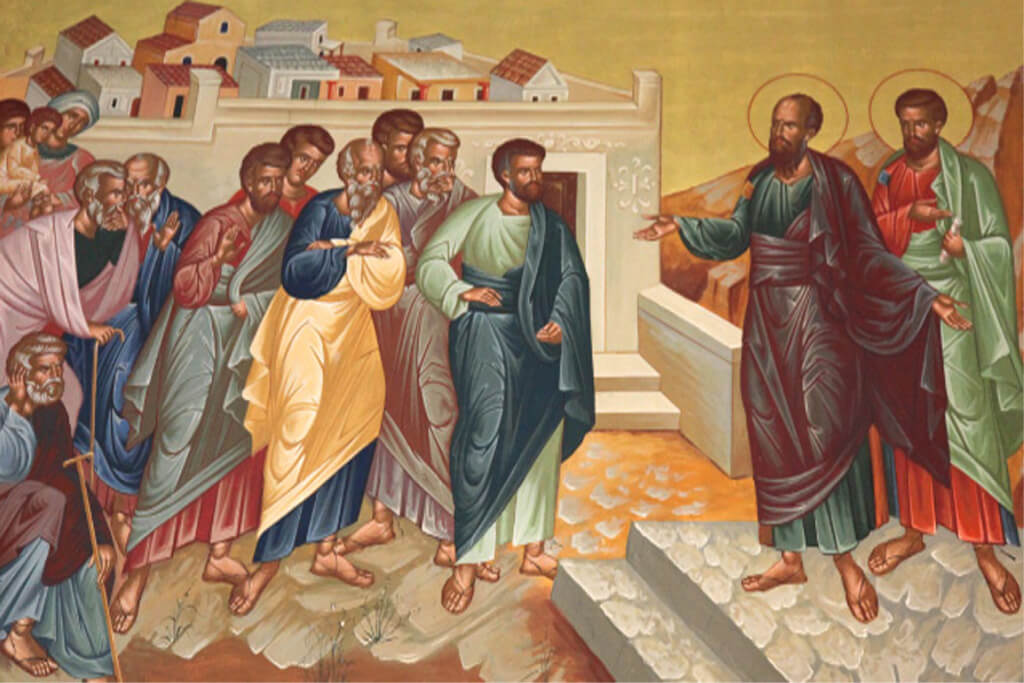
6th Week of Easter 2024 - Wednesday - Evangelizing lessons from St. Paul in Athens

 Paul's proclamation of the gospel in Athens contains lessons for our evangelizing today.

Normally, as he did in Philippi, it was Paul’s custom to go to the synagogues to preach to the Jews and God-fearing Gentiles there. But not in Athens.

In Athens, Paul, in the manner of the Greek Philosophers, goes to the public square. He does not wait for people to come to church, as we may be inclined to do, but rather goes out in search of the lost like the Good Shepherd. 

Convinced of the truth and necessity of the Gospel, Paul is not afraid or ashamed to engage strangers in matters of faith, despite the unfamiliarity and even strangeness of the Christian message to the people with whom he is talking. Instead he does his best to explain and defend his beliefs. 

Notice, when Paul is invited to speak, he finds something positive to say about the sincere religious striving of his audience. He looks for common ground. He meets them where they are with the truth of the Gospel, as Bishop Perez liked to say—even affirming something true in their religion that he can use as a starting point for sharing the gospel. That’s a great strategy. We can affirm what is true in Islam and Hinduism and Buddhism and the Protestant denominations. What’s true is true. And that can be a starting point.

So Paul tailors his approach to his Pagan audience. He acknowledges that they are deeply religious. They pray, they worship, they engage in devotional practices. They are mindful of the gods in their daily lives.

But then he introduces the truth that there are in fact not a multiplicity of gods, but a single All-powerful Creator God who has sent his son as Savior. 

Paul quotes the Pagan poets—again meeting people where they are—yet, he corrects his audiences mistaken ideas about divinity. 

He then explains the necessity of repentance and tells them the sober truth about future judgment. He boldly asserts Jesus Christ, though he surely knows that this assertion will cause many Greeks to scoff. Finally, he is not discouraged when only a few receive his message. With evangelical fortitude, he sets out for his next mission, in the city of Corinth

Important lessons no? Don’t be afraid to engage strangers. Meet them where they are. Seek to understand them and what they believe. So you can lead them from that place to the fullness of truth. Don’t be afraid to assert the need to seek the truth revealed by God in Christ—the need to repentance. After all, the very first word of the Lord’s own public preaching, was “repent and believe.”

- - - - 

That the ordained and all members of the Church throughout the world may be a more visible sign of the love of God for humanity, calling all people to new life and communion with Him; and that our parish may bear witness with great confidence to the Resurrection of Christ and his tender love for sinners and for the poor

For those who do not believe in God and for those who have fallen away from the Church.

For an increase in the gifts of the Holy Spirit among all Christians, and for all who are persecuted for the faith.

For the sick, the suffering, those in nursing homes, hospitals, and hospice care, for the underemployed and unemployed, for the imprisoned, those with addictions, for those who grieve the loss of a loved one, and those who will die today, that the Spirit of Consolation may comfort them.

For the deceased members of our families, friends and parish, for all of the poor souls in purgatory, for all those who fought and died for our freedom.

O God, who know that our life in this present age is subject to suffering and need, hear the prayers of those who cry to you and receive the prayers of those who believe in you. Through Christ our Lord.


Monday, May 6, 2024

6th Week of Easter 2024 - Monday - Preaching Jesus is indispensable

Having completed one missionary circuit through Asia minor with Barnabas, around the year 50 A.D., Paul set out a second time, this time joined by a young convert named Timothy.

And this second journey will take the Gospel beyond Asia minor into Europe. And the reading today contains the story of the first European convert: a business woman named Lydia. Lydia, was probably a widow who had taken over her husband's business selling luxurious purple-dyed cloth. She was a rarity in the 1st century: a business woman in a male dominated world.

The reading from Acts described her as among a group of women who had gathered for and a "worshiper of God". This suggests that she was a Gentile who had come to believe in the God of Israel.

Paul sits down with her, and finds her receptive to the Gospel. Paul attributes her receptiveness to the Lord Jesus himself, who opened her heart to what Paul was saying.

Sometimes we fear sharing the Gospel with others because we fear that we will not be able to convert them. But recall, Jesus is the one who wants to open their hearts. If we are sitting down with a prayerful seeker of truth, we can trust that grace has already preceded the conversation.

God is at work in the lives and minds and hearts of the people of this neighborhood, to make them receptive to the Gospel. But we like Paul have to go to them and sit down with them and share the reasons of our faith. We must preach the Gospel with deeds and words. Deeds are not enough. Words are not enough. We must use both. Like our Lord did. Like Paul.

In his great document on evangelizing the modern world, Pope Paul VI wrote, “It is by her conduct and by her life that the Church will evangelize the world, in other words, by her living witness of fidelity to the Lord Jesus—the witness of poverty and detachment, of freedom in the face of the powers of this world, in short, the witness of sanctity.”

But also, “it is not superfluous to emphasize the importance and necessity of preaching. "And how are they to believe in him of whom they have never heard? And how are they to hear without a preacher?... So faith comes from what is heard and what is heard comes by the preaching of Christ." This law once laid down by the Apostle Paul maintains its full force today. Preaching, the verbal proclamation of a message, is indeed always indispensable.”

There are women like Lydia in this neighborhood, prayerful women, God fearing women, women with keen minds for business and the like. And the Lord Jesus wants to open their hearts to his Gospel, through us. May we be faithful to our call to witness, to testify, to preach for the glory of God and the salvation of souls.

- - - - - -  

That all bishops, priests, catechists, and parents may be faithful in preaching and teaching the saving Gospel of Christ.

For those who do not believe in God and for those who have fallen away from the Church.

For an increase in the gifts of the Holy Spirit among all Christians, and for all who are persecuted for the faith.

For the sick, the suffering, those in nursing homes, hospitals, and hospice care, for the underemployed and unemployed, for the imprisoned, those with addictions, for those who grieve the loss of a loved one, and those who will die today, that the Spirit of Consolation may comfort them.

For the deceased members of our families, friends and parish, for all of the poor souls in purgatory, for all those who fought and died for our freedom.

O God, who know that our life in this present age is subject to suffering and need, hear the prayers of those who cry to you and receive the prayers of those who believe in you. Through Christ our Lord.


Wednesday, April 24, 2024

4th Week of Easter 2024 - Wednesday - Antioch: Spiritual Home and Strategic Hub for Evangelization


In this part of the Easter season, we hear in our readings from the Acts of the Apostles a lot about the city of Antioch. Yesterday, we heard that it was in Antioch that the followers of Jesus Christ were first called Christians. And so Antioch was a place where the identity of the early Church was developed—a place where we came to understand who we were and our mission in the world.

Antioch was one of the largest and most cosmopolitan cities in the ancient world, serving as a melting pot of cultures, religions, and ethnicities. This diversity provided an ideal setting for the spread of the Christian faith, as it allowed for the dissemination of the gospel message to people from various backgrounds. It was the first city where the gospel was really preached to the Gentiles on a large scale. 

And so Antioch become home to one of the most vibrant Christian communities outside of Jerusalem. Antioch was a center for Christian activity and growth, with believers gathering for worship, fellowship, charitable work, and the sharing of resources. As we heard in the reading today, there were Christians in Antioch with spiritual gifts like prophecy and teaching, so it was a place where spiritual gifts were discerned and developed. The Christians of Antioch practiced fasting and attentiveness to the guidance of the Holy Spirit. 

It was in this atmosphere of vibrant faith in Antioch that the Holy Spirit formed Paul and his companions as missionaries and sent them out into the world. So Antioch, served as a spiritual and strategic hub for early Christian missionary efforts. 

Every parish is called to be a little Antioch, no? For a parish is a place where Christians are to gather together, to understand themselves and their mission, to teach and be taught, to be inspired and challenged by words of prophecy, to fast and pray, and listen to the guidance of the Holy Spirit in order to be formed for going out into the world. Every parish is a spiritual home, but also a strategic and spiritual hub for our evangelizing mission.

Yesterday, I went to the doctors for my annual check-up and the waiting room reminded me of Antioch. It was extremely culturally diverse: there were jews, muslims, whites, blacks, Hispanics, Russians, and ukranians. And like Antioch of old, the cultural diversity of a place is not simply a challenge or obstacle, but an opportunity for the Gospel to spread out like electrical currents in a body of water, when we are faithful to our mission. 

May the liturgical, catechetical, aesthetical, and charitable life of our parish help us to be attentive to the guidance of the Holy Spirit, in sharing the Gospel in this diverse neighborhood, for the glory of God and the salvation of souls. 

- - - - -  

That the Church will deepen in her devotion to the Eucharistic sacrifice which is the source and summit of our Christian life, and that during this time of intentional Eucharistic Revival, our faith may be deepened, grace may increase, and our mission may be furthered. 

That the outpouring of charity in Christ’s Eucharistic Self-Sacrifice will become manifest in all marriages, in all business relations, in all daily encounters, in our concern for the downtrodden and care for the most vulnerable, among friends, strangers, and enemies.  

For those who suffer from physical or mental illness, addiction or grief; and for the consolation of all the afflicted. 

That the Eucharist will be for priests the source of their joy and their deeper configuration to Jesus Christ.  

For all those who have died, for all of the poor souls in purgatory, for all who have fought and died for our country’s freedom, and for [intention below], for whom this Mass is offered.

Incline your merciful ear to our prayers, we ask, O Lord, and listen in kindness to the supplications of those who call on you. Through Christ our Lord.


Monday, April 22, 2024

4th Week of Easter 2024 - Monday - Universal Love, Universal Mission

 During the Easter season we consider the Church’s call to spread the gospel of salvation through Jesus Christ to the ends of the earth.

The Lord, in his first recorded post-resurrection appearance to his disciples in the Gospel of Matthew, mandates them to “go and teach and baptize and make disciples of all nations. 

We are sent to all nations and peoples because God loves all nations and all peoples. Our universal missionary mandate is grounded in the eternal and universal love of the Most Holy Trinity. God "desires all men to be saved and to come to the knowledge of the truth" writes Paul to Timothy.

And even though this mandate was clearly enunciated by the Lord, it was certainly a challenge to the early Christians. Remember the earliest Christians including the apostles were Jews. The Jews were treated with suspicion and disdain even then, not to mention, they were a conquered people, non-Romans in a Roman controlled world—fisherman and farmers in a world controlled by military might. On top of that, their whole religion was about avoiding contact with the Gentiles, who were considered unclean for a variety of reasons.

Now, yes, there are many scriptural prophecies of how God would use the Jews to gather all nations, how the nations of the world would stream up to Jerusalem to glorify God. But Jesus’ commission wasn’t just to wait around in Jerusalem, waiting for the nations to magically appear—Jesus’ commission was to go out and gather, to put out into the deep. 

In the reading from the Acts of the Apostles, St Peter explains to the early Jewish converts in Jerusalem how he himself was initially hesitant to go out to the Gentiles, but God kept reminding him, like in the dream he described, not to call unclean what God has made clean. Not only was there a mission to the Gentiles, but through Christ, the Gentile is made clean, equally clean—a brother in the Lord.

Those of us of non-Jewish descent must be eternally thankful that Peter and Paul and the early Church overcame their fears and heeded the mandate. And as they did, so must we, in our own day, in our age, to all people in all places—not just waiting for others to come to us, but to go out and teach and share.

For, the Great Commission given by Jesus is not merely a suggestion but a mandate to actively go out and share the Good News with the entire world. Like those early Jewish converts we must allow the Holy Spirit to fill us with courage to reach across cultural barriers, prejudices, and the fear of rejection—to be motivated by authentic Trinitarian love for all people for the glory of God and the salvation of souls.

That the love and goodness of the Good Shepherd may be evident in the charitable self-giving of Christians towards the poor; for unity among believers, protection from worldly errors and evils, and the gathering of scattered humanity into the one flock of Christ. 

For the whole world, that it may truly know the peace of the Risen Christ—especially in places afflicted with violence, corruption, injustice and oppression.

That our parish may bear witness with great confidence to the Resurrection of Christ, and that the newly initiated hold fast to the faith they have received. 

For those who suffer from physical or mental illness, addiction or grief; and for the consolation of all the afflicted. 

That all of our beloved dead and all the souls in purgatory may come to the glory of the Resurrection.

O God, you know that our life in this present age is subject to suffering and need, hear the desires of those who cry to you and receive the prayers of those who believe in you. Through Christ our lord.


Monday, June 19, 2023

June 19 2023 - St. Romuald - Reparation & Evangelization

 On Friday we celebrated the Solemnity of the Sacred Heart of Jesus—a feast day on which we make reparation—through prayer and penance—for the blasphemies and sins committed against God and His Holy Church. And throughout the year, the first Friday of each month is traditionally set aside for this purpose as well—to do penance and offer prayer and make reparation for our sins and those of the world.

Well the saint honored today, made that his life. St. Romuald grew up without the practice of religion in Ravenna, Italy. But after he witnessed his father kill a relative in a duel over and argument about money, he entered monastic life to escape the violence of the world and to perform penance for his father. 

He took penance very seriously, and made some of the less strict monks a bit uncomfortable. But after some time, his father repented of his sins, and entered the monastery as well.

Now, Romuald would later become abbot of the monastery, and would also go on to be sent by the Pope to preach in Hungary, and also founded a new religious order, the Camaldolese hermits, but that initial inspiration to do penance for another shouldn’t be glossed over.

We see a lot of evil in the world right now—sins repugnant to the call to holiness are pridefully celebrated, blasphemies are broadcast, vice is normalized and encouraged. What can I we, the church asks? We can follow the example of St Romuald—if not entering religious life to do penance, we can certainly fast and pray a little bit more assiduously in reparation for the multitude to of sins and for the conversion of sinners. Our Blessed Lord Himself said, some demons are only cast out through prayer and fasting. 

We speak a lot about evangelization these days, the need to spread the Gospel. Monks and hermits like St. Romuald remind us of a powerful way of engaging in evangelization—joining a religious community who take religious vows of poverty, chastity, and obedience in the context of a penitential rule of life. The great powerhouses of evangelization throughout history, have often been those monasteries where men and women have sought to conform themselves to Christ and to do penance for sin. Hermits inspire people to turn away from the emptiness and the noise of the world in order to find Christ. That’s evangelization. We become effective instruments of evangelization when we are serious about our personal call to holiness. 

And shouldn’t that be the pursuit about which we are most serious? St. Romuald brought his father to Christ through his humble quiet life of prayer and penance. May his example and heavenly intercession inspire us to similar endeavors for the glory of God and salvation of souls.

To God the Father Almighty, may every prayer of our heart be directed, for it is His will that all humanity should be saved and come to the knowledge of the truth.

For the holy Church of God, that the Lord may graciously watch over her and care for her.

For the peoples of all the world, that the Lord may graciously preserve harmony among them, and deepen in them the virtues of justice and religion.

For an increase in vocations to the consecrated religious life—especially to those holy orders of hermits—who inspired us by their vows of poverty, chastity, and obedience.

For all who are oppressed by any kind of need, that the Lord may graciously grant them relief, especially for the sick and victims of war and terror and natural disaster.

For the repose of the souls of our beloved dead, For the deceased members of our families, friends, and parish, for the deceased priests and religious of the diocese of Cleveland, for the poor souls in purgatory, and for those who have fought and died for our freedom.


Monday, June 12, 2023

Corpus Christi 2023 - The power and witness of the Corpus Christi Procession

 Just a few weeks ago we celebrated the Feast of the Lord’s Ascension. And St. Luke gave us a very interesting detail about the apostles who witnessed the Lord’s Ascension, do you remember? St. Luke told us, “While the apostles were looking intently at the sky as the Lord was ascending into heaven, suddenly two men dressed in white garments stood beside them. And they said, “Men of Galilee, why are you standing there looking at the sky?” As if to say, why are you just standing around. The Church isn’t supposed to just stand around, immobile, paralyzed. Don’t just stand there. It’s time to move. 

Well, tomorrow/this morning, we are going to do just that. We are going to take to the streets, bringing the Lord Jesus in procession out into the world—in our Corpus Christi Procession.

Why will we process with the Eucharist through the streets surrounding our parish church? The procession is an act of homage and worship. We do it because we love the Lord, we want to honor him, we want to spread his glory in the world. We seek to honor God and to extend the thanksgiving and glory we give to God at the Eucharistic sacrifice of the Mass out in the world. 

It’s also an act of imitation, in a sense. Our Lord went into the highways and byways, preaching. And so we bring the Lord into the streets of our neighborhood, that he may preach through his Eucharistic Presence. 

We may appear strange to unbelievers: carrying enshrined in the elaborate monstrance, what looks to the world as a piece of bread. Why do they do this strange thing, they might ask? But that question sparked by our procession might be the beginning of God’s truth breaking into their lives. So we gladly process with the Blessed Sacrament for the world to see, that the Lord may draw souls to Himself through this act of devotion of his Church.

For finally, the procession is an act of evangelization. Showing to the world that believing in Jesus makes a difference in our lives. Look how he gathers people from all different walks of life, he feeds us all, he invites us all to follow him.

Pope Benedict XVI in 2008 spoke about the power of Eucharistic Processions. He said, “The Corpus Christi procession teaches us that the Eucharist seeks to free us from every kind of despondency and discouragement, wants to raise us, so that we can set out on the journey with the strength God gives us through Jesus Christ.”

There is a lot of despondency and discouragement out there, no? There have been few eras in human history with such discouragement and loneliness. Drugs and alcohol, porn and prostitution, binge watching, binge eating, binge shopping are signs of that loneliness and emptiness in modern society, signs of spiritual starvation. And the Corpus Christi Procession is a countersign to the world that there is something more, something that satisfies, something worthy putting down your iphones, getting out off your couch, out of your house, in order to obtain. It’s a sign that God has visited his people and gives us the food that strengthens us for the challenges of life. 

Pope Benedict goes on. He says, The Corpus Christi Procession witnesses that, we can find our way through this life if we allow ourselves to encounter “the One who is the Word and the Bread of Life” and if we let ourselves “be guided by his friendly presence.” Our humble yet joyful Eucharistic Procession shows that Christ’s presence is a friendly presence, one that invites. After all, we are here today because we have responded to that invitation, and the Eucharistic Procession is one way the Lord extends that invitation to others. 

Finally, Pope Benedict asks, “Without the God-with-us, the God who is close, how can we stand up to the pilgrimage through life, either on our own or as society and the family of peoples? The Eucharist is the Sacrament of the God who does not leave us alone on the journey but stays at our side and shows us the way. Indeed, it is not enough to move onwards, one must also see where one is going! “Progress” does not suffice, if there are no criteria as reference points. On the contrary, if one loses the way one risks coming to a precipice, or at any rate more rapidly distancing oneself from the goal.”

With all of the confusion and chaos in the world, humanity needs a reference point, needs to know that something is true and good. And if God is not the reference point, then we are distancing ourselves from Him—we are nearing the precipice, the edge of a cliff.  And doesn’t it feel like that right now? Doesn’t it feel like our society is on the edge of a cliff and is dangerously close to falling off? 

But the Eucharist Procession, says, God can lead us through this difficult time. God can lead us through the chaos. It’s not yet too late. Follow Jesus. Trust Jesus. 

When our blessed Lord saw the hungry crowd  he said, “I am sorry for the multitude. They have nothing to eat.” But he fed them. And in the Gospel today, he explains how, he gives not just ordinary physical bread for the sustenance of our bodies. But the Bread of Life for the sustenance of our souls.

And the Church is tasked with feeding the world with both. Feeding the physically hungry. And also making invitation to the table at which the Lord feeds our souls. He sends us out to the spiritually starving multitude of the world, and he sends us out to say, God has food for you, inside his Church, come inside, God sees how hungry you are. The Savior feeds us. Step away from the precipice. God is here. The hungry, lonely night is over. 

“This is the bread that came down from heaven. Unlike your ancestors who ate and still died, whoever eats this bread will live forever" for the glory of God and salvation of souls.


Friday, June 9, 2023

June 9 2023 - St. Columbkille - Faithfulness in all circumstances


 Earlier this week we celebrated the Apostle to the Germans, St. Boniface, who brought Christianity to the Germanic Tribes of northern Europe. Today, we honor a saint who lived about a 150 years before St. Boniface, who is credited with taking Christianity to Scotland. While today is also the feast of St. Ephraim, I like to honor St. Columbkille, as he is the patron saint of my first parish assignment at St. Columbkille Parish in Parma. 

Born of royal bloodlines on both his mother’s and father’s side in County Donegal in northern Ireland on December 5, 521, his proper name was Colum MacFehlin MacFergus. He completed his studies in the Irish monastic schools, and was ordained a priest, and spent the first fifteen years of his priesthood working among the poor in his native Ireland and became famous for his works of charity and preaching. He also spent time as a scribe, copying the Scriptures. The great illuminated manuscript, the Book of Kells, is attributed to St. Columbkille.

Tradition asserts that there was a bit of a feud between St. Columbkille and St. Finian over the ownership of a particular manuscript, and the feud got so heated that Columbkille discerned that it was an opportune time to leave Ireland and go evangelize an entirely different country. Funny how God works.

So, in 563 with twelve fellow monks, Columbkille left Ireland and set sail for the Scottish Isle of Iona, where he established a monastery which served as a base for his evangelizing mission. He spent the next 34 years establishing churches and schools and making disciples who were attracted to the faith due to Columbkille’s ardent penances, fervent prayer, sincere preaching, and deep confidence in God. Columbkille died in 597 and is honored as the Patron of Scotland.  He is a patron of poets, bookbinders, and a co-patron of Ireland.  And you can still visit the Iona Abbey, on the Isle of Iona, off of Scotland.

Here's an example of a saint, who made good use of the time he had been given in circumstances that were beyond his control. He was forced to leave his native land. But because he persevered in the faith, he sowed the seeds for Christianity to grow in a place where it had not been before. And this was possible because he had allowed Christianity to flourish in his life through prayer, penance, study, and even writing holy poetry for God.

And isn’t that what Christians are called to do? We don’t get to control all the circumstances of our lives. But we are to live out the faith and spread the faith in whatever circumstance we find ourselves. 

May St. Columbkille inspire us to generously live out our faith in all the challenging circumstances of our lives for the glory of God and salvation of souls.

- - - - - 

That those in public office may govern with wisdom, put an end to all political corruption, and work for a society of authentic justice and peace with special care for the most vulnerable.

For an increase in vocations to the priesthood and consecrated religious life, for a strengthening of marriages, for all single people who strive to follow Christ, and for the graces needed for our evangelizing mission.

For an end to oppression, racism, hatred, addiction and injustice. For the healing of all the sick. 

That those who have died may share in the joy of life-everlasting; for our deceased family members, friends, and fellow parishioners, for all the poor souls in purgatory, and for X. for whom this mass is offered.

O God, who know that our life in this present age is subject to suffering and need, hear the prayers of those who cry to you and receive the prayers of those who believe in you. Through Christ our Lord.


Wednesday, April 26, 2023

3rd Week of Easter 2023 - Wednesday - Scattered, yet still preaching


Over the last two days, we’ve celebrated the feasts of martyrs: St. Fidelis, on Monday—the poor man’s lawyer turned capuchin Franciscan who was killed by Swiss Calvinists in the 1600s, And then, yesterday, St. Mark, the evangelist, who was killed in Egypt for preaching the Gospel to the pagan Egyptians. In both cases, the Gospel threatened an established religion.

For St. Fidelis, it was the Calvinists. For St. Mark, it was the pagan Egyptians, with their superstitions, sorcery, and polytheistic worship. The Gospel preached by the martyrs, was the truth. And just as Our Lord Himself was silenced for preaching truth, so is His Bride, the Church. 

In the acts of the Apostles, today, we heard how “There broke out a severe persecution of the Church in Jerusalem, and all were scattered.” For a few weeks now, those readings from Acts have included how the preaching of the Gospel threatened the established Jewish religion in Jerusalem. The Pharisees and Sadducees have the apostles arrested and beaten and threatened with death.

And it wasn’t just the apostles who were targeted, not just the bishops, but the people too. We heard today, “All were scattered throughout the countryside of Judea and Samaria.” The men, women and children of Jerusalem, who came to believe that Jesus the Son of God had risen from the dead were expelled from their synagogues and had to flee their homes and families because of their faith in Christ.

And did you notice what they did while they were driven from their homes? Acts said, “Now those who had been scattered went about preaching the word.”

You drive us from our homes, we will just keep on preaching wherever we are driven. That’s Christianity. That’s evangelization. That’s Easter faith. That’s our mission. 

We cannot be afraid to preach the Gospel in its entirety because some of those aspects of the Gospel threaten worldly powers or established modes of thinking or established cultural values. Through our courageous witness God breaks down some these societal dysfunctions and deliver souls to Christ.

Sure you might lose friends over the Gospel, but through faith we make new friends and form deeper bonds with brothers and sisters in Christ, not to mention fellowship with the saints who come to our aid in times of distress. Will you be driven from your homes like the early Christians? Maybe not in this country. But in some countries right now, in 2023, there are Christians sacrificing their homes and family bonds for Christ. That sort of detachment and courage makes them powerful witnesses. And not only do they deserve our prayers, but also, our emulation of their example, for the glory of God and salvation of souls.

- - - - - -  

Filled with Paschal joy, let us turn earnestly to God, to graciously hear our prayers and supplications.

For the shepherds of our souls, the pope, bishops, and clergy, that they may govern wisely the flock entrusted to them by the Good Shepherd, leading the Church to embrace hardships for the sake of the Gospel.

For the whole world, that it may truly know the peace of the Risen Christ.

That our parish may bear witness with great confidence to the Resurrection of Christ, and that the newly initiated hold fast to the faith they have received. 

For our brothers and sisters who suffer, that their sorrow may be turned to gladness through the Christian faith.

That all of our beloved dead and all the souls in purgatory may come to the glory of the Resurrection.

O God, you know that our life in this present age is subject to suffering and need, hear the desires of those who cry to you and receive the prayers of those who believe in you. Through Christ our lord.


Wednesday, October 12, 2022

28th Week in Ordinary Time 2022 - Wednesday - Fruits of the Spirit


Friedrich Nietzsche once told a group of Christians, “You Christians disgust me, if you really are redeemed, why don’t you look redeemed?”  Now of course Nietzsche and others are so hardened to Christianity that they are blinded to goodness and truth when it is right in front of them. But, he does have a point! Why don’t we look redeemed?

In today’s first reading (Gal 5:18-25) St. Paul explains that the fruits of the Spirit need to be evident in our lives.  The fruits of the Spirit are to be evident in us; “love, joy, peace, patience, kindness, generosity, faithfulness, gentleness, self-control”, they need to be seen, obvious, apparent, manifest in word and deed, clear to believers and unbelievers. 

Why should they be evident? Because they point to God. They are signs that God is real and that his Spirit dwells within us. They are signs that we take our faith seriously. But most importantly, they point to God. And our job—our mission—is to point others to God. In the Gospels, the Lord says, “let your light shine before men, so that they may see your good works and give glory to your Father who is in heaven.” 

Making evident the fruits of the spirit is not a selfish endeavor—it’s not prideful for us to display kindness, generosity and joy. We don’t seek to make the fruits of the Spirit evident in our lives for worldly attention or fame: “Look at me. Look how holy I am.” No, of course not. Christians are to cultivate the fruits of the Spirit for the sake of the mission, for drawing souls to Christ. 

When people detect the fruits of the Spirit in us, they become intrigued, they are our best advertisement for God. Wow, the world is so full of hatred and jealousy, but look at this Christian, their kindness, their generosity points to something else, something bigger than them. 

Are the fruits of the Spirit evident in my life? If not, why not? Is it because I have not cultivated them through prayer and good works? Is it because I’m too busy indulging in the works of the flesh?  Sometimes cultivating the fruits of the Spirit is difficult because we’ve lacked good role models. Sometimes it’s hard for us to be patient or joyful because our parents were not really patient or joyful people. Or it’s hard to practice self-control because we really didn’t have good teachers of that fruit. So we have to really struggle to bear those fruits.

But the Holy Spirit will teach you all these things and cause them to grow in you, if you really till the soil. 

Homework: identify which fruit of the Spirit is most evident in your life, and identify which is most lacking. Ask the Holy Spirit to help you make use of your strongest fruit, and help you to identify what you need to do to strengthen your weakest fruit, that the life of God may be evident in you, for the glory of God and Salvation of Souls.

For “love, joy, peace, patience, kindness, generosity, faithfulness, gentleness, self-control”. 

For wisdom to guide the life of the Church, the decisions of government leaders, and the ordering of our personal lives.

For our young people, that they may be raised in homes where the Word of God is studied, cherished, and practiced. 

During this month of October, dedicated to the Most Holy Rosary, may Catholics take up this devotion with renewed vigor and trust in Our Lady’s never-failing intercession.

For all victims of war, For hurricane victims and for all affected by flooding and severe weather conditions, and for those experiencing any kind of hardship or sorrow, isolation, addiction, or disease: that they may know God’s sustaining grace.

For the deceased members of our families, friends, and parish; for all of the poor souls in purgatory and for N.

Incline your merciful ear to our prayers, we ask, O Lord, and listen in kindness to the supplications of those who call on you. Through Christ our Lord.


Friday, May 27, 2022

May 27 2022 - St. Augustine of Canterbury - Small Steps


On Wednesday, we celebrated the venerable Benedictine monk, St. Bede. Today we honor another Benedictine who lived about 100 years earlier, St. Augustine of Canterbury.

Bede put his impressive intellectual gifts in service of the Church, writing histories, biographies, martyrologies, works of science, numerous commentaries on the bible and sacred chant, from within the confines of his monastery, St. Augustine of Canterbury served the Lord in a different way. He didn't stay in his home monastery. Rather, he was a member of a delegation of missionaries to early Anglo-Saxon England.

Early missionary activity amongst the Anglo-Saxons of Brittainy were largely unsuccessful. The Gospel failed to take root in the British Isles initially, except among the small pockets of Celtic peoples. So around the year 595, Pope St. Gregory the Great sent a delegation of forty monks to Brittania, including the Italian Benedictine monk, Augustine.

Though Augustine and his band of monks heard stories about the ferocious Anglo-Saxons and the treacherous waters of the English Channel, they proceeded on their mission with the assurance of the Pope. They constructed a church and monastery at Canterbury, on the site where the famous Canterbury Cathedral now stands presently. Augustine was consecrated its first Bishop.  And by 597, thousands of people were coming to actively seek baptism.  

Most of us do not receive letters from the Pope telling us to go evangelize particular nations and regions, but all of us have received the commission of our Lord to go and make disciples of all nations, all of the baptized have the vocation of laboring for the spread of the Gospel.

We also live in a culture much like that which Augustine found upon his arrival to Britain, small pockets of Christian faith, mingled with pagan elements, with considerable opposition from the culture.

In a letter to Augustine, Pope Gregory the Great wrote: "He who would climb to a lofty height must go by steps, not leaps."  The task of evangelization might seem like a lofty mountain, but we can make great inroads through small steps: conversations with non-Catholics, small acts of charity towards strangers, imitating Christ in all of our attitudes and choices.

Through the prayerful intercession and holy example of St. Augustine of Canterbury may we be faithful to the small steps the Lord calls us to take in the spread of his kingdom for the glory of God and salvation of souls.

- - - - - -  

That the Saints may inspire us and continue to help us put Christ at the center of our life. 

That the Saints may inspire us to works of charity and caring for the needy.

That the Saints may inspire us to confess our sins, strengthen in virtue, and be devoted to the spread of the Gospel.

That the Saints may inspire us to bear our sufferings in union with Christ, and may help the suffering to know the comforting presence of God, especially the sick, the elderly, those in nursing homes, hospitals, hospice care, addicts and those imprisoned, those who grieve the loss of a loved one, and those who will die today.

In the wake of the horrific school shooting in Texas this week, we pray for the victims of this shooting and their families, for all the public safety responders and for the southwest Texas communities stunned by this unthinkable incident.

For our beloved dead…

O God, who know that our life in this present age is subject to suffering and need, hear the prayers of those who cry to you and receive the prayers of those who believe in you. Through Christ our Lord.


Tuesday, May 10, 2022

May 10 2022 - St. Damien the leper - Our crosses open doors

 
For the first four weeks of the easter season, we’ve been reading from the book of Acts— how the Gospel was spread first in Jerusalem and then throughout Judea amongst the Jews.  But today, we hear of one of the great breakthroughs of human history.  

Last week, we heard how following the death of St. Stephen, Christians were scattered due to persecution. But the Christians took advantage of their scattering. They preached to the Jews, as we heard today, as far as Phoenicia, Cyprus, and Antioch.

As some of the new Christians were Greek-speakers, they began to share the good news with some of the Gentiles in Antioch.  This may seem very natural and inevitable to us now, but this really was a breakthrough—the first time the Church became truly faithful to the Lord’s command to make disciples of all nations…not just the Jews of the Holy Land—but all nations.

Each of us are called to work for converts by sharing the Good News. So, where do the breakthroughs need to occur in your own life for that to happen? What do you need from the Lord do be able to share the faith more confidently with strangers?

Jesus says in the Gospel today, “my sheep hears my voice”.  He wants to use us as his mouthpiece.  There are people who long to hear the voice of Jesus calling them into the flock of the Church. They are waiting for us to share what we know of Jesus, of Catholicism, but they have no one to talk to. The internet can’t do our job for us.

Today, the Church celebrates St. Damien of Molokai, the apostle to the lepers. He spent sixteen years tending the physical, spiritual, and emotional needs on the island leper colony of Molokai of Hawaii.  And when he contracted leprosy himself, he continued to preach the Gospel. 

We aren’t just to preach the Gospel from a top an ivory tower, we are to enter into the world of the forgotten and the outcast, in order to show them, that they are not forgotten by God. 

For the Christians in the book of Acts, the persecution led them to preach to an entirely new group of people. For St. Damian, his leprosy enabled him to draw closer to the other lepers, to preach even more effectively by entering their world.

Our own crosses are keys that open doors into the lives of others who suffer, who are longing to hear the voice of the Shepherd. May we embrace those crosses, and enter through those doors, for the glory of God and salvation of souls.

 - - - - - - - 

That all Christians may be deeply committed to the spread of Christ’s Gospel, and for the success of the Church’s missionary activity. Let us pray to the Lord.


For those in public office: may they govern with wisdom and compassion for the most vulnerable among us—especially unborn children, the elderly, the indigent, and persons with disabilities.  Let us pray to the Lord.


That the isolated and abandoned may know the love of God through the labors of the Church. Let us pray to the Lord.


For the repose of the souls of our beloved dead, the deceased members of our families friends and parishes, for those who fought and died for our freedom, and for N. for whom this mass is offered.


Graciously grant our petitions, we beseech thee, O Lord; may your grace sustain us always in your service, through Christ Our Lord.


Friday, May 6, 2022

3rd Week of Easter 2022 - Friday - "My flesh is true food..."


There is a short Eucharistic hymn from the 14th century, composed by an unknown author, possibly Pope Innocent VI, the fifth of the Avignon Popes. The hymn is called Ave Verum Corpus. It was sung often during benediction, when the host would be elevated in the monstrance for our adoration. While gazing upon, what appears to be ordinary bread, in the ornate golden monstrance, the choir would sing Ave Verum Corpus—"Hail true flesh born of the Virgin Mary who having truly suffered, was sacrificed on the cross for mankind, whose pierced side flowed with water and blood: Be for us a foretaste of the Heavenly banquet in the trial of death."  

St. Thomas Aquinas maintained that believing that bread is transformed—trans-substantiated—into the flesh of the Savior is a difficult doctrine. The Eucharist does not look like Christ, nor his flesh; thus it tests our faith—the doctrine requires faith.  But we believe it because this teaching comes from the Lord himself.

“unless you eat the Flesh of the Son of Man and drink his Blood you do not have life within you.”

The non-Catholic denominations of Christianity have to do some pretty strange intellectual gymnastics to support their claims which contradict what Catholics have held as true from the beginning of the Church. The flesh and blood offered on the cross for our salvation becomes present on the altar under the appearance of bread and wine, and is given to us to eat and drink.

Already around the year 150, St. Justin the Martyr explains what was already well-established teaching about the transformation of bread and wine into the true flesh and blood of Jesus. He said, “We do not consume the eucharistic bread and wine as if it were ordinary food and drink, for we have been taught that as Jesus Christ our Savior became a man of flesh and blood by the power of the Word of God, so also the food that our flesh and blood assimilates for its nourishment becomes the flesh and blood of the incarnate Jesus by the power of his own words contained in the prayer of thanksgiving”—that is the Eucharistic Prayer at Mass.

It is a terrible horrific tragedy that so many Catholics, who should know better, deprive themselves of the Flesh and Blood of Our Lord, choosing to skip Mass, and fill their lives with so much garbage that does not satisfy, that does not give life. So part of our Easter mission is to urge them to return to the sacraments, so that they might not be deprived of eternal life.

May we find our nourishment in the Eucharist, and be strengthened in our mission by the Eucharist, for the glory of God and salvation of souls.

- - - - - - -  

That the Church will deepen in her devotion to the Eucharistic sacrifice which is the source and summit of our Christian life.  

That the outpouring of charity in Christ’s Eucharistic Self-Sacrifice will become manifest in all marriages, in all business relations, in all daily encounters, in our concern for the downtrodden and care for the most vulnerable, among friends, strangers, and enemies.  

That the Eucharist will be for priests the source of their joy and their deeper configuration to Jesus Christ.  

For all those who have died, for all of the poor souls in purgatory, for all who have fought and died for our country’s freedom, and for [intention below], for whom this Mass is offered.

Incline your merciful ear to our prayers, we ask, O Lord, and listen in kindness to the supplications of those who call on you. Through Christ our Lord.