Showing posts with label letter to the hebrews. Show all posts

Friday, February 7, 2025

First Friday Holy Hour - February 2025 - Christ is the same yesterday, today, forever

Since the conclusion of the Christmas season, the ordinary first readings from weekday Mass have been taken from the letter to the Hebrews. The letter was written to Christian converts from Judaism. For embracing Christ, they had been expelled from their synagogues, shunned by their families, and now also experienced persecution for being Christian in the Roman Empire. 

The letter seeks to embolden those who were wavering in their faith or tempted to return to their old way of life. 

Much of Hebrews focuses on deep theological truths that serve to embolden the Jewish Christians—how Jesus is our eternal High Priest, the fulfillment of the Old Covenant, and the one true mediator between God and man. 

Today’s passage comes from the final chapter of the letter, and pivots from theological excursus to practical morality, showing that true faith is not just a matter of theological understanding but must be lived out through brotherly love, hospitality, compassion, sexual purity, detachment from material goods, and trust in God’s providence.

The passage concludes with the powerful affirmation: “Jesus Christ is the same yesterday, today, and forever.” This declaration ties back to the earlier chapters of Hebrews, which emphasize: Christ’s eternal priesthood and the unchanging nature of God’s promise.

And in doing so, this passage bridges the doctrinal and practical. After spending so much time explaining who Christ is and what He has accomplished, but this passage reminds us that knowing Christ should change how we live.

Similarly, as we gather for Eucharistic adoration, adoring Christ for his sacrificial self-giving for us, we recall that we are called to go forth and live out that love—showing hospitality, caring for the suffering, embracing purity, and trusting in His providence.

"Jesus Christ is the same yesterday, today, and forever." He is our foundation, our strength, our constant companion. In the stillness of this Holy Hour, let us ask Him to transform us, that we, like Him, may love more deeply, to serve more generously, to live more faithfully. May this time set our hearts afire with the desire to make His presence known in the world, so that through us, others may come to know the One who never forsakes or abandons His people, for the glory of God and the salvation of souls.


Friday, March 29, 2024

Good Friday 2024 - Morning Prayer - Keep your eyes fixed on Jesus

 There is a poignant line from the Letter to the Hebrews which contains an important injunction for any day of the year, but particularly for today, Good Friday. The biblical author writes, “let us rid ourselves of every burden and sin that clings to us and persevere in running the race that lies before us while keeping our eyes fixed on Jesus, the leader and perfecter of faith. For the sake of the joy that lay before him he endured the cross.”

This line from the Letter to the Hebrews is particularly poignant for Good Friday because it encapsulates the essence of Jesus' sacrifice on the cross.

Let’s break it down. First we are told,  “let us rid ourselves of every burden of sin”. Good Friday is a day of reflection on the weight of sin and our own inability to overcome it on our own. Yet, we must do our part in “ridding ourselves”—rooting out sin with the help of God’s grace, acknowledging our selfishness, and making a firm purpose of amendment to overcome it as we can. 

Next we are told to perseverance in Running the Race of Faith: Good Friday marks the culmination of Jesus' earthly ministry, during which he endured trials, opposition, and ultimately, crucifixion. And we his followers are to persevere in our own journey of faith, following the Lord’s example of steadfastness and endurance, even in the face of suffering and persecution. In this way, the Lord is the leader and perfecter of our faith. Our faith is imperfect until it attains union with Christ crucified. 

Then we are told to keep Our Eyes Fixed on Jesus. This is our task on Good Friday. We are to keep your focus firmly on Jesus throughout the day by reflecting on his life, his teachings, his sacrificial love, his obedience to God's will, the wounds, and blows, and mockery, and agony he suffered to obtain the ultimate victory over sin and death. Make every effort today to avert your eyes from all things that are not Him. 

Finally, Hebrews says that he endured the cross for the sake of the joy that lay before him. Despite the agony and suffering of the cross, Jesus endured it all for the sake of the joy that lay before him. This joy refers to the redemption and salvation of humanity. Your redemption and freedom from sin is God’s joy. Which is why, for God, today is Good. 

May our prayer this morning help us to enter into the goodness of the day. Helping us to keep our eyes fixed on him, to persevere with him to the cross, to be cleansed by him, that we may know his joy, for the glory of God and the salvation of souls.


Friday, January 20, 2023

2nd Week of Ordinary Time 2023 - Friday - Keep your heart fixed on Christ

 Over the past two weeks, our weekday readings have made their way through just over half of the Letter to the Hebrews.

Remember, the letter was written first to those jewish converts to Christianity. For accepting Christ, they were kicked out of their synagogues, they were persecuted by the Romans, and their gentile brothers and sisters in Christ were probably a bit skeptical of them at times too. 

So the author to the letter to the Hebrews writes to these dear ones and reminds them to hold fast to their Christian faith, don’t fall back to the old way of life, but throughout all of your troubles, everything that you are going through, your rejection by former friends and family, the hostility from the Romans, the very slow acceptance of gentile Christians, throughout all that, keep your heart and mind focused on Christ.

And the same is true for us: going through an illness, keep your heart focused on Christ; a family drama—keep your heart focused on Christ; an economic crisis, a temptation of an addiction you thought you had long-ago overcome? Experiencing paralyzing anxiety? Keep your heart focused on Christ. Imagine him. Imagine his face. Imagine him nailed to the cross for you. With real effort of will, fix your heart on Him.

This mid-section of the letter to the Hebrews is highly Christocentric. Chapters five, six, seven develop a rich theology of Christ’s priestly sacrifice. He is the eternal high priest. He is the fulfillment of the both the priesthood of Melchizedek and the priesthood of the Levites. He himself is the sacrifice, offering himself to his Father out of love for us.

Today, from chapter 8 we hear how the Lord having died and risen, has ascended to the right hand of His Father in heaven, into the heavenly sanctuary. The perfect sacrifice has risen to the heavenly sanctuary itself. The self-sacrifice of the obedient Son is now in heaven and is a guarantee of the promises of salvation—a guarantee of the new and everlasting covenant.

This explains the Letter to the Hebrew’s emphasis on keeping your heart fixed on Christ. For the Father Himself in the heavenly sanctuary fixes his eyes and heart on his crucified-and-risen Son. To keep your heart fixed on Christ is a divine thing. It’s a foretaste of heaven that can carry you through the most difficult moments of life. It’s the act of the will that can be justified at every moment of every day, Keep your heart fixed on Christ, for the glory of God and salvation of souls.

- - - - - 

To God the Father Almighty we direct the prayers of our heart for the needs and salvation of humanity and the good of His faithful ones.

For the holy Church of God, that the Lord may graciously watch over her, care for her, and aid her in her mission.

For the peoples of the world, that the Lord may establish and preserve harmony among us.

For all who are oppressed by any kind of need, that the Lord may grant them relief and move Christians to come to the aid of the suffering.

For our beloved dead, for the poor souls in purgatory, and for X, for whom this Mass is offered.

O God, our refuge and our strength, hear the prayers of your Church, for you yourself are the source of all devotion, and grant, we pray, that what we ask in faith we may truly obtain. Through Christ our Lord.


Monday, January 16, 2023

2nd Week of Ordinary Time 2023 - Monday - Christ the High Priest

 One of the reoccurring subjects of the Letter to the Hebrews is the priesthood of Jesus Christ. 

Last week, in Hebrews chapter 2, we heard that “Christ had to become like his brothers in every way, that he might be a merciful and faithful high priest before God to expiate the sins of the people.”

In chapter 3, there is another reference to Christ’s priesthood: “That is why all of you who are holy brothers and share the same heavenly call should turn your minds to Jesus, the apostle and the high priest of our profession of faith.” The author of Hebrews says “turn your minds” to Christ’s priesthood—as if to say, Christ’s priesthood is something that Christians should ponder and meditate upon.

Today’s reading from Hebrews chapters 5 continues this subject: “Every high priest is taken from among men and made their representative before God, to offer gifts and sacrifices for sins.” What is a priest? One who is a representative of God who offers gifts and sacrifices to God.

And all throughout the Old Testament we find people undertaking the priestly duty. Cain and Abel offer sacrifices—though only Abel’s sacrifice was found pleasing to God. Noah offered sacrifices, as did Abraham, who even showed willingness to offer his most beloved son Isaac, if it were God’s will. Prior to the tribe of Levi becoming the official priestly class of Israel, every father of a family and his sons undertook this priestly role, offering bloody animal sacrifices on behalf of the family. 

A high priest, Kohen Gadol in the Hebrew, would be chosen from those Levites who could trace their lineage back to Aaron, the brother of Moses, who would enter the holy of holies in the tabernacle and later in the temple, and offer sacrifice for the expiation of the sins of the entire nation. 

Yet, Hebrews speaks of another order of priests, the order of Melchizedek, whose name means “righteous king”. St. Jerome and other church fathers says that Melchizedek is likely Noah’s son Shem. Abraham came to Melchizedek, who offered not a bloody animal sacrifice, but the sacrifice of bread and wine.

The Catechism says, “Everything that the priesthood of the Old Covenant prefigured finds its fulfillment in Christ Jesus, the "one mediator between God and men." He is the high priest who offers himself for the expiation of sins on the cross, and gives his flesh and blood to us, under the appearance of bread and wine, the eucharistic sacrifice of the altar which blesses, unites, and gives life to his brothers and sisters.

Ordained priests, like myself, continue the perpetuation of the sacrifice of the altar under sacramental signs, but in Baptism, all Christians have a share in Christ’s priesthood. All Christians are called to offer gifts and sacrifices to the honor and glory of God, “to offer ourselves as living sacrifices” as St. Paul says, and to labor to lead others out of sin. May we be faithful to this priestly vocation of ours in union with Christ the High Priest, for the glory of God and salvation of souls.

To God the Father Almighty we direct the prayers of our heart for the needs and salvation of humanity and the good of His faithful ones.

For the holy Church of God, that the Lord may graciously watch over her and care for her.

For the peoples of the world, that the Lord may graciously preserve harmony among them.

For all who are oppressed by any kind of need, that the Lord may graciously grant them relief.

For ourselves and our own community, that the Lord may graciously receive us as a sacrifice acceptable to himself.

For our beloved dead, for the poor souls in purgatory, and for X, for whom this Mass is offered.

O God, our refuge and our strength, hear the prayers of your Church, for you yourself are the source of all devotion, and grant, we pray, that what we ask in faith we may truly obtain. Through Christ our Lord.


Friday, January 13, 2023

1st Week of Ordinary Time 2023 - Friday - Strive to enter God's rest


The letter to the Hebrews today quotes a very important Psalm—the 95th Psalm.  Psalm 95 is prayed daily at the very beginning of the Liturgy of the Hours in what is called the invitatory prayer. A line from Psalm 95 is written above the sanctuary in the old lower church here at St. Ignatius: come let us adore and worship. 

Consider, the Church begins every day contemplating this Psalm. And what a Psalm it is, for it contains so many themes and lessons vital to the spiritual life: the importance of coming before God to worship, of singing God praises and giving thanks for the beauty of creation and God’s governance over it. It contains a warning of not hardening our hearts against God’s commandments, so that, as we heard quoted today, we may finally, at the end of our long journey, come to enter into God’s rest.

Remember, the original audience of the letter to the Hebrews were to those early Jewish converts to Christianity who were experiencing persecution, enduring hardship for the Gospel. And so the sacred author of Hebrews quotes Psalm 95 to them, and to the Church of all ages, to encourage us to not to grow weary in our witness to Jesus, to not harden our hearts to the Gospel when things get difficult. Rather, we are to strive, to work hard, be zealous, be eager, to be diligent, to enter into God’s rest.

The attainment of our eternal destination is to be our highest priority. “Seek first the kingdom of God,” says the Lord. And this means overcoming the opposition we face to that goal: resisting temptations, turning to the Lord to carry us through times of trepidation and human weakness, learning to detach ourselves from earthly distractions, prioritizing the spiritual over the physical—zealously, eagerly, with haste, striving for the kingdom with assurance of the rest and the reward which awaits those who persevere.

In the Gospel, we have the powerful example of the group of four men striving to bring their friend near to Jesus to be healed. They go above and beyond what many would consider normal conventions to bring their friend to Jesus—they climb a roof, and lower their friend through the ceiling, to get him to Jesus. Striving to bring souls close to Jesus is part of our mission, and that not only requires zeal, eagerness, diligence and effort, it often requires us to work together, as members of the Church, to bring lost souls, sick souls, paralyzed souls, deluded souls to Jesus. 

May the Holy Spirit enliven us and give us strength and enthusiasm for our mission, in striving to enter into God’s rest through a life well-lived in diligent and zealous service of the Gospel, for the glory of God and salvation of souls.

- - - - -  

To God the Father Almighty we direct the prayers of our heart for the needs and salvation of humanity and the good of His faithful ones.

For the holy Church of God, that the Lord may graciously watch over her and care for her.

For the peoples of the world, that the Lord may graciously preserve harmony among them.

For all who are oppressed by any kind of need, that the Lord may graciously grant them relief.

For ourselves and our own community, that the Lord may graciously receive us as a sacrifice acceptable to himself.

For our beloved dead, for the poor souls in purgatory, and for X, for whom this Mass is offered.

O God, our refuge and our strength, hear the prayers of your Church, for you yourself are the source of all devotion, and grant, we pray, that what we ask in faith we may truly obtain. Through Christ our Lord.


Tuesday, January 10, 2023

1st Week of Ordinary Time 2023 - Tuesday - All things are subject to Him


Until the beginning of February, the first readings on normal weekdays will be taken from the Letter to the Hebrews.  The Church does not know who wrote the letter to the Hebrews, for many years, a certain verse of chapter 13 seemed to point to Saint Paul, but the jury is still out.

This Letter seems to be addressed to Jewish Christians who were undergoing persecution for their new belief in Christ. The letter itself states how these converts to Christ "endured mockery, scourging, even chains and imprisonment. They were stoned, sawed in two, put to death at sword's point".

And so, the sacred author of this letter wrote to encourage them—to persevere in their faith even unto death because Christ is victorious. He is Lord. He is the True High Priest. He is the perfection that was promised, who established a new covenant in his blood. All things are subject to Him.

But today, just in chapter 2 of the letter, read a verse that is brutally honest: “at present we do not see all things subject to him.” Ain’t that the truth! The Church proclaims Christ is victorious. Well, to those who are experiencing persecution, or anyone whose eyes are open, it sure doesn’t look that way, at least not initially.

If all things are subject to Christ, why were the powers of the world still holding such sway. Why were the Romans so bloody efficient at putting Christians to death? Why were there still imposter kings imposing their godless wills. The Messiah was supposed to usher in the eternal kingdom of justice and peace. So where was the justice, where was the peace? Why are the wicked still in control? 

And why should those who are being persecuted, keep the faith, if this promise of peace and justice has not been fulfilled? 

This letter is grappling with some serious questions. It’s the same question that Job grappled with. The problem of evil. If God is omnipotent, why is does evil persist? If the claim is that Christ is victorious, why doesn’t it look that way? 

The answer probably has to do with the cross, doesn’t it? The victory came through the perfect one’s suffering and death. And to share in his victory will also require us to share in his cross. And the evil in the world, the persecution, is in a sense, our cross. “Endure your trials,” Hebrews says.  As you are experiencing them, “they seem a cause not for joy but for pain, yet later it brings the peaceful fruit of righteousness to those who are trained” by them.

During this season called Ordinary Time, we are to learn from our Lord, how to endure our trials patiently, with endurance and faith, that they may produce the fruits of righteousness, for the glory of God and salvation of souls.

- - - - -  

To God the Father Almighty we direct the prayers of our heart for the needs and salvation of humanity and the good of His faithful ones.

For the holy Church of God, that the Lord may graciously watch over her and care for her.

For the peoples of the world, that the Lord may graciously preserve harmony among them.

For all who are oppressed by any kind of need, that the Lord may graciously grant them relief.

For ourselves and our own community, that the Lord may graciously receive us as a sacrifice acceptable to himself.

For our beloved dead, for the poor souls in purgatory, and for X, for whom this Mass is offered.

O God, our refuge and our strength, hear the prayers of your Church, for you yourself are the source of all devotion, and grant, we pray, that what we ask in faith we may truly obtain. Through Christ our Lord.


Monday, August 15, 2022

20th Sunday in Ordinary Time 2022 - Great Cloud of Witnesses


 Every week in the bulletin, we include a calendar of the liturgical feasts and feast days of the saints for the upcoming week. Most of you are not able to attend mass on the weekdays, or maybe you never thought that you should. But those feast days and saints are listed in the bulletin so that you can remain connected to the liturgical calendar. For example, so that on the feast day of St. Clare, this last week, you could call to mind that great saint, maybe reflect a little on her life, so that your life might be filled with some of the wisdom and virtue that filled her life.

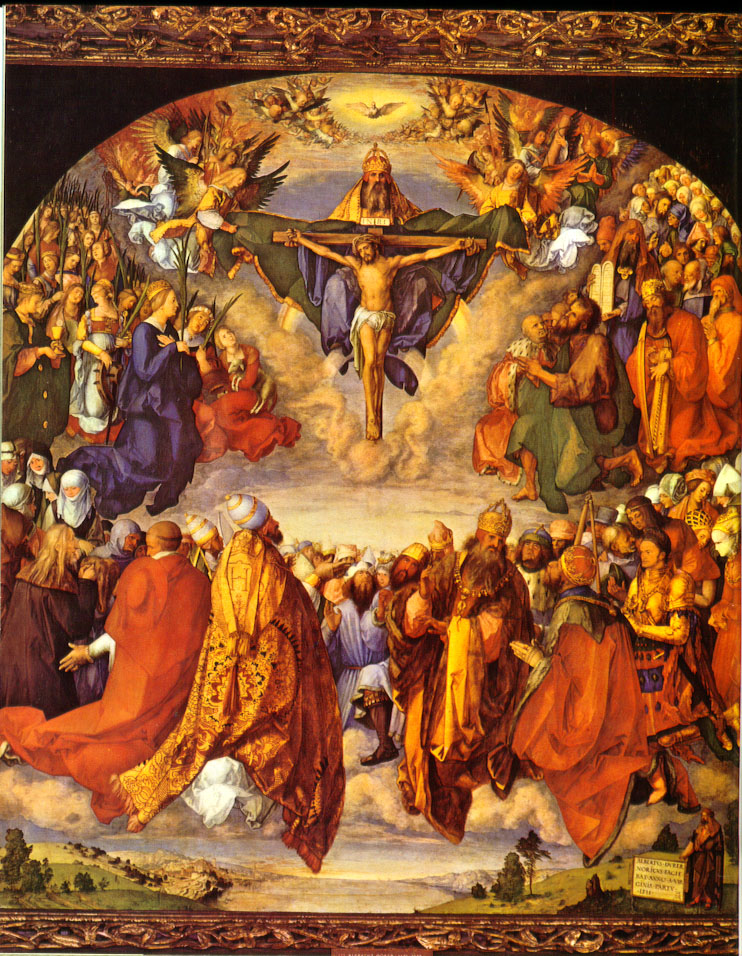
Devotion to the saints should be a consistent part of our life as Catholics. We celebrate the feast of All Saints every year as a holy day of obligation on November 1, reminding us of that great cloud of witnesses, as the letter to the Hebrews puts it, who urge us on in the Christian life. 

The great cloud of witnesses are those who have taken up the Cross of Christ, who have walked by faith with Jesus Christ as their Lord, who now intercede for us from their place in heavenly glory. We are connected, part of a communion of saints, not only with our contemporaries who are alive on earth, but also with the dead, who are alive in heaven.

This doctrine is important, it helps us to know and to seek the assistance of our brothers and sisters. For, the members of the Church on earth are like athletes in a stadium, competing for the gold medal of eternal life, and the saints of heaven are the past gold medal winners who are cheering us on, bringing us a drink of water when we are thirsty through their intercession, and also giving us coaching tips through their example.

This month of August we have already celebrated some real heavy-hitters—powerful saints: August 1, the great Alphonsus Ligouri, moral theologian who taught the Church so much about striving for virtue—the need to strengthen your faith like strengthening your muscles. August 2 celebrated St. Eusebius of Vercelli, a faithful bishop who stood up for the faith when many of his fellow bishops were siding with the heretical Roman emperor.

August 4 was celebration of the patron saint of parish priests, my patron, St. John Vianney, who labored tirelessly for his parishioners in the small French town of Ars, often hearing 12 hours of confessions a day—so many confessions that a train track was laid to travel from Paris to his small French village parish. Please pray to him for me. 

August 8, this week was the feast of St. Dominic who traveled throughout Europe preaching the Gospel in the face of a heresy called Albigensianism, and teaching people how to pray the rosary, which the Blessed Virgin Mary personally gave to him.

August 9 was the feast of St. Theresa Benedicta of the Cross, a jewish philosophy student whose search for truth led her to the Catholic faith, who after joining the Carmelites, was arrested and sent to the gas chamber at Aushwitz.

August 11, my mother’s birthday, was also the feast of St. Clare, who was raised as an Italian noble, but gave up her wealth and her social prospects, and heard the call of St. Francis to a life of total devotion to God, and consecrated herself to a life of adoration of Jesus in the Most Blessed Sacrament 

August 14 is the feast of St. Maximillian Kolbe, a priest who was arrested and sent to the concentration camp at Auschwitz, who traded his life for a jewish prisioner condemned to death.

And that’s just the first half of August. Such a great cloud of witnesses, who teach us to strive after holiness. The Lord in the Gospel says "I have come to set the earth on fire, and how I wish it were already blazing!” Well, the earth is set on fire through saints. The fire of holiness blazes in the hearts of the saints and they spread that fire as the serve the Lord. And God wants that fire to be set ablaze in our hearts. 

The saints I mentioned themselves looked to the great cloud of witnesses who went before the. No doubt, St. Alphonsus looked to the witness of great theologians before him like Augustine and Aquinas. No doubt, St. Eusebius looked to the example of faithful bishops who refused to bow to earthly pressure like Athanasius. No doubt Saint Clare looked to the example of the holy women who gave up earthly riches to follow Christ more deeply like St. Agatha, St. Cecilia, St. Catherine of Alexandria, a philosopher saint who also no doubt inspired St. Theresa Benedicta of the Cross.

If you want to keep your eyes fixed on Jesus, as Hebrews tells us, the saints will help you. I love to preach on the saints throughout the week, and I hope some of you take up the invitation to attend mass on the feasts of the saints, to honor these holy ones—to hear of their example, so they can inspire you and help you.

Now in the Gospel the Lord also speaks of how he has come to cause division—the consequences, even in families, that come from being his follower, the sufferings that we must endure from the hands of sinners, as Hebrews puts it. 

And the saints also know what it’s like to experience the consequences of being a Christian. For opposing the heretical bishops and the heretical emperor, St. Eusebius was arrested, dragged through the streets, and imprisoned. The Albigensians, who were poisoning the minds and souls of good Christians throughout Europe, no doubt drove St. Dominic out of some of their strongholds. St. Clare, experienced, probably not just a little bit of hostility from her own family, when she told them she was going to renounce her wealth and follow a homeless preacher. We certainly know the resistance that St. Theresa Benedicta and St. Maximilian Kolbe suffered, arrested and murdered by Nazis. 

St. John Vianney faced great hostility from the devil himself. The devil set John Vianney’s bed on fire and hurled furniture at him to discourage him. But John Vianney knew, that when the devil started acting up, when those hostilities were the greatest, it was always a sign, that God was about to do something amazing, usually in the form of bringing a soul who had been away from confession for a number of years back to the sacraments. 

God is glorified in his saints and in the sufferings of the saints, and God wants to shine his glory, make his glory known to the world, through us. But we must cooperate with grace. We must strive to develop those virtues, those unused, undeveloped, neglected muscles. We must make time for prayer and study and service. We must confess our sins, seeking to be rid of every sin that clings to us, as Hebrews puts it, and adore the Eucharist, keeping our eyes fixed on Jesus.

But when we do imitate the saints, the Lord begins to shine so brilliantly in our lives, not to mention giving us the strength to endure our hardships and crosses, for the glory of God and salvation of souls.


Sunday, April 3, 2022

Passion Sunday 2022 (EF) - The Eternal High Priest and the gift of Mercy

Today the Church celebrates Passion Sunday, the beginning of the brief liturgical season called in the extraordinary form Passiontide, during which the Church turns all of her attention more explicitly toward the betrayal of the Lord, his sufferings and death. Passiontide helps us to prepare well to enter deeply into the mystery of, and receive more fruitfully than ever before, what the Lord accomplished for us during his passion, death and resurrection. 

Regardless of how the Season of Lent has gone until now — whether it’s been what it should have been, a season of conversion through more intense prayer, fasting, and sacrifice; or whether it’s been a series of missed opportunities — now is the time to focus, to get serious, to reorient priorities to make sure we’re not just bystanders of the sacred mysteries, but active participants, zealous recipients, and passionate sharers of Christ’s saving work.

In the Letter to the Hebrews, we are presented with this image of Our Lord as the Eternal High Priest. The letter contrasts the Lord’s Passion with the sacrifices offered on the Jewish Day of Atonement—Yom Kippur. On Yom Kippur, there were three ritual sacrifices: a bullock that, following the Book of Leviticus (16:15,21-22), the priest offered for his sins; a goat that he offered for the sins of the people; and, following what God dictated in the Book of Numbers (Numbers 19), a red heifer whose blood would be sprinkled in front of the tabernacle area and whose ashes would be placed in a clean place outside the camp. The Jews believed that those sacrifices, whether in the temple or in the desert, were necessary and sufficient for taking away their sins.

And so the Epistle to the Hebrews helps us to appreciate what the Lord accomplished as our high priest: he made forgiveness of sins possible for us by becoming not only our high priest but making himself the victim, the sacrifice, by whose blood achieve eternal redemption.

The Letter also makes clear what our response has to be: the High Priest and Saving Victim has cleansed us from dead works that we might use our freedom to “worship the living God.” And so, as we approach Holy Week, we need to examine whether worship of the living God is really the center of our life or just a part of it.

In the Gospel, the Lord is in contentious dialogue with the scribes, Pharisees, chief priests, and others in the Temple area immediately after saving the life of the woman caught in adultery. In their hardness of hearts they had absolutely refused to acknowledge the mission of the Savior; as a result, they schemed in a thousand ways to oppose His teachings and to belittle Him before the people by declaring Him a liar and one possessed by the devil. Their animosity had increased to the point where they decided to stone Him.

But in the face of such hostility, the Lord exhibits zeal for their souls, meekness, and total abandonment to God; he seeks to enlighten their minds, attempting to drawn them away from error. We are certainly challenged to consider any hostility within us toward the conversion, purification and enlightenment the Lord desires for us, and seek to imitate his composure, his patience, his love, his conviction. We seek his mercy for squandering the time we’ve been given and allowing selfishness to continue to reign in our minds, hearts, and wills.

Nine years ago, Pope Francis preached his first Sunday mass as Pope, in which was read the Gospel of the woman caught in adultery, but his words are relevant to us as well. After explaining how the woman caught in adultery encountered the mercy of God,  the Holy Father stressed “God never tires of forgiving us…it’s we who tire of asking for forgiveness.” Then he prayed, “May we never tire of asking for what God never tires to give!”

Next week, on Palm Sunday, we will hear the Lord’s Passion, how the High Priest goes to the cross that each of us may be forgiven, over and over, if need be. All we have to do is repent, confess our sins, intend to sin no more, put forth some effort in amending our lives.

“May we never tire of asking for what God never tires to give!” for the glory of God and salvation of souls

- - - - - - - 

 A reading from the Epistle to the Hebrews

Brethren: But when Christ came as high priest of the good things that have come to be, passing through the greater and more perfect tabernacle not made by hands, that is, not belonging to this creation, he entered once for all into the sanctuary, not with the blood of goats and calves but with his own blood, thus obtaining eternal redemption. For if the blood of goats and bulls and the sprinkling of a heifer’s ashes can sanctify those who are defiled so that their flesh is cleansed, how much more will the blood of Christ, who through the eternal spirit offered himself unblemished to God, cleanse our consciences from dead works to worship the living God. For this reason he is mediator of a new covenant: since a death has taken place for deliverance from transgressions under the first covenant, those who are called may receive the promised eternal inheritance.

The continuation of the Gospel according to St. John

At that time Jesus said to the multitudes of the Jews:Can any of you charge me with sin? If I am telling the truth, why do you not believe me? Whoever belongs to God hears the words of God; for this reason you do not listen, because you do not belong to God.” The Jews answered and said to him, “Are we not right in saying that you are a Samaritan and are possessed?” Jesus answered, “I am not possessed; I honor my Father, but you dishonor me. I do not seek my own glory; there is one who seeks it and he is the one who judges. Amen, amen, I say to you, whoever keeps my word will never see death.” [So] the Jews said to him, “Now we are sure that you are possessed. Abraham died, as did the prophets, yet you say, ‘Whoever keeps my word will never taste death.’ Are you greater than our father Abraham, who died? Or the prophets, who died? Who do you make yourself out to be?” Jesus answered, “If I glorify myself, my glory is worth nothing; but it is my Father who glorifies me, of whom you say, ‘He is our God.’ You do not know him, but I know him. And if I should say that I do not know him, I would be like you a liar. But I do know him and I keep his word. Abraham your father rejoiced to see my day; he saw it and was glad. So the Jews said to him, “You are not yet fifty years old and you have seen Abraham?” Jesus said to them, “Amen, amen, I say to you, before Abraham came to be, I AM.” So they picked up stones to throw at him; but Jesus hid and went out of the temple area.

Monday, February 15, 2021

6th Week in OT 2021 - Monday - The wholehearted sacrifice

 Over the past few weeks in RCIA, I’ve been offering catechesis to our catechumens on the Sacraments. We start with baptism, of course, the doorway to the sacraments, and make our way to the culmination of the sacramental life of the church, the source and summit of the Church’s life, the Eucharist. 

And I begin the session on the Eucharist examining the notion of sacrifice in the scriptures—sacrificial offerings made to God, for the Eucharist, of course, is the sacrifice the Son makes to the Father of his flesh and blood and life for the sake of the world. 

This morning we read from the book of Genesis the first depiction of sacrifice in scripture: Cain brought an offering to the LORD from the fruit of the soil, while Abel, for his part, brought one of the best firstlings of his flock.

Both of the sons of Adam and Eve offered sacrifice to God—they made sacrifice offerings from the fruit of their work. Both had no doubt worked hard for the fruits of their labors—by the sweat of their brows they shall obtain fruit. And even though, but were born with the effects of the sins of their parents, both still had this urge to make sacrificial offering to God. 

And yet, God smiled upon Abel’s sacrifice, where upon Cain’s he did not. Why? Well, we read Abel, brought the best of his flock. Cain, by contrast, did not; he gave God the leftovers. The Letter to the Hebrews explains  “By faith Abel offered God a sacrifice greater than Cain’s.”  Abel’s sacrifice was filled with faith and love, Cain’s was lacking. 

Perhaps Cain offered the sacrifice half-heartedly.  This makes us think, perhaps, of the widow in the Gospel, praised by the Lord, who offers not her leftovers, but from her sustenance. 

Perhaps Cain loved the fruits of his labor more than God—loving what is seen more than He who is unseen. Perhaps he wanted to get the sacrifice over as soon as possible so he could go back to worldly pursuits--like the person who wants Mass t
o be over as soon as possible so they can go back to playing Candy Crush on their iPhones—or back to his resentful musings which led to his brother’s murder.

Perhaps, he only offered the sacrifice in order to get something out of it.  Kind of like the followers of the so-called Prosperity Gospel today, who come to Christ because they believe God will make them prosperous and wealthy in this life on earth.  

On the Cross, and therefore, in the Eucharist, the Lord Jesus offers the perfect sacrifice, the wholehearted sacrifice, the sacrifice of his very self to the honor and glory of his father and for the highest good of others, greater even than the favored sacrifice of Abel. Again from Hebrews: “You have drawn near…to Jesus…and to the sprinkled blood which speaks more eloquently than that of Abel.”

In the Eucharist we draw near to the perfect sacrifice, we receive it, that we may become what we receive, that we may give the wholehearted, unselfish, sacrifice of our lives for the glory of God and salvation of souls.

- - - - - - -  

That all members of the Church will discover and offer their gifts wholeheartedly in service of the Gospel. 

For an increase in vocations to the priesthood and religious life, that young people may live in faith-filled homes where the Gospel is cherished, studied, and lived-out.

For the grace to set good Christian example, and to courage to share the faith with non-believers and the lapsed.

On this President’s Day, Assist with your spirit of counsel and fortitude the President of these United States, Joseph Biden, that his administration may be conducted in righteousness, and be eminently useful to your people over whom he presides. May he encourage due respect for virtue and religion. May he execute the laws with justice and mercy. May he seek to restrain crime, vice, and immorality.

For all of the sick and suffering, for the grace to unite their sufferings with Christ and to know His consolation and peace.

For our departed loved ones and all of the souls in purgatory, and for N. for whom this Mass is offered. We pray to the Lord.

Incline your merciful ear to our prayers, we ask, O Lord, and listen in kindness to the supplications of those who call on you. Through Christ our Lord


Wednesday, February 3, 2021

4th Week of Ordinary Time 2021 - Wednesday - Bonum Diffusivum Sui


There is an medieval latin aphorism:  bonum diffusivum sui, goodness spreads out from itself. A saint for example, spreads the goodness of God. The light of Christ, like that which we celebrated at Candlemas, yesterday, isn’t to be hidden under a bushel basket, right, but spreads, as it is lived devoutly and generously. 

This truth can be seen even in the life of the Holy Trinity. God is perfect, perfect goodness, perfect joy, and yet, he chooses to bring creation into being, and share that goodness, and life and joy with his creatures, particularly mankind made in his image.

We are happiest and most fulfilled in life when we are engaging in acts of goodness because that’s what we’re made for, not for selfish self-centeredness, but selfless self-giving, even self-sacrifice.

It is true that bonum diffusivum sui, but, in our first reading today, we also find that goodness’s opposite also spreads. “See to it that no one be deprived of the grace of God, that no bitter root spring up and cause trouble, through which many may become defiled.” In other words, the bad apple can spoil the bunch. Selfishness, sin, the deprivation of grace, can also spread and defile and spoil the bunch.

We have to be very careful when we are in the presence of a gossip, for example, that we aren’t drawn into their habit of gossiping. We have to be very careful when we are in the presence of drunkards and gluttons, that we don’t begin to mimic their behavior. 

Of course, we are all sinners, and have the potential to set bad example for each other, from time to time. And yes, we need to be out in the world of sinners spreading the Gospel and doing our best to set good example for each other and non-believers. But we also have to be very careful that we don’t begin to assume to errors and sinful lifestyles of the world.

Discipline, is needed. “Do not disdain the discipline of the Lord”, we hear today. Endure your trials as “discipline”; discipline seems a cause not for joy but for pain, yet later it brings the peaceful fruit of righteousness to those who are trained by it.

In two weeks, we’ll be beginning once again the great season of Lent, a time of discipline. We do well to identify those parts of our lives that do need to be brought under the Lord’s dominion once again, for God’s Word promises the peaceful fruit of righteousness, to those who endure their trials. 

The disciplined soul, therefore, becomes a tree for others, a fountain, a spring for the refreshment of others, and instrument which draws others to the grace of Christ, for the glory of God and salvation of souls.

- - - - - - -  

For a deeper openness to God’s will, readiness for service, attentiveness to those in need, endurance to do the will of God, and peace in our world and our hearts.  Let us pray to the Lord.


During this Catholic Schools week, for all young people, for their teachers and catechists and parents who are the first teachers of the faith, and that the truth of the faith may be learned, cherished, and practiced in every Catholic school and Christian home.


For the discipline necessary to resist temptation and to build virtue. 


For those who struggle because of addiction, discouragement, mental illness, chronic sickness, unemployment, or ongoing trials of any kind:  that the new wine of God’s grace through Christ will bring them consolation and peace.


For the repose of the souls of our beloved dead, For the deceased members of our family, friends, and parish, for the souls in purgatory and for…N. for whom this mass is offered.


O God, our refuge and our strength, hear the prayers of your Church, for you yourself are the source of all devotion, and grant, we pray, that what we ask in faith we may truly obtain. Through Christ our Lord.


Friday, January 29, 2021

3rd Week of Ordinary Time 2021 - Friday - Endurance to do the will of God

 Since Monday of the first week of Ordinary Time our first reading from daily mass has been from the letter to the Hebrews, and we’ll continue to hear from it until the Saturday before Ash Wednesday.    In the New Testament you can find the Letter to the Hebrews immediately after the thirteen Pauline letters.  No one but God knows who wrote this letter.  A passing reference to Saint Timothy seems to suggest that it was written by someone in the circle of Saint Paul and his assistants, but it’s authorship is ultimately unknown.

It seems to be addressed to a group of Jewish Christians who were undergoing persecution for their new faith, but we do not know where this group of Jewish Christians lived; it could have been Rome, Jerusalem, Ephesus, Alexandria, Antioch, we don't know.  

What we do know, as is evidenced in today’s reading, is that these Jewish Christians had and were continuing to face ongoing persecution. And so today's reading is urging them not to give up faith. Don’t draw back from Christ, don’t give up the faith, “for those who keep faith will possess life”. 

Hebrews also gives some very good advice for all of us, who aren’t necessarily being openly persecuted, but those who strive to do the will of God, which isn't always easy--perhaps to keep a commitment to praying daily, or fasting more. “You need endurance to do the will of God”. 

Yes, in our weakness we need to learn to rely on God’s grace. But real spiritual growth, real effectiveness in ministry, requires something on our part. Endurance. How can the Christian keep on going amidst spiritual difficulties, how does one hang in there once the initial enthusiasm is gone? Endurance.

When the going starts to get tough in the vineyard of the Lord, what can we do to boost our Christian endurance? A number of things. Firstly, call to mind scriptures like this, remind yourself, that God never promised that things wouldn’t get tough, and that endurance can carry us far. Secondly, call to mind why you’re doing what you’re doing in the first place. I’m going to pray because I want to seek the Lord, I want to know the Lord, I want to encounter the Lord, I want to grow in holiness. Thirdly, call to mind the example of the Lord’s own endurance, particularly on his way to Calvary, carrying the cross, amidst the mockery and harassment of the onlookers. Consider how even the Lord himself must have drawn refreshment by meeting his mother on the via crucis. Fourthly, ask for help. God sustain me. God help me. God carry me over this slump, help me to remain faithful to my commitments. When we do so, God causes the mustard seed of our human endurance put forth large sturdy branches that even others will benefit from.

Paul writes, “Endurance produces proven character, and proven character produces hope. And hope does not disappoint.” 

In our spiritual lives and in our holy labors may we practice the Christian endurance that deepens our hope and spreads hope to others unto eternal life, for the glory of God and salvation of souls.

- - - - - - -   


For a deeper openness to God’s will, readiness for service, attentiveness to those in need, endurance to do the will of God, and peace in our world and our hearts.  Let us pray to the Lord.


For a new springtime of justice: that all people of good will may work together against the increasing threats to civility, religious liberty and human life.  Let us pray to the Lord.


For those who struggle because of addiction, discouragement, mental illness, chronic sickness, unemployment, or ongoing trials of any kind:  that the new wine of God’s grace through Christ will bring them consolation and peace.


For the repose of the souls of our beloved dead, For the deceased members of our family, friends, and parish, for the souls in purgatory and for…N. for whom this mass is offered.


O God, our refuge and our strength, hear the prayers of your Church, for you yourself are the source of all devotion, and grant, we pray, that what we ask in faith we may truly obtain. Through Christ our Lord.


Tuesday, January 19, 2021

2nd Week in Ordinary Time - Tuesday - The Remedy for Discouragement


In my Sunday homily, I reflected a bit about discouragement. Discouragement, that feeling that my hard work is wasted, that the forces of evil are too great, can be paralyzing.  Injustice, the injustice experienced by those who love God and wish to serve God, and are hated for it, and persecuted for it, can be a terrible source of discouragement. 

The opening line from our reading from the letter to the Hebrews today offers an important remedy for discouragement. “God is not unjust so as to overlook your work and the love you have demonstrated for his name by having served and continuing to serve the holy ones.”

The author of the Hebrews epistle is writing to a group of converts from Judaism who have already begun to experience some serious resistance in their living our the Christian faith; and yet, for now, their faith has endured, they’ve resisted faithfully writes the author, “to the point of shedding their blood” for the Gospel. But knowing that the long, drawn-out hostility from the world, can wear on the strongest Christian soul, so he writes this letter to embolden, and encourage.

And he writes today, God does not overlook your work, your sufferings, your labors. God sees it, and will reward it. Likely, not in this life. But certainly in eternity, we merit a greater share in heavenly reward, through our service to God. The soul that suffers much and endures much and serves much and demonstrated much love shall be rewarded much in heaven.


In times of discouragement, the promise of heavenly reward, helps to fend off the sluggishness and inactivity that can begin to creep in when we face resistance.

Sometimes the forces that oppose us are so great, it is like we are being tossed about like a small ship on the waves of a terrible sea, and so the Hebrews author evokes that powerful symbol of the anchor. “This we have as an anchor of the soul, sure and firm, which reaches into the interior behind the veil.” The anchor are the promises of God. And his promises are not empty. He is no liar. His promise of life and glory is validated by the resurrection of Jesus. He is risen, just as he said he would. 

So, another remedy for discouragement, and really the only remedy, is to keep our eyes fixed on Jesus. Through prayer and service and penance with our eyes and hearts fixed on Him. For, He is the light that shines in the darkness. He is the promiser and the fulfillment of the promise. He is the one who suffers with us and the reward for those who suffer. He is the source of justice, the distributor of justice, he is justice itself. 

May the hope of eternity with Him banish our discouragement and spurn us on to persevere in our holy labors for the glory of God and salvation of souls.

- - - - - - -  

For a deeper openness to God’s will, readiness for service, attentiveness to those in need, and peace in our world and our hearts.  Let us pray to the Lord.


For a new springtime of justice: that all people of good will may work together against the increasing threats to civility, religious liberty and human life.  Let us pray to the Lord.


For those who struggle because of addiction, discouragement, mental illness, chronic sickness, unemployment, or ongoing trials of any kind:  that the new wine of God’s grace through Christ will bring them consolation and peace.


For the repose of the souls of our beloved dead, For the deceased members of our family, friends, and parish, for the souls in purgatory and for…N. for whom this mass is offered.


O God, our refuge and our strength, hear the prayers of your Church, for you yourself are the source of all devotion, and grant, we pray, that what we ask in faith we may truly obtain. Through Christ our Lord.


Monday, June 11, 2018

June 11 2018 - St. Barnabas - Words of Encouragement

Though he was not one of the twelve, the liturgy and tradition gives St. Barnabas the title of Apostle. Barbabas was a levite Jew born in Cyprus. His birth name was Joseph and was changed when he was given a share in the apostolic mission to “Barnabas”. The book of Acts tells us the name Barnabas means “the son of encouragement”

We heard in today’s reading how Barnabas was sent to Antioch and rejoiced and encouraged the Christians there to remain faithful to the Lord and he was filled with the Holy Spirit and faith, and through him a large number of people were added to the Lord. 

After Antioch, Barnabas met up with Paul and accompanied Paul on his first missionary journey, through very dangerous territories. After completing the missionary journey, Barnabas and Paul attended the Council of Jerusalem, after which, the scriptures are silent about him.

Some Church writers believe him to be the others of the letter to the Hebrews since he was a levite and the letter to the Hebrews often uses very priestly language. 

Tradition holds that he returned to Cyprus, and was stoned to death while preaching the Gospel on the steps of a Jewish synogogue in the ancient Cyprian city of Salamis. His body was recovered by his cousin St. Mark, and brought to Constantinople, where it is venerated to this day.

Barnabas, the “son of encouragement” is a model for all Christians. We are all to be about the business of encouragement. We are to encourage our fellow Christians to remain faithful to the Gospel, to live more fully for the Gospel. 

“But encourage one another daily…so that none of you may be hardened by sin’s deceitfulness,” those words from the letter to the Hebrews, as I mentioned, were perhaps written by the “son of encouragement”, St. Barnabas himself. Paul writes, “Therefore encourage one another and build each other up.”

Through the encouragement of Barnabas, the apostle Paul was first accepted by the church in Jerusalem (Acts 9:27). Through the encouragement of Barnabas, Mark was given a second chance after an abject failure (Acts 13:13; 15:39).

Mutual encouragement is essential to Gospel living, for as Jesus himself in the Gospels says, “In this world you will have trouble. But take heart! I have overcome the world” Being a Christian in this fallen world is difficult business. The world hates us, temptation seeks to overcome us, perseverance is difficult, and we are caught in the crosshairs of spiritual battle.

Whether you have the highest ecclesiastical office, newly baptized, a widow, spouse, or single person, we need encouragement, that we may remember that our sufferings for the Gospel are meaningful, that we are not abandoned by God when suffering seems to overwhelm us.

Encouragement helps us through times of discipline and testing (Hebrews 12:5). Encouragement nurtures patience and kindness (see 1 Corinthians 13:4-7 and Galatians 5:22-26). Encouragement makes it easier to sacrifice our own desires for the advancement of God’s kingdom.

To borrow from proverbs, Encouraging words are “a honeycomb, sweet to the soul and healing down to the bone”. May we be sensitive to all those in need of encouragement today, and respond generously to them for the glory of God and salvation of souls.
- - - - - - - -
For all the priests of our diocese who will be changing assignments this week, and for their parishes, that we may all be encouraged for the continuing work of the Gospel.

For those experiencing discouragement or despair, that they may know the goodness and closeness of God through the charity of faithful Christians.

For the unity of the Church, for the conversion of those in error, for those who deny God’s existence or despair of his mercy.

For all the needs of the sick and the suffering, the homebound, those in nursing homes and hospitals, the underemployed and unemployed, immigrants and refugees, victims of natural disaster, war, and terrorism, for all those who grieve the loss of a loved one, and those who will die today, for their comfort, and the consolation of their families.

For all who have died, and for all the poor souls in purgatory, and for X. for whom this Mass is offered.

Incline your merciful ear to our prayers, we ask, O Lord, and listen in kindness to the supplications of those who call on you. Through Christ our Lord