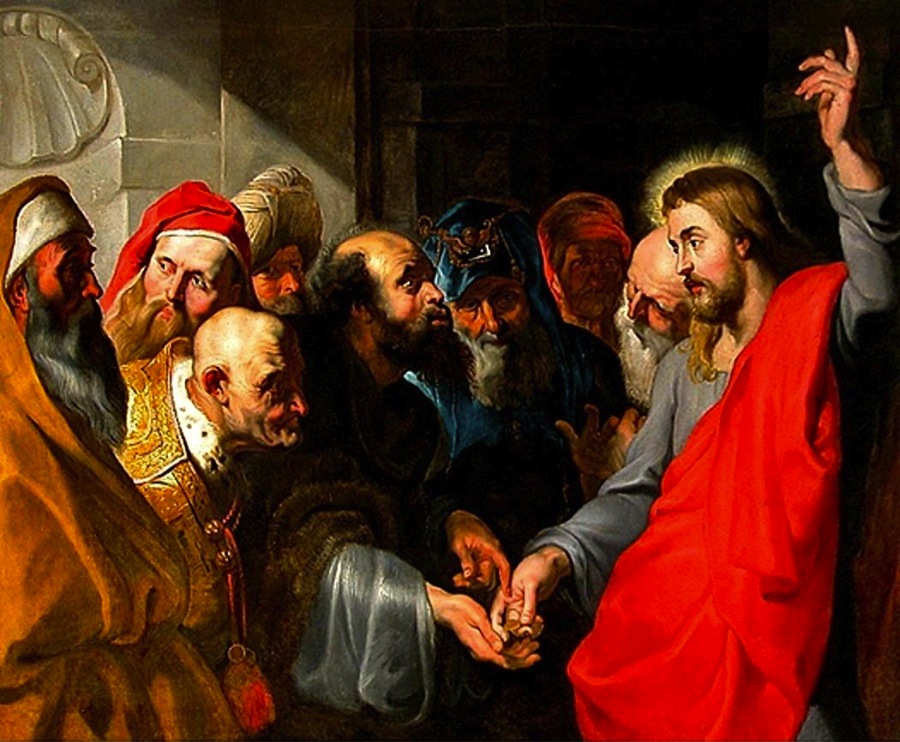
"Render therefore to Caesar the things that are Caesar's, and to God the things that are God's." Today’s Gospel certainly brings to mind the tension of the last month and a half. Can the government tell us we can’t go to Church? Can the government demand we wear masks? Can the government keep us from assembling to protest the infringement of our rights? What is the limit of civil authority? And what is our responsibility to obey legitimate authority?
The Catechism of the Catholic Church helps us to answer some of these questions. The section in the Catechism on the 4th Commandment elaborates on not only the honor we owe father and mother, but also our relationship with civil authorities.
Firstly, it talks what Caesar owes his subjects. “Political authorities are obliged to respect the fundamental rights of the human person.” This is a matter of justice. Caesar must respect our fundamental rights of life, liberty, and the pursuit of happiness. Our Declaration of Independence does a pretty good job at listing some of these rights, identifying that our rights don’t come from the state, but are more fundamental, they come from God.
Then the Catechism goes on to explain the duties of citizens: “Those subject to authority should regard those in authority as representatives of God, who has made them stewards of his gifts: "Be subject for the Lord's sake to every human institution.... Live as free men, yet without using your freedom as a pretext for evil; but live as servants of God." Their loyal collaboration includes the right, and at times the duty, to voice their just criticisms of that which seems harmful to the dignity of persons and to the good of the community.” The Catechism then goes on to explain some of our duties: “Submission to authority and co-responsibility for the common good make it morally obligatory to pay taxes, to exercise the right to vote, and to defend one's country.”
The Catechism does a pretty good job to make clear that yes, we need to collaborate with our authorities, we have a responsibility to the common good, but then Catechism explains the limits of Caesar’s power. Catechism 2242 states: “The citizen is obliged in conscience not to follow the directives of civil authorities when they are contrary to the demands of the moral order, to the fundamental rights of persons or the teachings of the Gospel. Refusing obedience to civil authorities, when their demands are contrary to those of an upright conscience, finds its justification in the distinction between serving God and serving the political community. "Render therefore to Caesar the things that are Caesar's, and to God the things that are God's."
Then quoting the Acts of the Apostles, Catechism states: “We must obey God rather than men" Whenever Caesar hinders our ability to give to God what belongs to God, we must obey God first. That may bring the wrath of Caesar…if Caesar is smart he’ll back down, for in opposing the will of God he brings upon himself God’s wrath.
How do we know what belongs to God? Luckily, we don’t have to figure that out on our own, we have our bishops, we have our scriptures, we have our Catechism, we have our sense of faith nurtured through years of Catholic spiritual formation. We certainly pray for those who have distanced themselves from the font of truth. For to be separated from truth, they cannot hope to respond well to the demands of justice.
Today we honor two saints, the priest Marcellinus and the exorcist, Peter, martyrs mentioned in the first Eucharistic prayer. They were imprisoned and killed for their Christian faith, for obeying God rather than Caesar. May Marcellinus and Peter and all of the martyrs of the One True Church help us to courageously confess Christ in our own day and place, remaining true to Him in word and deed, loving Him with all of our heart, mind, and strength, for the glory of God and salvation of souls.
- - - - - -
That our bishops and all people of faith may remain vigilant in defending their religious liberty and that our President and all government authorities will preserve and protect authentic liberty and justice according to the moral precepts which come from God.
That religious indifference in our country and around the world may be transformed to radical commitment to the Gospel of Christ.
For all the needs of the sick and the suffering, the homebound, those in nursing homes and hospitals, the underemployed and unemployed, victims of natural disaster, war, and terrorism, for all those who grieve the loss of a loved one, and those who will die today, for their comfort, and the consolation of their families.
For the repose of the souls of our beloved dead, for all of the poor souls in purgatory, for the deceased members of our families, friends, and parish, for the deceased priests and religious of the diocese of Cleveland, and for those who have fought and died for our freedom.
Incline your merciful ear to our prayers, we ask, O Lord, and listen in kindness to the supplications of those who call on you. Through Christ our Lord.
Showing posts with label authority. Show all posts
Tuesday, June 2, 2020
Wednesday, July 10, 2019
14th Week in OT 2019 - Wednesday - Power to push back the armies of hell
“Jesus summoned his Twelve disciples and gave them authority”. That word—“authority”—is an important in Matthew’s Gospel.
Jesus is depicted throughout the Gospel having “authority”. His authority over the powers of nature is shown in his many miracles: calming the storm, walking on water. His authority over unclean spirits is seen in his many exorcisms: casting out demons, silencing them. His authority over life and death is seen ultimately in his resurrection.
In Matthew chapter 9, Jesus says that He has “authority on earth to forgive sins”. And in Matthew chapter 28, he says “To me has been given all authority in heaven and on earth”. He has authority because He is the Faithful Son of the Father.
When Jesus gives authority to the twelve, what is he giving them authority to do? To Drive out demons and cure every disease. They are given the authority to do a lot of what Jesus has been doing since he came out of the Desert and began his ministry.
The Greek word, for authority, is εξουσια. It’s a great word in Greek having several connotations. Firstly, εξουσια is the power to act, the freedom to decide, that ability of will to choose. Secondly, it’s the power or ability to complete an action. Thirdly, εξουσια can mean delegated authority, the authorization to do some work. And fourthly, it refers to jurisdiction or sphere of authority.
And Jesus is giving this authority to the apostles in every sense of the word. Free will to do God’s work, the ability to do supernatural tasks, they are delegated by the one who has the divine authority, and their sphere of influence will first be to the surrounding towns and to the lost sheep of Israel, but later, it will be to all nations.
Consider what this power to drive out demons really means. Yes, it’s the power to perform exorcisms. But It’s also power to push back the armies of hell, to reclaim territory formerly claimed by the devil. Think of all the areas of society where evil seems to reign, places where murder, corruption, lust, greed, perversion, selfishness seem to hold sway. The hearts of politicians, the minds of the youth, the dark corridors of the hearts of lost souls. God made flesh has given authority to drive these dark forces back.
It’s the power to bring transformation to the corrupt, to bring healing to the most wounded, to bring about miraculous change and conversion. But, it’s up to us to use the authority given to us by the Lord, to be courageous in facing evil, going to the dark places to bring the light of Christ for the glory of God and salvation of souls.
- - - - - - -
That the Bishops, the successors of the Apostles, may use their authority wisely and courageously in standing against the evils of this world.
For all those under the sway of evil, error, and corruption, for their deliverance by the power of Christ.
For the protection of young people from the corrupting influences of the world, for Christians families, and for the conversion of the faithless.
For the sick, suffering, and sorrowful, for miracles for hopeless causes.
For the souls in purgatory, and for N. for whom this Mass is offered.
O God, our refuge and our strength, hear the prayers of your Church, for you yourself are the source of all devotion, and grant, we pray, that what we ask in faith we may truly obtain. Through Christ our Lord.
Jesus is depicted throughout the Gospel having “authority”. His authority over the powers of nature is shown in his many miracles: calming the storm, walking on water. His authority over unclean spirits is seen in his many exorcisms: casting out demons, silencing them. His authority over life and death is seen ultimately in his resurrection.
In Matthew chapter 9, Jesus says that He has “authority on earth to forgive sins”. And in Matthew chapter 28, he says “To me has been given all authority in heaven and on earth”. He has authority because He is the Faithful Son of the Father.
When Jesus gives authority to the twelve, what is he giving them authority to do? To Drive out demons and cure every disease. They are given the authority to do a lot of what Jesus has been doing since he came out of the Desert and began his ministry.
The Greek word, for authority, is εξουσια. It’s a great word in Greek having several connotations. Firstly, εξουσια is the power to act, the freedom to decide, that ability of will to choose. Secondly, it’s the power or ability to complete an action. Thirdly, εξουσια can mean delegated authority, the authorization to do some work. And fourthly, it refers to jurisdiction or sphere of authority.
And Jesus is giving this authority to the apostles in every sense of the word. Free will to do God’s work, the ability to do supernatural tasks, they are delegated by the one who has the divine authority, and their sphere of influence will first be to the surrounding towns and to the lost sheep of Israel, but later, it will be to all nations.
Consider what this power to drive out demons really means. Yes, it’s the power to perform exorcisms. But It’s also power to push back the armies of hell, to reclaim territory formerly claimed by the devil. Think of all the areas of society where evil seems to reign, places where murder, corruption, lust, greed, perversion, selfishness seem to hold sway. The hearts of politicians, the minds of the youth, the dark corridors of the hearts of lost souls. God made flesh has given authority to drive these dark forces back.
It’s the power to bring transformation to the corrupt, to bring healing to the most wounded, to bring about miraculous change and conversion. But, it’s up to us to use the authority given to us by the Lord, to be courageous in facing evil, going to the dark places to bring the light of Christ for the glory of God and salvation of souls.
- - - - - - -
That the Bishops, the successors of the Apostles, may use their authority wisely and courageously in standing against the evils of this world.
For all those under the sway of evil, error, and corruption, for their deliverance by the power of Christ.
For the protection of young people from the corrupting influences of the world, for Christians families, and for the conversion of the faithless.
For the sick, suffering, and sorrowful, for miracles for hopeless causes.
For the souls in purgatory, and for N. for whom this Mass is offered.
O God, our refuge and our strength, hear the prayers of your Church, for you yourself are the source of all devotion, and grant, we pray, that what we ask in faith we may truly obtain. Through Christ our Lord.
Sunday, January 20, 2019
2nd Sunday in OT 2019 - Buddhist Detachment & Christian Morality
I was watching a documentary last night that contained an old Buddhist story, I think you might like. There was an old farmer who had a prized horse. And one day the horse ran away. And the farmer’s neighbor comes over to commiserate—to offer his condolences. He says, “I’m so sorry. I heard about your horse.” And the old farmer says, “who knows what is good or bad?” And the neighbor is confused because this is the farmer’s prized horse, after all. So the neighbor bids his farewell. Well the next day, the horse returns and he brings with him 12 wild horses from the countryside. Now the farmer is rich in horses. And the neighbor comes over and says, “Congratulations, you have all these horses.” And the old farmer says, “Who knows what’s good or bad?” And the neighbor is confused again. And then the next day the old farmer’s son is taming one of the horses and is thrown off the horse and breaks his leg. And the neighbor comes over again to commiserate, and the farmer says, “who knows what’s good or what’s bad”. And then the next day the army comes through the countryside and they are conscripting able-bodied young men to go off and fight in the war, and the farmer’s son is spared. And this story can go on and on and on.
Though this is a Buddhist story, there is some Christian truth. The Christian is to be detached
in a sense. We don’t know what the events of our life will hold. As they say, when God closes a door he opens a window. Being fired from one’s job, for example, might open up a new opportunity that is in the end more lucrative or more meaningful and fulfilling. The Christian martyrs, like our own St. Ignatius, they saw meaning behind what most people would consider evil: their suffering. St. Ignatius even told the Christians of Antioch not to try to rescue him from being brought to Rome for his martyrdom, so confident was he, that God could bring about something good through his suffering, just as God brought about the greatest good through the greatest suffering, our human salvation through the suffering and death of Jesus.
So, like the old farmer, Christians are called to practice a certain level of detachment. We aren’t to curse God when things don’t go our way. We are to trust God’s providence. Like Old Job would say, “the Lord giveth, the Lord taketh away, blessed be the name of the Lord.”
The Buddhist story however seems to only give insight into the events that happen around us. What it doesn’t address is human choice, human free will, that choices that I make. “Who knows what’s good or bad” applies to the events that happen to us and around us. The farmer had no choice that his horse ran away—so who knows if it was good or bad. However, the choices that we make, the exercise of free-will, that’s different. The Judeo-Christian tradition, our scriptures, the teachings of our Lord and the theologians are very clear that choices are either good or bad, and we can know the difference.
Some choices are so clearly in violation of the natural moral law, they are called objectively evil, objectively sinful: it doesn’t matter who does them, or the circumstance, they are always evil. One example, is the intentional destruction of innocent human life in the womb. And thousands and thousands and thousands of Christians and people of good-will marched upon our nation’s capital on Friday to bring an end to this national tragedy—this embarrassment to history--the legal allowance to murder unborn babies because they are unwanted by their parents. Christians are called to be the moral conscience of a place.
So some choices are clearly wrong. Sometimes it’s not always easy to know what is right or wrong. So God has given us through the Scriptures and through the teaching of his own lips, clear moral teaching. The 10 commandments, the sermon on the mount help to illuminate for us the right way to live, the way that leads to the flourishing of the human soul, the way that leads to everlasting life.
Our Gospel today contains some very important moral teaching from the lips of our blessed mother. Mary doesn't speak often in the Sacred Scriptures, but every time she does speak her words overflow with wisdom: "Do whatever he tells you." That is what is good, always. The teachings and commandments of Christ are always good. They aren’t always easy, but they are always good.
In the case of the wedding at Cana, the command was to bring Jesus jars of water, a strange request. But, when happened when the stewards were faithful to the command of Christ: goodness and power and glory were manifest.
“Do whatever he tells you” means that we can have unbounded confidence in Jesus. His teachings flow from a heart full of goodness, mercy, and love that understands humanity better than we understand ourselves. He wants what is best for us——he came to reconcile sinful man with God, to save sinful man from error and death. And when you trust him he will lead you to all truth. The compelling thing about Christian truth, besides the fact it comes from God himself, is that it is logically consistent, it holds up to greatest rational scrutiny. It is truly Catholic—universally intelligible to all people of all places of all times.
So we trust in Christ and those who he has established to speak and teach in his name. We are to have unbounded confidence in Him and in the teachings of His Church. For he himself said, “he who hears you” speaking to the Apostles, “hears me”. And “he who rejects you rejects Me.” He’s given His authority to the church in matters of faith and morality. And so when the Church clearly teaches that a particular human action is a sin, we trust that teaching and adapt our lives accordingly.
The true test of our confidence in God's goodness and power is our obedience to his will. To “do whatever he tells us”. And what does he tell us? To feed the hungry, to clothe the naked, to carry our crosses, to love our enemies, to forgive unreservedly, to build our lives and families on the solid foundation of his teaching, to believe in all the all the truths which the holy Catholic Church teaches, because God has revealed them, who can neither deceive nor be deceived.
Believing in good and bad is becoming increasingly unpopular. Naming actions as good or bad is labeled as intolerant or bigoted. But our Gospel today shows us, that when we say yes to Jesus, as incomprehensible as that is to the world, bringing 80 gallons of water to be changed into wine, when we say yes, to whatever he tells us, he does something amazing, something that reveals the goodness and power and glory of God that leads hearts to salvation through belief in Him.
May we be faithful to all the Lord and His Holy Church teaches and commands, may we do “whatever he tells us” for the glory of God and salvation of souls.
Though this is a Buddhist story, there is some Christian truth. The Christian is to be detached
in a sense. We don’t know what the events of our life will hold. As they say, when God closes a door he opens a window. Being fired from one’s job, for example, might open up a new opportunity that is in the end more lucrative or more meaningful and fulfilling. The Christian martyrs, like our own St. Ignatius, they saw meaning behind what most people would consider evil: their suffering. St. Ignatius even told the Christians of Antioch not to try to rescue him from being brought to Rome for his martyrdom, so confident was he, that God could bring about something good through his suffering, just as God brought about the greatest good through the greatest suffering, our human salvation through the suffering and death of Jesus.
So, like the old farmer, Christians are called to practice a certain level of detachment. We aren’t to curse God when things don’t go our way. We are to trust God’s providence. Like Old Job would say, “the Lord giveth, the Lord taketh away, blessed be the name of the Lord.”
The Buddhist story however seems to only give insight into the events that happen around us. What it doesn’t address is human choice, human free will, that choices that I make. “Who knows what’s good or bad” applies to the events that happen to us and around us. The farmer had no choice that his horse ran away—so who knows if it was good or bad. However, the choices that we make, the exercise of free-will, that’s different. The Judeo-Christian tradition, our scriptures, the teachings of our Lord and the theologians are very clear that choices are either good or bad, and we can know the difference.
Some choices are so clearly in violation of the natural moral law, they are called objectively evil, objectively sinful: it doesn’t matter who does them, or the circumstance, they are always evil. One example, is the intentional destruction of innocent human life in the womb. And thousands and thousands and thousands of Christians and people of good-will marched upon our nation’s capital on Friday to bring an end to this national tragedy—this embarrassment to history--the legal allowance to murder unborn babies because they are unwanted by their parents. Christians are called to be the moral conscience of a place.
So some choices are clearly wrong. Sometimes it’s not always easy to know what is right or wrong. So God has given us through the Scriptures and through the teaching of his own lips, clear moral teaching. The 10 commandments, the sermon on the mount help to illuminate for us the right way to live, the way that leads to the flourishing of the human soul, the way that leads to everlasting life.
Our Gospel today contains some very important moral teaching from the lips of our blessed mother. Mary doesn't speak often in the Sacred Scriptures, but every time she does speak her words overflow with wisdom: "Do whatever he tells you." That is what is good, always. The teachings and commandments of Christ are always good. They aren’t always easy, but they are always good.
In the case of the wedding at Cana, the command was to bring Jesus jars of water, a strange request. But, when happened when the stewards were faithful to the command of Christ: goodness and power and glory were manifest.
“Do whatever he tells you” means that we can have unbounded confidence in Jesus. His teachings flow from a heart full of goodness, mercy, and love that understands humanity better than we understand ourselves. He wants what is best for us——he came to reconcile sinful man with God, to save sinful man from error and death. And when you trust him he will lead you to all truth. The compelling thing about Christian truth, besides the fact it comes from God himself, is that it is logically consistent, it holds up to greatest rational scrutiny. It is truly Catholic—universally intelligible to all people of all places of all times.
So we trust in Christ and those who he has established to speak and teach in his name. We are to have unbounded confidence in Him and in the teachings of His Church. For he himself said, “he who hears you” speaking to the Apostles, “hears me”. And “he who rejects you rejects Me.” He’s given His authority to the church in matters of faith and morality. And so when the Church clearly teaches that a particular human action is a sin, we trust that teaching and adapt our lives accordingly.
The true test of our confidence in God's goodness and power is our obedience to his will. To “do whatever he tells us”. And what does he tell us? To feed the hungry, to clothe the naked, to carry our crosses, to love our enemies, to forgive unreservedly, to build our lives and families on the solid foundation of his teaching, to believe in all the all the truths which the holy Catholic Church teaches, because God has revealed them, who can neither deceive nor be deceived.
Believing in good and bad is becoming increasingly unpopular. Naming actions as good or bad is labeled as intolerant or bigoted. But our Gospel today shows us, that when we say yes to Jesus, as incomprehensible as that is to the world, bringing 80 gallons of water to be changed into wine, when we say yes, to whatever he tells us, he does something amazing, something that reveals the goodness and power and glory of God that leads hearts to salvation through belief in Him.
May we be faithful to all the Lord and His Holy Church teaches and commands, may we do “whatever he tells us” for the glory of God and salvation of souls.
Subscribe to:
Posts (Atom)


