Showing posts with label faithful citizenship. Show all posts

Tuesday, June 2, 2020

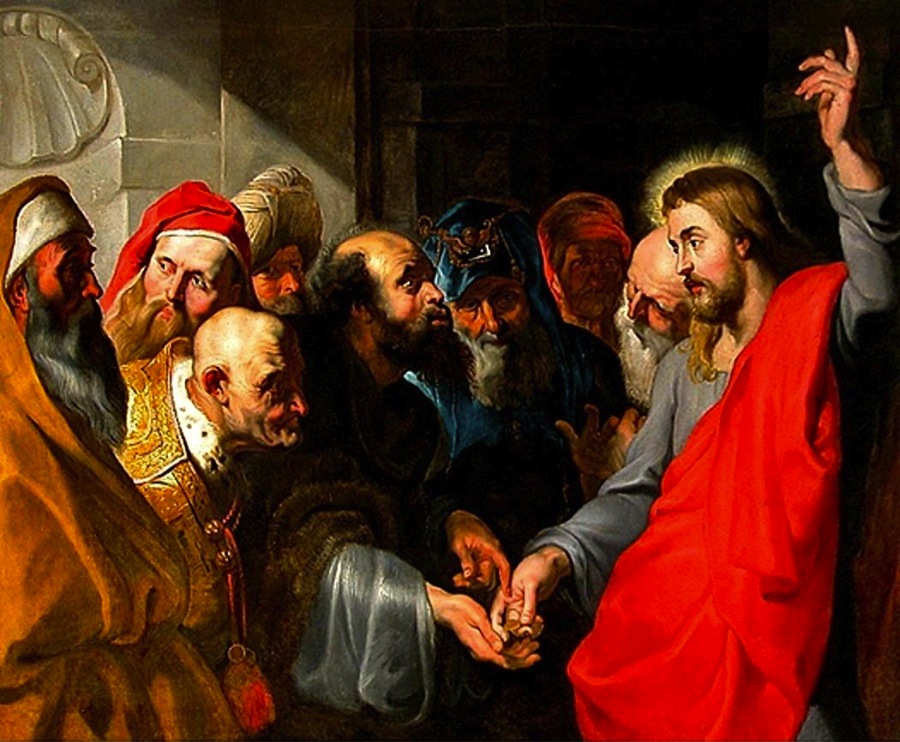
9th Week of OT 2020 - Tuesday - What belongs to Caesar?

"Render therefore to Caesar the things that are Caesar's, and to God the things that are God's." Today’s Gospel certainly brings to mind the tension of the last month and a half. Can the government tell us we can’t go to Church? Can the government demand we wear masks? Can the government keep us from assembling to protest the infringement of our rights? What is the limit of civil authority? And what is our responsibility to obey legitimate authority?

The Catechism of the Catholic Church helps us to answer some of these questions. The section in the Catechism on the 4th Commandment elaborates on not only the honor we owe  father and mother, but also our relationship with civil authorities.

Firstly, it talks what Caesar owes his subjects. “Political authorities are obliged to respect the fundamental rights of the human person.” This is a matter of justice. Caesar must respect our fundamental rights of life, liberty, and the pursuit of happiness. Our Declaration of Independence does a pretty good job at listing some of these rights, identifying that our rights don’t come from the state, but are more fundamental, they come from God.

Then the Catechism goes on to explain the duties of citizens: “Those subject to authority should regard those in authority as representatives of God, who has made them stewards of his gifts: "Be subject for the Lord's sake to every human institution.... Live as free men, yet without using your freedom as a pretext for evil; but live as servants of God." Their loyal collaboration includes the right, and at times the duty, to voice their just criticisms of that which seems harmful to the dignity of persons and to the good of the community.” The Catechism then goes on to explain some of our duties: “Submission to authority and co-responsibility for the common good make it morally obligatory to pay taxes, to exercise the right to vote, and to defend one's country.”

The Catechism does a pretty good job to make clear that yes, we need to collaborate with our authorities, we have a responsibility to the common good, but then Catechism explains the limits of Caesar’s power. Catechism 2242 states: “The citizen is obliged in conscience not to follow the directives of civil authorities when they are contrary to the demands of the moral order, to the fundamental rights of persons or the teachings of the Gospel. Refusing obedience to civil authorities, when their demands are contrary to those of an upright conscience, finds its justification in the distinction between serving God and serving the political community. "Render therefore to Caesar the things that are Caesar's, and to God the things that are God's."

Then quoting the Acts of the Apostles, Catechism states: “We must obey God rather than men" Whenever Caesar hinders our ability to give to God what belongs to God, we must obey God first. That may bring the wrath of Caesar…if Caesar is smart he’ll back down, for in opposing the will of God he brings upon himself God’s wrath.

How do we know what belongs to God? Luckily, we don’t have to figure that out on our own, we have our bishops, we have our scriptures, we have our Catechism, we have our sense of faith nurtured through years of Catholic spiritual formation. We certainly pray for those who have distanced themselves from the font of truth. For to be separated from truth, they cannot hope to respond well to the demands of justice.

Today we honor two saints, the priest Marcellinus and the exorcist, Peter, martyrs mentioned in the first Eucharistic prayer. They were imprisoned and killed for their Christian faith, for obeying God rather than Caesar. May Marcellinus and Peter and all of the martyrs of the One True Church help us to courageously confess Christ in our own day and place, remaining true to Him in word and deed, loving Him with all of our heart, mind, and strength, for the glory of God and salvation of souls.

- - - - - -

That our bishops and all people of faith may remain vigilant in defending their religious liberty and that our President and all government authorities will preserve and protect authentic liberty and justice according to the moral precepts which come from God.

That religious indifference in our country and around the world may be transformed to radical commitment to the Gospel of Christ.

For all the needs of the sick and the suffering, the homebound, those in nursing homes and hospitals, the underemployed and unemployed, victims of natural disaster, war, and terrorism, for all those who grieve the loss of a loved one, and those who will die today, for their comfort, and the consolation of their families.

For the repose of the souls of our beloved dead, for all of the poor souls in purgatory, for the deceased members of our families, friends, and parish, for the deceased priests and religious of the diocese of Cleveland, and for those who have fought and died for our freedom.

Incline your merciful ear to our prayers, we ask, O Lord, and listen in kindness to the supplications of those who call on you. Through Christ our Lord.

Sunday, November 6, 2016

Homily: 32nd Sunday in OT 2016 - Principles for voting


How often at work or with friends or in family gathers, when the topics of politics or religion come up, nostrils flare, or an awkward nervousness surrounds the conversation? This happens so much that people say that the two things you aren’t supposed to talk about are politics and religion. Priests even hear this. Father, don’t talk about politics, the church as no business in politics.

How sad it is, that to remain civil with each other, we have to ignore the two things that are supposed to help keep civil. For religion helps us to be civil and respectful, gentle, patient, and kind. And, politics, at its best, is help us bring about civil order, fostering an environment of civility for discussion and working for peace and justice.

Since this Tuesday is election day, here are a few principles to keep in mind as you prepare for the moral choice of voting, and hopefully we don’t have too many flared nostrils or awkward feelings.
Number 1: The Church, herself, as an institution, is not a political organism. Meaning, it is not the job of the Church as an institution to run governments. It’s not the job of the Church to sponsor or endorse a particular candidate, but it is very much the job of the Church to guide her members to think and act in accord with the faith we profess.

So the Church, rightfully speaks about “the duty of politicians” and  “the duty of voters”  to help political leaders and voters act in accordance with the moral law.

Number 2: ‘Catholic’ is a word that has real meaning. We cannot simply pick and choose the teachings of the Church that we like and just follow those and ignore the others, especially for the purpose of political expediency. As Catholics, we are baptized into the Body of Christ, the Church; we inherit our Catholicity by receiving the entire moral and divine law of God. We cannot truthfully call ourselves Catholic, and act opposite of that, saying, “well, I’m just Catholic in some areas of life.” To be Catholic is to accept it all. Our Catholic faith is meant to shape our actions in the voting booth, in the bedroom, at the workplace, in public, and in private. If we choose to call ourselves Catholics, that word has consequences, for what we believe and how we act.

It is especially atrocious when a public leader, a politician, identifies as a Catholic but acts otherwise. Any Catholic politician who says, “I’m Catholic and personally opposed to abortion or euthanasia, but I’m going to keep voting to legalize these immoralities because some people, especially my donors, think otherwise”—that politician is either a liar or coward, but certainly morally corrupt and definitely not a faithful Catholic.

If a person knows what abortion is: the brutally violent destruction of an innocent human life, then one cannot say, “I’m personally opposed…but…” If a politician said, “we’ll, I’m personally opposed to slavery, but I’m going to vote to keep it legal and encourage slavery”, would you vote for that person? Abortion is not only slavery of the unborn, it is brutal murder. And so, a candidate’s view on this issue speaks volumes about their moral beliefs and how they will govern and their vision for the society.

Number 3: There are some moral and political issues which are negotiable, because there can be different valid approaches and even disagreements between Catholics and people of good will.  Some of these include: how to care for the poor, how to stimulate an economy, how to allow immigrants to become citizens, how to provide healthcare, how to care for the environment, national defense. These are negotiable, different approaches, with their own pro’s and con’s.

However, there are non-negotiable issues. Issues which have to do with intrinsic evils. Some of these include: abortion, euthanasia, embryonic stem-cell research, so-called “gay marriage”, and the coercion of people of religious conscience. These are moral issues, Church teaching is clear, and there is no room for exceptions. The Church teaches against them, no matter what, no matter who is running for office, any office. It is not the Church’s fault if a party platform or individual politician isn’t in line with what the Church teaches. The Church doesn’t change her teaching based on who is running to appear non-partisan.

You must consider a politician’s stance on these issues: if you don’t know their stance, you shouldn’t vote.

Number 4:  Perhaps you’ve heard this line: don’t bring morality into politics, or don’t force your morality on me.

But, to say that politics and morality are mutually exclusive is a lie. Every law is a legislation of morality. Every law is based on some sort of moral premise. Laws about trespassing are legislation about the moral good of private property. Even speed limits are legislating about the moral good of not endangering people’s lives through reckless driving.

Archbishop Chaput of Philadelphia said this: “Politics is where the competing moral visions of a society meet and struggle.” And since a large majority of American citizens are religious believers, it makes sense for people and communities of faith to bring their moral truth into the public sphere, and to work to build our society according to an authentic moral vision.

The so-called separation of Church and state can never mean that religious believers should be silent about legislative issues, or public policies, or the appointment of judges, all of which are important this election cycle.

Number 5: Our Catholicism has public consequences. We cannot simply stand-by and watch when immigrants are mistreated, the poor are robbed, unborn children are killed, marriage is redefined, and religious liberty is trampled. If our faith is real, then it will bear fruit in our public decisions and behaviors.

Again, Archbishop Chaput said: as a result, if we believe that a particular issue is evil then we have a duty, not just a religious duty, but a democratic duty, to hold accountable those candidates who want to allow that evil. Failing to do so is an abuse of responsibility on our part.

Finally, Number 6: America has been referred to as “the great experiment in democracy”, but we must remember that it all experiments, all nations, all candidates, all voters are subject to God’s judgment. Are actions have purpose, meaning, and consequences. How we vote makes a difference to our country, our world, and our souls. How we vote, how we exercise our political responsibilities has a bearing on our salvation. And we’ll be held accountable by God for our misuse of that responsibility.

No matter who wins the election this Tuesday, many people will have their hopes smashed.  And so we recall that our ultimate Hope is not in ideologies or parties or politicians, but in our Blessed Lord.
And so, come and pray on election day. Perhaps visit the Eucharistic chapel on your way to vote. If you’ve already voted, wonderful, then you have more time to pray.

Pray for our country, that all may open their hearts to God’s law, that true peace and prosperity may come to this country.

The heart of a truly faithful citizenship is this: we are better citizens when we are faithful Catholics. Trust the Church, trust the Lord. Vote, not as a republican or democrat, but first as a Catholic, with a fully Catholic moral vision for the glory of God and the salvation of souls.

Thanks to Fr. Matthew Pfeiffer, pastor of St. Paul, Akron for the inspiration for this homily.