Showing posts with label lord of the rings. Show all posts

Sunday, January 17, 2021

2nd Sunday in OT 2021 - "What to do with the time that is given us"


 A few months ago, I was named by the bishop as spiritual director for the Legion of Mary for the West Side of Cleveland. And last night was our monthly meeting for the officers of the different Legion of Mary groups in the west side parishes. And, I have to be honest, it wasn’t a great meeting. We’ve been using conference calling for a few months, as we cannot meet in person. And we got about 20 minutes into the meeting when we realized that the new conference calling service had limited the number of participants and about half the people weren’t there. We then decided to go back to our old service, which we stopped using because of this terrible static that would cause the meeting to stop. 

At each meeting, we read from the Legion of Mary Handbook, and as spiritual director, I give an allocution on the reading, a short reflection on how the legion of mary principles apply to our current situation. And with all the problems we were having with this conference call, and with all the political turmoil, and COVID and everything, the holy spirit provided the perfect reading. 

The reading from the Legion of Mary Handbook dealt with discouragement. How sometimes in the work of the Legion of Mary, and the work of the Church in general, meets with resistance, as if the entire world were against us, not to mention the powers of hell. It certainly seemed that way last night. There’s also discouragement, isn’t there, when our most devoted labors bear little fruit. You begin to wonder if all the effort is worth it.

Then the reading went on to describe how, the chief danger of discouragement, isn’t from the fact that all these forces are against us. The real danger is that we forget that the chief source of discouragement is often ourselves…we forget that we do not get to choose the time or the circumstances in which we are tasked with laboring for God. We forget that God has chosen us, to labor for him, now, in 2021, with all of 2021’s challenges and problems.

The founder of the Legion of Mary and the author of our Handbook was a layman named Frank Duff. A devout Irish Catholic, whose cause for canonization is underway. And in last night’s reading, Servant of God Frank Duff quoted a religious sister, named Janet Erskine Stuart, whom I had never heard of before. Janet Erskine Stuart was a convert to Catholicism, she converted around the age of 21 from the Church of England, her father in fact, was an Anglican minister. Janet Erskine Stuart certainly faced and overcame discouragement. She knew that her conversion would cost her—family and friends—but she could not deny her call to conversion. 

Three years after her conversion to Catholicism she joined the Society of the Sacred Heart, a religious congregation for women, having communities here in Europe and later here in the US. Janet Erskine Stuart would go on to serve as the fourth Mother Superior of her order. 

Again, here’s a woman who faced some serious challenges in her life: the pressure of family to not follow where Christ was leading her, the challenges of governing a burgeoning religious order as it began to grow internationally. 

And so Frank Duff the founder of the Legion of Mary, so aptly quotes Mother Janet Erskine Stuart in overcoming the danger of discouragement, when she writes “If you look to Sacred History, Church History, and even to your own experience which each year must add to, you will see that God’s work is never done in ideal conditions, never as we should have imagined or chosen.” In other words, the difficult conditions of our work, and the challenges of the age in which we live, should not be a cause for discouragement. 

We Catholics in 2021, would never have imagined, and we never would have chosen, to be Catholic in the age of COVID-19 and the political corruption and turmoil that surrounds us. Who would choose this? Not to mention the growing secularism and scandal which has caused so many Catholics over the past 50 years simply to leave the Church, which causes us still such difficulty in evangelizing non-believers.

And yet, the Legion of Mary Handbook makes this vital point. It says “For it is ever God’s pleasure to show his power by extracting success from unpromising conditions and by accomplishing his greatest projects with inadequate instruments.” We live in what we would call unideal conditions. But God is so great that he can extract great success in these times, and he chooses to use us, we imperfect instruments, for the vital work of the Church, now in 2021.

J.R.R. Tolkien makes a similar point, which immediately sprang to mind. In his Lord of the Rings, his main character Frodo, speaking about the evil of his age, the evil rising in Mordor, and this pressing need to undertake the terrible journey to bring the ring of power to the cracks of Mount Doom, Frodo says “I wish it need not have happened in MY time. "So do I," said Gandalf, "and so do all who live to see such times. But that is not for them to decide. All we have to decide is what to do with the time that is given us.”
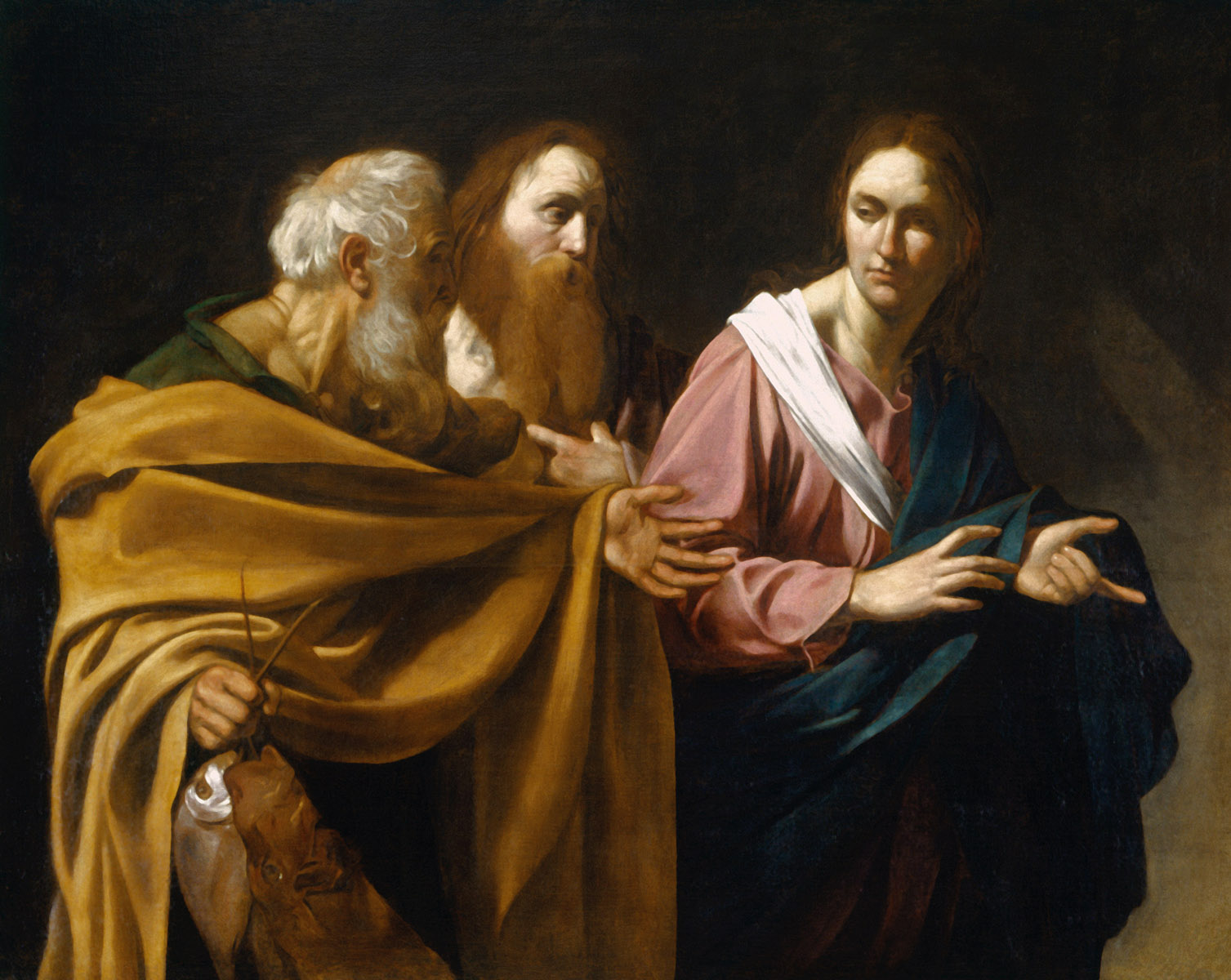
This lesson is even evident in our Gospel today. There is John the Baptist, standing with two of his disciples, and as Jesus walks by, he proclaims, he evangelizes,  “Behold, the Lamb of God.” In the original greek of the Gospel, the text reads, “Ide o amnos tu theu.”  Behold the Lamb of God. The Lamb, the ‘amnos’—was a very special type of lamb, one that would be used in sacrificial offering. And John is telling his disciples that Jesus is the lamb who will be sacrificed for the sins of the world.  Following him, would have consequences. It wouldn’t be easy. With that in mind, they follow him anyway. 

And John’s disciples, which included Andrew, the brother of peter, could have said, “uh, no thanks. I’m looking for truth, but, not enough to suffer for it. Let’s just keep doing what we’ve been doing.” Had he done that, overwhelmed by the fear of suffering, discouragement would certainly have set in. 

But Andrew, whose name, Andreas, means manliness, virtuousness, does something that should be emulated by every one of us. When the Lamb of God comes into your life, you follow him. And you tell others about him. That changed his life. That changed the life of Mother Janet Erskine Stuart. Following Jesus, despite the difficulties, despite the potential challenges, despite the risk, in this unideal moment of history changes those who choose Him over the thousand and one other things that arise .

And this lesson is applicable to our prayer life, passing on the faith to the young, spreading the faith to non-believers, engaging in the acts of charity. If we wait for what we think are ideal circumstances to do the work of God, then we will sit and wait for something that will never come. If you are waiting for some ideal condition to get serious about your prayer life or to study the bible or begin a new charitable endeavor, to enter the convent or seminary, or to develop a new skill for the service of others…it's not tomorrow, when we hope the conditions will be right, it’s now! “Speak, for your servant is listening” in the words of Samuel…this is the prayer of a heart open to doing the will of God no matter what the circumstances. 

Let us dare to utter those same words, with that same openness, trust that God knew what he was doing when he chose us for the work of the Gospel in 2021, and this is the only time that we’ve been given for the glory of God and salvation of souls.


Sunday, March 8, 2020

2nd Sunday of Lent 2020 - The dangerous business of going out your door

 One of the great works of literature from the 20th century was written by Catholic author J.R.R. Tolkien. You may have read or watched the film production of his “Lord of the Rings” Trilogy. This fantasy saga about hobbits and elves and wizards and dragons is heavily infused with imagery inspired by Tolkien’s Catholic faith.

The tale begins with the discovery of a magic ring. The main character, Frodo, and his friend Sam are tasked with the perilous quest of bringing the mysterious ring to a group of wise elves who will determine what to do with this dangerous artifact.

I thought of Tolkien’s story in regards to our first reading today. Abraham is tasked by God to leave his home, his native land, and venture to a new place, filled with strangers and enemies. A perilous quest for anyone, but particularly Abraham who was 75 years old.

There is a great scene near the beginning of Tolkien’s Lord of the Rings, where Frodo and Sam, having walked for about a day and half from their village, reach the edge of field, and Sam stops and says, “this is it…If I take one more step, I'll be the farthest away from home I've ever been.” To which Frodo responds, “Come on, Sam. Remember what my uncle used to say: "It's a dangerous business,  going out your door. You step onto the road, and if you don't keep your feet, there's no telling where you might be swept off to."

Sam spoke those words with no idea that his feet would take him so far from home, farther than he could ever dream of, and he would do things he never thought himself possible of doing. Like Abraham, like moses, like the prophets, like the apostles and saints. These holy men and women all took a risk of stepping out their front door, and allowing God to lead them to unknown lands, figuratively and oftentimes literally, further from home than they’ve ever been. God invites all of us to trust him, to allow him to lead us into the unknown, into new ways of service and sacrifice,
prayer and evamgelization.

In the Gospel we hear of Peter, James, and John being led up a mountain by Jesus. They had already taken the risk of leaving their fathers’ fishing businesses, following this itinerant preacher and miracle worker all over Galilee. And now, he was leading them up this strange mountain. St. Matthew uses this wonderful word in the Greek for Jesus’ act of leading his apostles up the mountain side. The word is anaphora. Anaphora means to lead up or carry up or bring up.  The word also has the connotation of offering up:  as in the high priest offering up sacrifices for the forgiveness of the sins of the people.

This connection of being led up a mountain and offering up a sacrifice, should certainly make us think of our blessed Lord being led up to mount calvary by the will of his father. And indeed, Christians have always seen the story of the Transfiguration as a foreshadowing of the Lord climbing the Mount of Calvary and also our vocation of following where our master has gone before us.
Peter, James, and John, like their Lord would go on to climb the mountain of suffering for the sake of the Gospel; they “bore their share of hardship for the gospel” as Paul writes to timothy in our second reading. Peter, like the Lord, was crucified. James, was the first to be martyred among the apostles. John, though he died of old age, suffered greatly, he was even boiled in oil, but he survived.
We must all trust the Lord enough to allow him to lead us up the holy mountain. It’s not an easy journey. It’s steep. It’s hard. It requires courage and fortitude. It might even be, like it was for Peter James and John, quite terrifying, initially.

But something happens at the top of the mountain that makes the terrible journey worth it. At the top of the mountain, we encounter God. And that too might be terrifying at first, as it was for Peter, James, and John. But that mountain top encounter with God, changes you, bolsters you, in fact, we long for it. This desire for the mountaintop encounter with the true and living God is deeper than our fears.

Pope Benedict writes, “This letting oneself be guided where one does not want to be led is an essential dimension of our service, and it is exactly what makes us free. In this being guided, which can be contrary to our ideas and plans, we experience something new—the wealth of God’s love.”
There is no doubt, for each and every person here, some place, that God wants to lead us, where we, initially, don’t want to be led. It could be because of our swollen ego, or our fear of suffering, our fear of being rejected by our fellow man. But each one of us, no doubt, is being called by God up a mountain.

That mountain’s name for some of us, might be “forgiveness”, forgiving someone who hurt you deeply. For some, it might be “chastity or self-control”, putting an end to unchaste or spiritually unhealthy habits and actions. For some, it might be “generosity”—learning to trust God enough to give to others more generously. For some, the name of that mountain might be “Confession”. The Sacrament of Confession is sometimes daunting because it requires us to name our failures and seek to change, a very steep mountain indeed.

But, atop each of these daunting, steep mountains, is an encounter with Jesus Christ, which will set you free and bring you joy. In the end, that holy mountain, is the only one worth climbing.
The Eucharistic preface for this second Sunday of Lent, proclaims how the Lord brings the apostles up the holy mountain to show them that the Passion leads to the glory of the Resurrection. We willingly undergo the sufferings of the Christian life because of that promise, that what we suffer leads to the glory of the resurrection.

So this Lent, take a risk. Pray more than you ever have. Read the Bible more devoutly and reflectively. Fast more strictly than you ever have, trust that the Lord will feed you with what you will give you life. And Give like you never have. Take a risk, step out your front door, climb the mountain. Offer him your time, your body and soul.

The early Greek Christians used that wonderful word Anaphora to describe the Mass. And we Romans Catholics too, refer to that part of the Mass as the anaphora, when bread and wine are offered to God to become the flesh and blood of Jesus the High Priest who offers himself to the Father for our salvation.

As the Lord is offered up, may we offer our lives in union with him, and allow him to lead us in holiness, to grant us courage in leaving the comfort of our native lands, further from home than we’ve ever been. It’s dangerous out there, but he is with us, leading the way, for the glory of God and salvation of souls.