Monday, June 8, 2020

10th Week in OT 2020 - Monday - The need for spiritual poverty

Over the next three weeks we will read through Jesus’ Sermon on the Mount, for our daily Gospel readings, beginning today with Chapter 5 of St. Matthew’s Gospel. 

This is also the first day since February 25th this year that I am wearing liturgical green for Mass. Green, the liturgical color for the season of ordinary time, symbolizes growth, spiritual growth, growth in the virtue, growth in charity, growth in utilizing the gifts of the Holy Spirit, that is to occur throughout the ordinary seasons of our life. The ordinary day-to-day life of the Christian is meant to bring about growth in us.

And there is no better place to beginning to talk about spiritual growth than with the beatitudes. The beatitudes are read at baptisms, weddings, funerals, and throughout the Church year because they are the attitudes and dispositions we are meant to cultivate throughout all of life whether we are mourning or rejoicing.  By practicing the beatitudes the Christian orients himself to eternity by putting on the mind and heart of Christ.  We are to be meek, as he was meek; we are to be pure, as he was pure; we are to be devoted to doing the will of God as he was devoted. 

The very first beatitude is the key to all the rest and therefore the key to any real spiritual growth we hope to obtain. Blessed are the poor in spirit. First and foremost, we must practice poverty of spirit in everything we do, in every conversation we have, in every attempt to serve the physically, we must take upon ourselves the fundamental attitude of Christ—poverty of spirit.

Poverty of spirit means that we recognize our absolute need for God, that without God we our absolutely impoverished. Without God we have nothing, and without God we cannot hope to become the people we are meant to be. Without God, the builder builds his house in vain. Apart from me, Jesus says, “you can do nothing” at least nothing worth doing.

The sin of Adam and eve, and every sin, is essentially a failure to practice this very first beaitutide. Without it, we begin to believe and live as if we do not need God,  we do not need to trust God or obey his commandments. It is the belief that we can grasp and obtain happiness and life without God. Without the first beatitude we begin to swell with a sinful pride that leads to perdition.

Rather, the Christian is to cultivate the soil of their hearts, minds, and souls with and by humility, and by doing so, we become heirs of the kingdom of heaven, for the glory of God and salvation of souls.

- - - - - - -
That the preaching and teaching and charitable works of the Church will inspire all people to seek to practice the beatitudes of Christ.

That those in public office may govern with wisdom, put an end to all political corruption, and work for a society of authentic justice and peace with special care for the most vulnerable.

For an end to oppression, racism, hatred, addiction and injustice. For the healing of all the sick.
For an increase in vocations to the priesthood and consecrated religious life, for a strengthening of marriages, for all single people who strive to follow Christ, and for the grace to utilize our spiritual gifts for the building up of the Church.

That those who have died may share in the joy of life-everlasting; for our deceased family members, friends, and fellow parishioners, for all the poor souls in purgatory for Bishop George Murry, bishop of Youngstown and for Paul Becker, for whom this Mass is offered.

O God, who know that our life in this present age is subject to suffering and need, hear the prayers of those who cry to you and receive the prayers of those who believe in you. Through Christ our Lord.

Sunday, June 7, 2020

Trinity Sunday 2020 - Belief in the Trinity Matters

From all eternity there were certain truths so profound that they were known to God alone. Neither man nor angel could discover these truths through the use of reason nor by natural intellectual ability. Created intellects could only learn of these supernatural truths by divine revelation—by the direct activity of God revealing truth. The most profound of these supernatural truths is that God exists as Three Divine Persons sharing One Divine Nature. I speak of course of the dogma of the Blessed Trinity, which we enshrine in our liturgy today—the Solemnity of the Holy Trinity.

Christian belief in the Trinity—that God is Father, Son, and Holy Spirit, is evident from the very beginning of the Church, appearing in our earliest Creed, the Apostles’ Creed. The early Church councils were preoccupied with addressing confusion about this dogma or combating blatant attacks against it. The doctrine of the Trinity was so important that the Council of Constantinople in 553 declared that  “If anyone does not confess that there is one nature or substance of the Father and of the Son and of the Holy Spirit, and one power and one might, and that the Trinity is consubstantial, one Godhead being worshipped in three substances or persons, let such a one be anathema.” Anathema, that’s a strong word. It means officially excommunicated, outside of the body of believers, the body of Christ, outside of reasonable hope for salvation.

That God is a Trinity of Three Divine Persons is hinted at, foreshadowed, hidden in the Old Testament. On the sixth day of Creation, God says, “Let US make mankind in our image, in our likeness.” Also in Genesis we read of the three mysterious heavenly strangers sitting down to eat with Abraham and Sarah. Isaiah the prophet reports hearing the Lord say, “Whom shall I send? Who will go for US?” The Old Testament is not shy about calling God Father, but we also hear of the Son of Man coming upon the clouds on the day of judgment from the prophet Daniel, and the Spirit of God descending upon David when he was anointed in the first book of Samuel.

The monotheistic Jews had great difficulty explaining this mysterious language of plurality. But the doctrine of the Trinity becomes clear in the New Testament, in the preaching of Jesus, who speaks of his Father, his oneness with the Father, and how He and His Father Will Send The Holy Spirit Upon the Church. This doctrine was so important, that in the very last lines of the Gospel of Matthew, we find our Lord telling his disciples to go and Baptize all nations in the name of the Father, and the Son, and the Holy Spirit. The mark of the Christian disciple is to be their baptism using the names of Three Divine Persons of the Holy Trinity.

When St. Paul discovers a group of believers who had only received the baptism of John the Baptist, the ritual washing for the repentance of sin, St. Paul says that John’s baptism is not enough, they must be baptized in the name of the Father, and the Son, and the Holy Spirit.

The great doctor St. Athanasius wrote, “Whosoever will be saved, before all things it is necessary that he hold the Catholic faith…And the Catholic faith is this: That we worship one God in Trinity, and Trinity in Unity; Neither confounding the Persons; nor dividing the substance.”

Why does this belief matter…that God is a Trinity? Well, for one, Our God revels in revealing Himself—he wants us to know about Him. He wants us to cultivate a relationship with Him, with each of His Three Divine persons. Jesus taught us to call upon the Father. We need to invoke the Holy Spirit throughout the day. We need to pray for Sweet Jesus, Pie Iesu, have mercy on us, poor sinners.
Secondly, this doctrine matters because the preaching of Our Lord is pretty clear, St. Paul and the Apostles are pretty clear, the early Church councils are pretty clear, belief in this doctrine is required for membership in the body of Christ and for eternal life.

St. Francis Xavier, perhaps the greatest missionary in Church history after St. Paul, baptized thousands of people. As a missionary in the far east, he wrote about the difficulty he had in catechizing all these people—preparing them for baptism. Thousands of people would be in the villages, clamoring for baptism, yearning for membership in the Church.  Francis Xavier wrote that he considered it enough if he could properly teach them that in making that sign of the cross they were professing their faith in the one true God—if he could teach them that, that God the Father, sent God His Son to die on the Cross, and that God the Holy Spirit has been sent to the Church--he felt that that was enough for baptism.

Friends, there is a terrible trend in both academic theological circles and also among laity and I dare to say even among some members of the clergy, to diminish the importance of this dogma, to seek to refashion God or redefine God using modern terms. But to do this is to essentially deny that God has revealed Himself as Father, Son, and Holy Spirit. When we start messing with this doctrine it leads to a sort of creedless Christianity like the Unitarian Universalists. And maybe that’s what some people want, some sort of undefined God so that they can refashion God in their own image and thereby refashion religion in their own image. But this is not the Gospel preached by Jesus Christ, True God and True Man. Creedless Christianity is not Christianity. To deny this doctrine is to be separated from the font of Divine Revelation—separated from clear Scriptural evidence and Sacred Tradition.

But O! When we cultivate a love of the Holy Trinity—when we seek to know and love the Father, through the Son, in the power of the Holy Spirit, we begin to understand who we are as adopted children of God, who we are as instruments of God in this broken world. We are marked by the trinity, changed by the trinity, forgiven by the Trinity, made fearful to the devil by the trinity, justified by the Trinity, and given hope of heaven by the Trinity.

The Father is not some psychological symbol for the unknowable origin of Creation. The Son is not merely a psychological symbol for the importance of the spirit of self-sacrifice and love of neighbor. The Holy Spirit is not merely a symbol for sociological improvement or psychological growth. Father, Son, and Holy Spirit are Three Persons who love you. Who call you to believe in them and worship them to Communion with them, that you might have life. For the glory of God and salvation of souls.

Friday, June 5, 2020

June 2020 - First Friday - Eucharistic Lessons from an axe-wielding Bishop

At morning Mass I told one of my favorite stories from the saints, about the bishop and martyr St. Boniface, known as the apostle to the Germans. Boniface was an English Benedictine monk who devoted his life to evangelizing the Germanic Tribes, who at the time worshiped the false Norse gods and goddesses like Thor, Freya, Loki, and Odin. The Pagans were proving quite resistant to conversion, abandoning their false gods and accepting the Christian Gospel. So the holy missionary went to the giant oak tree where the Pagans gathered to offer false worship to Thor.  And Boniface took an axe, and he begins chopping down this pagan idol. The pagans cursed Boniface and waited for him to be struck dead by their gods for his sacrilege.  The story says that when Boniface had chopped just a small notch into the tree, God finished the job, the tree was blast apart from above.  And the pagans who had before cursed Boniface now began to believe.  And moreover, Boniface took the wood of the tree and built an oratory in honor of Saint Peter. 

Boniface’s actions certainly would not be considered politically correct in our modern age, but neither is the Gospel really, not when it is preached in its entirety.

What does this holy missionary, who went on to become bishop and a martyr for the faith teach us about eucharistic adoration? Well, we come here for the same reason, don’t we, that Boniface went to the pagan germans: that the Christian Gospel, that the kingdom may be spread, in our nation, in our neighborhoods, in our families, and in our hearts. We come here to pray that the Gospel may be spread—more devoutly preached and lived.

We also come here, not to a pagan idol, but to the One True God, truly present, here and now, under the appearance of bread and wine. He has the power to save us, he has the power to bring about true peace. He has the power to strike down the pagan oak trees that seem to be springing up like weeds in our modern culture. We come here to be equipped by him with the grace we need to be his instruments in the world--to be his axes in the world--his scythes for harvest and his swords of truth. We come here also to pray that our bishops, especially our future bishop of Cleveland, may be well-equipped and have the competency and courage to utilize the spiritual weapons at their disposal. That their faith may be sturdier than any pagan oak, that they may wield the blade of the spirit, to convict us of the Gospel.

And we come here before our Eucharistic Lord, that any worldliness, any vice, any coldness toward God or neighbor, may be struck down within us. May the Lord help us to identify anything within us that is resistant to the Gospel, any pagan oaks or weeds of worldliness, anything that keeps us from experiencing the peace that comes from God, and anything that keeps us from the courage exhibited by saints and martyrs like Boniface, any fear or timidity that keeps us from witnessing to the transforming power of the Gospel, for the glory of God and salvation of souls.

June 05 2020 - St. Boniface - The first few swings

Today we celebrate the feast of Saint Boniface, who is known as the apostle to the Germans.  This English Benedictine monk devoted his life to the evangelization of the Germanic tribes.  He made his first missionary journey to Germany in 719 at the request of Pope Gregory II.

His is one of my favorite stories from the lives of the saints. As he engaged on his preaching mission, Boniface found the land full of Pagans; the Germanic tribes worshipped gods of Norse Mythology: Odin and Thor and the like.  They were proving resistant to conversion, resistant to giving up the old gods.

Boniface learned of a giant oak tree where the Pagans gathered to offer false worship to the God Thor.  So Boniface, took an axe, and he begins chopping down this pagan idol. The pagans cursed Boniface and waited for him to be struck dead by their gods for his sacrilege.  The story says that when Boniface had chopped just a small notch into the tree, God finished the job, the tree was blast apart from above.  And the pagans who had before cursed Boniface now began to believe.  And moreover, Boniface took the wood of the tree and built an oratory in honor of Saint Peter. 

This is why you’ll often see stained glass windows and statues with St. Boniface in his bishops attire, holding an axe, standing on a tree trunk.

Pagan oaks of error, superstition, and false teaching seem to be sprouting up like weeds these days. Even within the Church, we have prelates and clerics who have made public opinion into idols, who fail to confront the moral errors of our day.

Working for the spread of the Gospel in our nation or even among our families seems like daunting work, but remember that Boniface only needed to take those first courageous swings with the axe before God did the rest of the work. In a letter written to a Benedictine abbess, Saint Boniface wrote: “Let us stand fast in what is right and prepare our souls for trial…let us be neither dogs that do not bark, nor silent onlookers, nor paid servants who run away before the wolf.”

In his 80th year, Boniface was preparing candidates for confirmation when they were attacked by barbarians and massacred, martyred for the faith.

As we prayed in the opening prayer: “may the Martyr Saint Boniface, be our advocate that we may firmly hold the faith he taught with his lips and sealed in his blood and confidently profess it by our deeds” for the glory of God and salvation of souls.

- - - - - - -

That our bishops and clergy may be zealous in preaching and teaching the truth of the Gospel, and that our future bishop of the diocese of Cleveland may be a man of true faith and the Holy Spirit.

That St. Boniface, patron saint of Germany, may enliven the faith of the German people and those of Germanic descent who have made their home in this land.

For our young people beginning summer vacation, that they may be kept close to the truth and heart of Jesus.

That the love of Christ, the divine physician, may bring healing to the sick and comfort to all the suffering.

For the deceased members of our families, friends, and parish, for the deceased priests and religious of the diocese of Cleveland, for the poor souls in purgatory, and for those who have fought and died for our freedom.

O God, who know that our life in this present age is subject to suffering and need, hear the prayers of those who cry to you and receive the prayers of those who believe in you. Through Christ our Lord.


Reading 1
ACTS 26:19-23

Paul said:
"King Agrippa, I was not disobedient to the heavenly vision.
On the contrary, first to those in Damascus and in Jerusalem
and throughout the whole country of Judea,
and then to the Gentiles,
I preached the need to repent and turn to God,
and to do works giving evidence of repentance.
That is why the Jews seized me when I was in the temple
and tried to kill me.
But I have enjoyed God's help to this very day,
and so I stand here testifying to small and great alike,
saying nothing different from what the prophets and Moses foretold,
that the Messiah must suffer and that,
as the first to rise from the dead,
he would proclaim light both to our people and to the Gentiles."

Responsorial Psalm
PS 117:1BC, 2
L  (Mark 16:15)  Go out to all the world and tell the Good News..
Praise the LORD, all you nations;
glorify him, all you peoples!
R.    Go out to all the world and tell the Good News.
For steadfast is his kindness toward us,
and the fidelity of the LORD endures forever.
R.    Go out to all the world and tell the Good News.

AlleluiaJN 10:14
R.    Alleluia, alleluia.
I am the good shepherd, says the Lord,
I know my sheep, and mine know me.
R.    Alleluia, alleluia.

Gospel JN 10:11-16
Jesus said:
"I am the good shepherd.
A good shepherd lays down his life for the sheep.
A hired man, who is not a shepherd
and whose sheep are not his own,
sees a wolf coming and leaves the sheep and runs away,
and the wolf catches and scatters them.
This is because he works for pay and has no concern for the sheep.
I am the good shepherd,
and I know mine and mine know me,
just as the Father knows me and I know the Father;
and I will lay down my life for the sheep.
I have other sheep that do not belong to this fold.
These also I must lead, and they will hear my voice,
and there will be one flock, one shepherd."

Wednesday, June 3, 2020

June 03 2020 - St. Charles Lwanga and Companions - Courage to preserve chastity

To many of us the name of the Ugandan Martyr Charles Lwanga is unfamiliar.  But, he is well-known and revered in much of tropical Africa as a patron saint of young people. Personally, I’ve grown increasingly devoted to this Courageous Saint over the past few years.

Uganda only began to be evangelized in the early to mid-1800s by the Society of Missionaries of Africa, known as the White Fathers because of the white cassock they wore. The earliest converts were soon preaching the Gospel in places inaccessible to the White Fathers. Charles Lwanga was among the early converts, and was a servant in the royal court of the Ugandan king, King Mwanga, who ruled in the south eastern part of the country.

Mwanga was a violent ruler and a pedophile who forced himself on the young boys and young men who served as his pages.  Following the violent death of the leader of the small Christian community within the court, Charles Lwanga took the leadership of offering Christian instruction within the community. When King Mwanga tried to force himself on these young men, Charles tried to serve as their protector, encouraged the young boys to preserve their chastity. For refusing the advances of the King, they were arrested and burned to death on June 3 by royal decree.

Charles and the 22 Ugandan martyrs are such valuable witnesses in a time where young people are increasingly at risk of falling to the perversions in our culture, and for all those who seek to practice Christian chastity in this over-sexualized age.

In that powerful reading from 2 Maccabees we hear of the unshakeable faith of the righteous young men. In the face of death, death by a king, they placed their trust and hope in God and in eternal life that can come only from Him: “It is my choice to die at the hands of men with the God-given hope of being restored to life by him”

In the face of temptation, and when faced with threats from the world to compromise the Gospel, may we take courage in our hope of eternal life, that those who remain faithful to God in this life, will receive the great reward of glory in eternity, for the glory of God and salvation of souls.

- - - - - - - 

That the witness, sufferings, and death of the  martyrs may bring about rebirth of Christianity and civilization, in those places where faith and morals have diminished.

Through the intercession of St. Charles Lwanga, patron of youth, may our young people be protected from the perversion of our culture and be infused with virtue.

That religious indifference in our country and around the world may be transformed to radical commitment to the Gospel of Christ.

For all the needs of the sick and the suffering, the homebound, those in nursing homes and hospitals, the underemployed and unemployed, victims of natural disaster, war, and terrorism, for all those who grieve the loss of a loved one, and those who will die today, for their comfort, and the consolation of their families.

For the repose of the souls of our beloved dead, for all of the poor souls in purgatory, for the deceased members of our families, friends, and parish, for those who have fought and died for our freedom, and for The Smigovsky & Kermes Family, for whom this mass is offered.

Incline your merciful ear to our prayers, we ask, O Lord, and listen in kindness to the supplications of those who call on you. Through Christ our Lord.

- - - - - - -


FIRST READING          2 Maccabees 7:1-2,9-14
It happened that seven brothers with their mother were arrested
and tortured with whips and scourges by the king,
to force them to eat pork in violation of God's law.
One of the brothers, speaking for the others, said:
"What do you expect to achieve by questioning us?
We are ready to die rather than transgress the laws of our ancestors."
At the point of death he said:
"You accursed fiend, you are depriving us of this present life,
but the King of the world will raise us up to live again forever.
It is for his laws that we are dying."
After him, the third suffered their cruel sport.
He put out his tongue at once when told to do so,
and bravely held out his hands, as he spoke these noble words:
"It was from Heaven that I received these;
for the sake of God's laws I disdain them;
from him I hope to receive them again."
Even the king and his attendants marveled at the young man's courage,
because he regarded his sufferings as nothing.
After he had died,
they tortured and maltreated the fourth brother in the same way.
When he was near death, he said,
"It is my choice to die at the hands of men
with the God-given hope of being restored to life by him;
but for you, there will be no resurrection to life."


RESPONSORIAL PSALM           124:2-3, 4-5, 7b-8
Anima nostra sicut passer erepta est de laqueo venantium.

R./ (7) Our soul has been rescued like a bird from the fowler’s snare.
Had not the Lord been with us–
When men rose up against us,
    then would they have swallowed us alive,
When their fury was inflamed against us.
R./ Our soul has been rescued like a bird from the fowler’s snare.
Then would the waters have overwhelmed us;
The torrent would have swept over us;
    over us then would have swept
    the raging waters.
R./ Our soul has been rescued like a bird from the fowler’s snare.
Broken was the snare,
    and we were freed.
Our help is in the name of the Lord,
    who made heaven and earth.
R./ Our soul has been rescued like a bird from the fowler’s snare.


ALLELUIA          Matt 5:3
Beati pauperes spiritu, quoniam ipsorum est regnum caelorum.
Blessed are the poor in spirit,
for theirs is the kingdom of heaven.


GOSPEL          Matthew 5:1-12a
When Jesus saw the crowds, he went up the mountain,
and after he had sat down, his disciples came to him.
He began to teach them, saying:
"Blessed are the poor in spirit,
for theirs is the Kingdom of heaven.
Blessed are they who mourn, for they will be comforted.
Blessed are the meek,
for they will inherit the land.
Blessed are they who hunger and thirst for righteousness,
for they will be satisfied.
Blessed are the merciful,
for they will be shown mercy.
Blessed are the clean of heart,
for they will see God.
Blessed are the peacemakers,
for they will be called children of God.
Blessed are they who are persecuted for the sake of righteousness,
for theirs is the Kingdom of heaven.
Blessed are you when they insult you and persecute you
and utter every kind of evil against you falsely because of me.
Rejoice and be glad,
for your reward will be great in heaven."

Tuesday, June 2, 2020

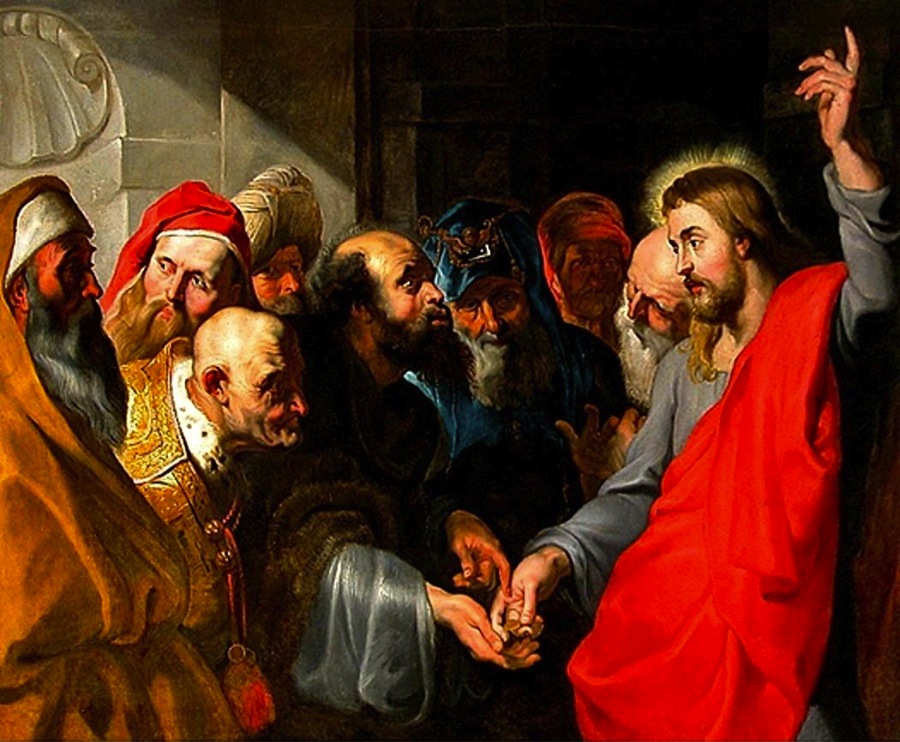
9th Week of OT 2020 - Tuesday - What belongs to Caesar?

"Render therefore to Caesar the things that are Caesar's, and to God the things that are God's." Today’s Gospel certainly brings to mind the tension of the last month and a half. Can the government tell us we can’t go to Church? Can the government demand we wear masks? Can the government keep us from assembling to protest the infringement of our rights? What is the limit of civil authority? And what is our responsibility to obey legitimate authority?

The Catechism of the Catholic Church helps us to answer some of these questions. The section in the Catechism on the 4th Commandment elaborates on not only the honor we owe  father and mother, but also our relationship with civil authorities.

Firstly, it talks what Caesar owes his subjects. “Political authorities are obliged to respect the fundamental rights of the human person.” This is a matter of justice. Caesar must respect our fundamental rights of life, liberty, and the pursuit of happiness. Our Declaration of Independence does a pretty good job at listing some of these rights, identifying that our rights don’t come from the state, but are more fundamental, they come from God.

Then the Catechism goes on to explain the duties of citizens: “Those subject to authority should regard those in authority as representatives of God, who has made them stewards of his gifts: "Be subject for the Lord's sake to every human institution.... Live as free men, yet without using your freedom as a pretext for evil; but live as servants of God." Their loyal collaboration includes the right, and at times the duty, to voice their just criticisms of that which seems harmful to the dignity of persons and to the good of the community.” The Catechism then goes on to explain some of our duties: “Submission to authority and co-responsibility for the common good make it morally obligatory to pay taxes, to exercise the right to vote, and to defend one's country.”

The Catechism does a pretty good job to make clear that yes, we need to collaborate with our authorities, we have a responsibility to the common good, but then Catechism explains the limits of Caesar’s power. Catechism 2242 states: “The citizen is obliged in conscience not to follow the directives of civil authorities when they are contrary to the demands of the moral order, to the fundamental rights of persons or the teachings of the Gospel. Refusing obedience to civil authorities, when their demands are contrary to those of an upright conscience, finds its justification in the distinction between serving God and serving the political community. "Render therefore to Caesar the things that are Caesar's, and to God the things that are God's."

Then quoting the Acts of the Apostles, Catechism states: “We must obey God rather than men" Whenever Caesar hinders our ability to give to God what belongs to God, we must obey God first. That may bring the wrath of Caesar…if Caesar is smart he’ll back down, for in opposing the will of God he brings upon himself God’s wrath.

How do we know what belongs to God? Luckily, we don’t have to figure that out on our own, we have our bishops, we have our scriptures, we have our Catechism, we have our sense of faith nurtured through years of Catholic spiritual formation. We certainly pray for those who have distanced themselves from the font of truth. For to be separated from truth, they cannot hope to respond well to the demands of justice.

Today we honor two saints, the priest Marcellinus and the exorcist, Peter, martyrs mentioned in the first Eucharistic prayer. They were imprisoned and killed for their Christian faith, for obeying God rather than Caesar. May Marcellinus and Peter and all of the martyrs of the One True Church help us to courageously confess Christ in our own day and place, remaining true to Him in word and deed, loving Him with all of our heart, mind, and strength, for the glory of God and salvation of souls.

- - - - - -

That our bishops and all people of faith may remain vigilant in defending their religious liberty and that our President and all government authorities will preserve and protect authentic liberty and justice according to the moral precepts which come from God.

That religious indifference in our country and around the world may be transformed to radical commitment to the Gospel of Christ.

For all the needs of the sick and the suffering, the homebound, those in nursing homes and hospitals, the underemployed and unemployed, victims of natural disaster, war, and terrorism, for all those who grieve the loss of a loved one, and those who will die today, for their comfort, and the consolation of their families.

For the repose of the souls of our beloved dead, for all of the poor souls in purgatory, for the deceased members of our families, friends, and parish, for the deceased priests and religious of the diocese of Cleveland, and for those who have fought and died for our freedom.

Incline your merciful ear to our prayers, we ask, O Lord, and listen in kindness to the supplications of those who call on you. Through Christ our Lord.

Monday, June 1, 2020

June 1 2020 - Mary, Mother of the Church

Just in 2018, Holy Father Pope Francis instituted a new liturgical feast to be celebrated universally the Monday after Pentecost, in honor of the Blessed Virgin, Mother of the Church.

The day after we celebrate, the birthday of the Church, so to speak on Pentecost, we celebrate our Mother, who was present, praying for the apostles, as the Holy Spirit descended upon them.

Theologically, this title of Mary is not difficult to grasp. The members of the body of Christ are one with her head. She is the Mother of Christ the head of the Church, and so she must be the mother of all the members who are mystically united with Him. She is mother of both head and body, as all mothers are to their children.

Mary’s spiritual relationship to the members of the Church is evidenced in Our Lord’s proclamation from the cross. He gave Mary to be the Mother of all the disciples, when he said, “woman, behold your son.” And he commanded all of his disciples to love and honor her as a mother, when he said, “Behold, your mother.”

The title “Mother of the Church” is not new, but has been ascribed to Our Lady for centuries, recognizing Our Lady’s spiritual motherhood of all Christians, of all disciples, of all believers, of clergy and religious, married, single, and all the lay faithful.

As Mother prays constantly for her children from her place in heaven, as she did on Pentecost, as she no doubt did every day of her earthly life.

She no doubt prays that we may be open to all of those spiritual gifts we need, the gifts that God wants for us, for the spread of the Gospel and the building up of the Church. And I believe this is the deep reason Pope Francis placed this feast in proximity to Pentecost.

If we wish to be open to the gifts of the spirit and utilize-well the gifts of the Spirit, we need to honor and love Our Mother, for God chose her as an instrument of our redemption and sanctification. 

Today is a fitting day to offer a Rosary in Our Lady’s honor and to commit to cultivating our relationship with Our Blessed Mother daily, praying, through her, for the sanctification of the church, for the protection of the Church, and renewal of the Church especially in areas of the church that have grown stagnant, corrupt, fearful, or lifeless.

Pray for us, O holy mother of God, Mother of the Church, that we may be made worthy of the promises of Christ, for the glory of God and salvation of souls. 

- - - - - -

To the Blessed Virgin Mary, Mother of the Church, we recommend ourselves and the entire Church.

Guide and assist our Holy Father and our Bishops in their apostolic mission, and aid all who help them in their work.

Mother of the Church! Enlighten the People of God along the paths of faith, hope and love! You were given to us as a mother by your Divine Son at the moment of his redeeming death.

Remember us your children, support our prayers to God. Preserve our Faith, strengthen our Hope, increase our Charity.

Immaculate Heart! Help us to conquer the menace of evil, which so easily takes root in the hearts of the people of today.

From nuclear war, from incalculable self-destruction, and from every kind of war, deliver us. From sins against human life from its very beginning, deliver us. From every kind of injustice in the life of society, deliver us.
From readiness to trample on the commandments of God, deliver us. From attempts to stifle the very truth of God, deliver us. From the loss of awareness of good and evil deliver us. From sins against the Holy Spirit, deliver us.

That those who have died may share in the joy of life-everlasting; for our deceased family members, friends, and fellow parishioners, for all the poor souls in purgatory and for…Valentine & Sophie Reindle, for whom this Mass is offered.