Showing posts with label september 11. Show all posts

Wednesday, September 11, 2024

23rd Week in Ordinary Time 2024 - Wednesday - Marriage, Celibacy, and Sept 11

 After spending a third of his letter addressing abuses and divisions within the Corinthian community, St. Paul turns to questions from the community or other areas of concern which had been reported to him.

Today’s passage is from a section dealing with Marriage and Virginity. It appears that there was considerable confusion about these topics. On one extreme, you had members of the community who were still abiding by the perverted sexual norms of the surrounding culture—Paul addressed these sins in the first part of his letter. On the other extreme, you had members of the community who were claiming that since Christ was coming soon, everyone needed to remain celibate and married people needed to practice total abstinence. 

While St. Paul recommends that those with the charism for perpetual virginity and celibacy should undividedly devote themselves entirely to the Lord, St. Paul also calls Christian marriage good. In his letter to the Ephesians Paul well develop the theology and sacramentality further teaching that sacramental Christian marriage is a sign, reminder, and expression of Christ’s union with the Church.

Paul’s approach of calling both celibacy and marriage good illustrates the beautiful unity-in-diversity of the Church. Celibacy, consecrated virginity and marriage can point to Christ. All Christians no matter their state are called to holiness.

The Lord’s teaching in the Gospel today, aren’t simply meant for priests and nuns, but for all Christians of all places of all times. All are to practice the beatitudes by cultivating poverty of spirit, mournfulness for sin, perseverance during trial, detachment from worldly riches, fame, and earthly pleasure. 

23 years ago today, our nation suffered a horrific terrorist attack resulting in the death nearly 3000 people. In the aftermath, Congress passed a bill requesting that the President designate September 11 as Patriot Day. 

Today, the U.S. flag is flown at half-staff at the White House and on all U.S. government buildings and establishments throughout the world; flags are also encouraged to be displayed on individual American homes. Additionally, a moment of silence is observed to correspond with the attacks, beginning at 8:46 a.m., the time the first plane, American Airlines Flight 11, struck the North Tower of the World Trade Center.

In a world full of such tremendous moral ugliness and disregard for human life, the task of the Christian is the same as it has been in every age, to cultivate holiness of soul that points others to Christ, to preach Christ and him crucified, for He is our only salvation and hope, for the glory of God and the salvation of souls.

- - - -  

That through Our Lady, Queen of Peace, terrorism and war, and the cheapening of human life may be brought to an end.

That our civil representatives may use their authority to lead and build our nation in godly ways.

For all those who harden their hearts toward God, for those who have left the Church, for all those in serious sin, for their conversion and the conversion of all hearts.

For the sick and afflicted, the homebound, those in nursing homes and hospitals, for victims of natural disaster and inclement weather, those who suffer from war, violence, and terrorism, for the mentally ill, those with addictions, the imprisoned, the unchaste, for the comfort of the dying and the consolation of their families. 

For the deceased members of our families, friends, and parish and all the poor souls in purgatory, for deceased priests and religious, and for those who have fought and died for our freedom. We pray.

Incline your merciful ear to our prayers, we ask, O Lord, and listen in kindness to the supplications of those who call on you. Through Christ our Lord.


Sunday, September 13, 2020

24th Sunday in OT 2020 - Anger and Forgiveness

What a remarkable coincidence that the readings for this 24th Sunday of Ordinary Time, dealing with Jesus’ teaching on forgiveness, occurs every three years near the anniversary of the September 11, 2001 terrorist attacks, one of the darkest days of our nation’s history.

Forgiveness was hard that day. Many of us remember, not only where we were, those 19 years ago, but the very strong emotions of sadness and anger. 

I was a first year seminarian in 2001.  And on that overcast autumn day here in Cleveland, a few of us seminarians were on our way to a Philosophy class entitled Philosophy of the Human Person taught by a Capuchin Franciscan Priest, Father Don Lippert who is now the bishop of Papua New Guinea.  In his brown Franciscan robes and brown beard and his peaceful demeanor, he reminded so many of us of Jesus himself.  So we were on our way to class, and another seminarian ran up to us and told us that a plane had just flown into one of the world trade center towers.  We ran to the classroom, and Fr. Lippert told us that class was canceled and we should go watch the news.  So, we went up to the student lounge to watch those terrible events unfold. And, at first, none of us new what was going on, right? None of us thought there would be a second plane. Or news of a crash in Pennsylvania, so close to here. Or an explosion at the Pentagon. We sat glued to the television, watching, and saw that horrific sight of the towers crumbling down, thinking, what just happened?  

When, I had enough, I remember going to my room, thinking of all of the tensions in the middle east at the time, all of the violence, and worry,  that things were just about to get  a lot worse.  And I remember also, the anger inside me.  Here, I lived with 70 men studying for the priesthood, seeking to bring Christ’s peace to human hearts through the Holy Gospel. And compare that with these men who sought to bring terror and death, who had not only disregard for their own souls, but the lives of innocent human beings.  About 3000 people were killed that day at the hand of human wickedness.  Those terrorist attacks continue to haunt us, too, every time we are forced to remove our shoes and belts at the airport.  It is hard not to look at people of middle eastern decent without some modicum of suspicion.  
And for a few weeks, back in 2001, Churches were packed, weren’t they, as people struggled to understand their anger and their hurt?

St. Thomas Aquinas said, “Anger is the natural response to injustice”.  Think of Dr. Martin Luther King , Jr.’s ’s “Anger” at racial inequality in the U.S., or Mahatma Ghandi’s anger over British imperialism, or Pope John Paul II’s anger at communist oppression.    Think of Jesus’ own anger at casting out the money changers. Or the anger over Bishops covering-up the abuse of minors. There was anger over September 11, 2001 because those attacks, the death and destruction was a massive injustice.  

We are hardwired to get angry over injustice. We were designed by God to respond to injustice in this way. And in a sense, we share this quality with God. Scripture speaks over and over about God’s anger toward evil, human wickedness, and injustice. God burns with anger when the people he freed from Egyptian slavery turn to worshipping false gods.  

Anger incites us to work for justice, to prosecute criminals, to overturn unjust laws, such as the laws enabling the destruction of the unborn.  Anger justly motivates us to hold our government leaders accountable for their failure to protect and lead. This sort of anger is legitimate, and a rightly formed conscience experiences this sort of anger in the face of injustice. Rightly ordered anger should stir us out of complacency and fear—to work to set things right.

However, St. Thomas Aquinas also talks about the deadly sin of Anger.  Where legitimate anger is the desire to set things right and is the proper response to injustice, the Deadly sin of anger is the exaggerated or irrational desire for vengeance, to seek justice through irrational means—such as destruction of private property or innocent human life.

How thoroughly Sirach describes the deadly sin of sin of anger in the first reading: “Wrath and anger are hateful things, yet the sinner hugs them tight.”  The deadly sin of anger is addictive, like a drug. It’s like a demon that can possess a person and can consume us and lead us to do terrible things and justify terrible things. We see this sort of anger on full display in some of the destructive riots going on in our country. Yes, there is injustice, but justice cannot be obtained through irrational means. The ends do not justify the means.

Dr. King didn’t promote destruction-- he didn’t want to destroy white America, he wanted to redeem it.  He did not insight terrorism against white America, he sought its righteousness, its perfection.  This differentiates Dr. King from those whose legitimate concern for racial injustice leads to irrational violence.  Yes, King was angered by racial injustice, but it was an anger tethered by love, which wills the good of the other.

Same thing with Ghandi.  He did not want to destroy the British.  He was angry at their oppression of his people, but as he famously said, I want the British to leave as our friends.  And St. John Paul II, did he want to kill all of the communists?  No.  He was angry as anyone over communist oppression, but he wanted them redeemed, to become better people.

Our readings speak to us this Sunday about forgiveness.  Forgiveness doesn’t mean we ignore injustice or forget about injustice. Forgiveness doesn’t mean burying our head in the sand. Forgiveness is able to call an injustice for what it is.  That evil is evil.  Jesus, who forgave from the cross, still called sin for what it is.


Rather, forgiveness is an act of the will, a choice. It is means to choose, “I will not allow the unjust actions of others to keep me from love”  Forgiveness, is to choose, “I will not allow myself to be controlled by bitterness, anger, or resentment.” Yes, sometimes forgiveness means releasing someone from a financial debt. But the Lord shows us the true face of forgiveness, “Even though you crucify me, I still choose to die for you.” It means not returning evil for evil, but seeking the greatest good of the other, no matter how they treat you.

For Jesus, forgiveness is an absolute for the Christian life. We will not be forgiven by God unless we forgive others.  Peter in today’s Gospel asks, how many times should I forgive my brother? Jesus answers, I say to you, not seven times, but seventy times seven times.  The Christian is to practice forgiveness over and over and over and over again, just as God forgives us over and over and over again.

So, we should not go to bed angry, meaning, we should not go to bed with the smallest ounce of bitterness or hatred. If at the end of the day, I can think of a single person toward whom I am holding on to irrational hatred or ill-will toward, I need to release that, to bring that to God for healing. We must wish no ill-will toward anyone, ever.

Through rightly ordered anger—we are motivated to work for an end to injustices—through forgiveness hatred is replaced with peace. May our lives be rightly ordered, may our hearts be filled with peace, for the glory of God and salvation of souls.

Friday, September 11, 2020

23rd Week in OT 2020 - Friday - Examining One's Conscience and September 11

It is part of our fallenness to notice the failings of other people but not our own. Some of us have even become experts in criticizing others whereas we seldom reflect on what needs to change in ourselves. We have 20/20 vision when it comes to seeing the mistakes of others, but how often do we honestly turn that critical gaze inward—to the parts of us that God wants to change, heal, or build up? 

The Lord commands us to remove the wooden planks from our eyes, so we can be effective in removing the splinters from others.  But, how do we come remove the planks blinding us?  The saints recommend the frequent practice of the examination of conscience.  On a daily basis, perhaps before getting into bed at night, to examine the events, choices, attitudes, interactions of the day, in light of the teachings of Jesus. 

To think of every person you saw that day, and to ask yourself, did I treat that person with the patience I should have? Did I attend to their needs or focus on my own? Someone once said, “you want to know the measure of a man? watch how he treats a waitress or a cashier.” So, how did I treat the cashiers, the waitresses, the janitors?  What was the reason I was so quick to gossip about the faults of my family members?  Did I pray today as much as God is challenging me to pray?  Where was I selfish with my time today? What blessings was I ungrateful for today?

Having made the daily examination, we also do well to make a big weekly or at least monthly examination. If there’s a sin that I’ve been struggling with on a regular basis, that sin needs to be brought to the sacrament of Confession. Because, in a sense, we can’t remove those planks on our own, we need the Lord’s help. Once the splinter is pulled, we need his healing, we need his help, so that another splinter just doesn’t take its place.

On this anniversary of the September 11 attacks, how can best honor those who died in this senseless tragedy? Certainly by remembering their names, but also, perhaps, to turn the gaze inward, to make use of the time we’ve been given to become the people we are meant to be, to cultivate that inner life, that for them was cut short. If we wish to be a positive force in the world, a force which opposes the evil which led to these attacks, we must confess our sins and grow in virtue that we may be filled with God's grace.

Having examined our consciences and confessed our sins, may we become instruments of the Lord’s healing grace, mercy, and forgiveness to those we meet, that we may run the race well and win that imperishable crown for the glory of God and salvation of souls.

Click Here for Examination of Conscience

- - - - - -  

That through Our Lady, Queen of Peace, terrorism and war and the cheapening of human life may be brought to an end.

For all those who harden their hearts toward God, for those who have left the Church, for all those in serious sin, for their conversion, and that Catholics in need of the Sacrament of Penance may make use of the opportunities to confess their sins and receive God’s mercy.

That our civil representatives may use their authority to lead and build our nation in godly ways.

For the sick and afflicted, the homebound, those in nursing homes and hospitals, for victims of natural disaster and inclement weather, those who suffer from war, violence, and terrorism, for the mentally ill, those with addictions, the imprisoned, the unchaste, for the comfort of the dying and the consolation of their families. 

For the deceased members of our families, friends, and parish and all the poor souls in purgatory, for deceased priests and religious, for the souls of those who died in the September 11 attacks, and for those who have fought and died for our freedom. We pray.

Incline your merciful ear to our prayers, we ask, O Lord, and listen in kindness to the supplications of those who call on you. Through Christ our Lord.


Wednesday, September 11, 2019

23rd Week in OT 2019 - Wednesday - September 11 and the Promise of Peace

Yesterday, I mentioned how the short letter to the Colossians is divided into two parts: the doctrinal and the practical. Well today’s reading begins Paul’s practical advice to the Christians of Colossae; and what practical advice does he give?

“Put to death, then, the parts of you that are earthly: immorality, impurity, passion, evil desire, and the greed that is idolatry…by these you once conducted yourself…but now you must put them all away…so put away anger fury, malice, slander, and obscene language out of your mouths.”

He doesn't begin with how they are to structure their community. He doesn't say what sort of charitable programs they are to offer. He begins with conversion. Putting sinful actions to death is a key to life. 

Though Christians have been raised up “in company with Christ” we know all too well how easy it is to fall back into the tendencies of the old nature, what Paul calls the “practices of the old self.” So, those sinful attitudes and tendencies have to be put to death over and over and over, lest they dominate our lives and reclaim our souls, and tear their community apart.

18 years ago, on September 11, 2001, the world evidenced what happens when those worldly powers have their way. Left to their own devices the world and the worldly are bent on self-destruction. Two smoldering heaps of ash and rubble is a perfect example of where immorality, fury, and malice leads.

Rather, Our Lord gives us the recipe for beatitude in the Gospels, to true fulfillment in union with God, the way to true, lasting and eternal peace. Jesus addresses in the beatitudes those who are poor, those who are weeping, those who are hungry, those who are insulted and excluded, and he promises that something better is possible through Him.

Through His help, through His Grace, and the grace of the Sacraments, may we seek what is above always, that beatitude the Lord desires for us, that he suffered and died to obtain for us, for the glory of God and salvation of souls.

- - - - - - - - -  
That through Our Lady, Queen of Peace, terrorism and war, may be brought to an end.

That our civil representatives may use their authority to lead and build our nation in godly ways.

For all those who harden their hearts toward God, for those who have left the Church, for all those in serious sin, for their conversion and the conversion of all hearts.

For the sick and afflicted, the homebound, those in nursing homes and hospitals, for victims of natural disaster and inclement weather, those who suffer from war, violence, and terrorism, for the mentally ill, those with addictions, the imprisoned,  for the comfort of the dying and the consolation of their families.

For the deceased members of our families, friends, and parish and all the poor souls in purgatory, for deceased priests and religious, and for those who have fought and died for our freedom. We pray.

Incline your merciful ear to our prayers, we ask, O Lord, and listen in kindness to the supplications of those who call on you. Through Christ our Lord.


Monday, September 10, 2018

Sept 10 2018 - Grandparents Day, Peace and Justice, Beatitude (School Mass)

As was mentioned in our introduction before Mass this morning, today we have a few events being commemorated today. We are celebrating the important role our grandparents play in our lives. We also remember the victims of the September 11th terrorist attacks, those who lost their lives because of hate and violence. We offer special prayers for justice and peace, that the justice and peace of Jesus Christ might fill our world and our hearts. And just like we do at every Mass, we gather to offer thanksgiving to God for the gift of our salvation.

Our Gospel reading is very fitting to have read today. We heard the famous beginning of Our Lord’s great Sermon on the Mount, these opening lines to his great sermon are known as the beatitudes. And we should be pretty familiar with the beatitudes. Our third graders, I believe, study them line by line when they learn about Jesus’ ministry. We do well to memorize the beatitudes, so that we always have them with us. And in the liturgical life of the Church, the beatitudes are read at baptisms, weddings, funerals, and throughout the Church year. We read them so often, and in so many different settings because they are the attitudes and dispositions we are meant to cultivate throughout all of life whether we are grieving at a funeral, or rejoicing at a wedding, or coming to a deeper understanding of what it means to be a Christian.

The beatitudes help us to practice the blessedness, the holiness, that God wants for all of us. Not all of us are designed by God to be great athletes, great musicians, great public speakers, greater writers or scientists, we all can’t be all those things. But God has designed all of us to be holy. Each one of us can become deeply holy, and we are to do so by practicing the beatitudes.

By practicing the beatitudes we begin to value heavenly things over earthly things; humility over pride, repentance over hard-heartedness, gentleness over harshness, justice and peace over violence and selfishness; courage over fear; purity over perversion.

The beatitudes teach us that True Success in this life isn’t measured by the size of our house or bank account, the number of athletic trophies or academic rewards we accumulate but by allowing the Christian faith to permeate every dimension of our life; by using our time, talent, and treasure for God’s Will, not our own.

We thank God today for our grandparents, who are so often models of holiness, and blessedness, and Christian faith for us. For many years, every Sunday, week after week, year after year, my grandparents would bring me to Sunday mass when my own parents would not. I would not be here today, a would not be a priest without my grandparents faith and generosity. Grandparents never underestimate your role in these young people’s lives.

We also pray today that each of us may put into practice the lessons the Lord teaches us, that grave evil, like the September 11th terrorist attacks may never happen again. We pray t who allow hatred and evil to fill their hearts, may come to know the love and peace of Jesus Christ, for the glory of God and salvation of souls.


Monday, September 11, 2017

Monday - 23rd Week of OT 2017 - 9/11 and discovering meaning in suffering

In the aftermath of those killed in the September 11, 2001 terrorist attacks, congress passed a bill requesting that the President designate September 11 of each year as Patriot Day. The U.S. flag is flown at half-staff at the White House and on all U.S. government buildings and establishments throughout the world; flags are also encouraged to be displayed on individual American homes. Additionally, a moment of silence is observed to correspond with the attacks, beginning at 8:46 a.m., the time the first plane, American Airlines Flight 11, struck the North Tower of the World Trade Center.
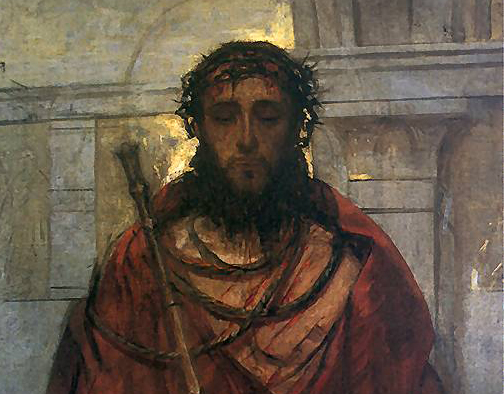
Ecce Homo by St. Adam Chmielowski (1881)

This year, Patriot Day is observed as our southern-most state is being ravaged by Hurricane Irma, the people of Houston struggle to rebuild their lives after Hurricane Harvey. These events cause us to reflect upon the presence of evil in the world, the chaos of Mother Nature which displaces families and disrupts life, and the evil in men’s hearts which lead to terrorism and war.

St. Paul wrote about suffering in our reading from his letter to the Colossians today. But his response to suffering is surprising. He doesn’t curse God, as Job did. Rather, he claims to rejoice in his sufferings. Paul suffered prison, shipwreck, beatings, starvation, and exhaustion, and ultimately death for the sake of the Gospel of Jesus Christ. And he saw his sufferings as gifts from God because they enabled him to understand more deeply the salvific meaning of suffering, they enabled him to understand more deeply the love of Christ.

Fulton Sheen was fond of saying that, the great tragedy in life is not suffering, but suffering that goes wasted, suffering that we do not allow to bring us closer to God.

Following the September 11 attacks the churches were packed. Our nation rightly responded to evil by falling to our knees, not simply praying to God to alleviate our suffering, but to help us to learn, so that evil may not be repeated.

And yet the lesson of suffering was only headed by some. Instead of drawing closer to God, repenting of sin, uniting to Christ through his Church, many dug in their heels to building a culture of death. Instead of stretching out the withered hand, they clutched all the tighter at perversion, greed, and power.

May God have mercy on all those who suffer, may He have mercy on our nation, which often seems hell bent on self-destruction, may faith increase and evil be renounced for the glory of God and salvation of souls.

- - - - - - -

That through Our Lady, Queen of Peace, terrorism and war, and the cheapening of human life may be brought to an end.

For all those who harden their hearts toward God, for those who have left the Church, for all those in serious sin, for their conversion and the conversion of all hearts.

That our civil representatives may use their authority to lead and build our nation in godly ways.
For Pope Francis’ prayer intention for the month of September: “That our parishes, animated by a missionary spirit, may be places where faith is communicated and charity is seen.”

For the sick and afflicted, the homebound, those in nursing homes and hospitals, for victims of natural disaster and inclement weather, those who suffer from war, violence, and terrorism, for the mentally ill, those with addictions, the imprisoned, the unchaste, for the comfort of the dying and the consolation of their families.

For the deceased members of our families, friends, and parish and all the poor souls in purgatory, for deceased priests and religious, and for those who have fought and died for our freedom. We pray.
Incline your merciful ear to our prayers, we ask, O Lord, and listen in kindness to the supplications of those who call on you. Through Christ our Lord.