Showing posts with label MLK. Show all posts

Sunday, September 18, 2022

25th Sunday in Ordinary Time 2022 - "Let justice roll on like a river"


 About this time of year, seven years ago already, Pope Francis made a Papal Visit to these United States. He met with our national leaders in Washington and presided over the Canonization of St. Junipero Serra; he addressed the United Nations and visited the 9/11 World Trade Center Memorial in New York, and he spoke to families at the World Meeting of Families in Philadelphia. 

While in Washington, the Holy Father addressed Congress. There he invited people of all faiths to consider one of the great American champions for justice, Dr. Martin Luther King, Jr. He spoke of Dr. King’s “dream” of civil and political rights for people of every race, and his call for all Americans to work together to build a nation of justice and peace. 

Justice is one of the famous themes of the prophets.  “The Lord is a God of Justice” Isaiah says. “Learn to do right; seek justice. Defend the oppressed. Take up the cause of the fatherless; plead the case of the widow.” Zechariah says, “Administer true justice; show mercy and compassion to one another.”

The prophet Amos in our first reading this weekend speaks about Justice. Amos, by the way, was often quoted by Dr. King. In his famous “I have a dream speech” Dr. King, evoked the prophet Amos when he said “Let justice roll on like a river, righteousness like a mighty stream!” 

What is Justice? Simply, Justice is a virtue by which we give to others what we owe them—to give God what belongs to God, to family what we owe to family, to neighbor what we owe to neighbor, to those in authority what we owe to them, and so on.

In the first reading, Amos is sent by God to the Jewish people who were failing to be just. “Hear this, you who trample upon the needy and destroy the poor of the land! Talk about grave injustice. "When will the new moon be over," you ask, "that we may sell our grain; and the Sabbath, that we may display the wheat?”  What’s going on here?

Well, the festival of the new moon was a key religious Jewish observance and during that time you didn’t do business.  And of course, the Sabbath day, was a day of rest, a day of prayer, of sacrifice, when you don’t work.

So, Amos here is calling to repentance his fellow Jews who are so concerned with their business operations and money making that they squirm with impatience during the religious observances.   They can’t wait to get back to work and get this religious stuff over with. They are failing to give God their undivided heart—which they owe him, as a matter of justice. Moreover, they were cheating the poor, tipping the scales in their favor. Their dishonesty in business, exploiting the poor, was a grave injustice. 

So, Amos was sent by God to let these people know God sees you. God sees your injustices and He is not pleased. And you will not escape the consequences of your injustices—unless you repent and make restitution.

Perhaps this is why there has been in the last few decades such a push to remove reference to God from civic life—the wicked hate to be reminded that they will face judgment. Especially Sundays have become divorced from God. Some of you may remember that just a few decades ago, Sunday was a day for God and family.   If you wanted to get gas for Sunday, you had to run out on Saturday night because Sunday morning Sohio gas station would be closed. The stores were closed. 

Now, Sunday seems an awful lot like any other day.  Practically all of the stores and restaurants are all open on Sunday. People aren’t squirming to hurry through their religious obligations; they are skipping them entirely. Less than 20% of Catholics in our country go to Mass on Sundays. In most European countries, it is even less than that.  

In line with the prophet Amos, from a biblical perspective, this loss of the importance of the Sabbath is nothing short of disastrous.  When we replace the Sabbath with human activity, religious life will soon evaporate. And how many of us have seen this in our own families. I know I have.

For when you begin to think you don’t owe God anything, you will soon come to believe you don’t owe anybody anything. Including respect and just treatment. 

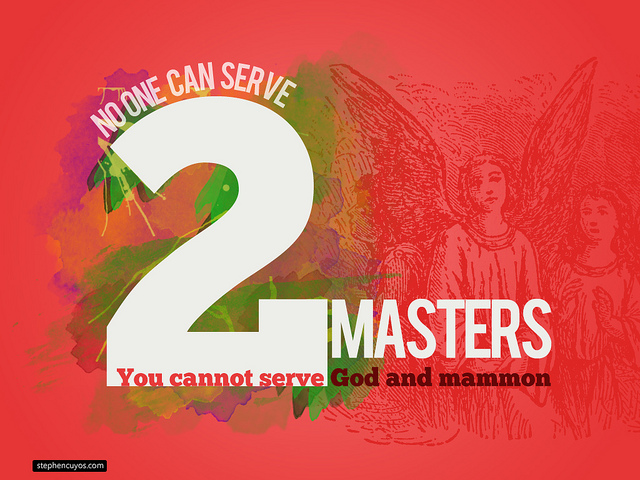
In the Gospel today, we heard of the dishonest steward. The dishonest steward gets caught for his unjust use of time and handling of his master’s resources. That’s us folks. We’ve been caught. We’ve sinned. And so, like the dishonest steward, we need to make good, prudent, shrewd use of the time we have left. We have to make a choice: choose your master, God or mammon. Jesus says we can’t serve both. One of them requires our undivided hearts.

Daily prayer, it’s a matter justice, we owe it to God. Obedience to the commandments, it’s a matter of justice, we owe it to God. Faithfully adhering to the laws of the Church, learning and adhering to Catholic doctrine, confessing our sins when we’ve transgressed, supporting the works of the Church and charity toward the poor no matter their race or creed or personal politics, showing mercy to those who ask of it, diligently using our time, resting on the Sabbath, giving God an undivided heart, these are all matters of justice.

Justice, as I mentioned, is a virtue. When we practice it we grow in holiness and happiness. Justice is a foretaste of the resurrection—when all injustice will be eradicated in the world and in our hearts. And we can grow in virtue in a number of ways. By seeking to avoid even the smallest injustice toward neighbor; by paying our debts and fulfilling our promises in a timely manner; by avoiding doing any harm in word or deed to the reputation of others; by showing special concern for the poor; and by giving to Caesar what is owed to Caesar, and to God what belongs to God.

We especially grow in justice toward God when we engage in the daily discipline of prayer, acknowledging and thanking God for the blessings he showers upon us; making sacrifices for the work of the Church.

The prophet Amos says “Hate evil, love good, and establish justice”. Catholics have a grave duty right now, to help reestablish justice in our country—recovering the importance of justice toward God and neighbor, justice in business, justice in politics, justice on Sundays, justice in public and justice in private, justice in the life of the Church. The just shall be remain in the hands of God, and no torment shall touch him.  In the words of the Psalm, “may justice flourish in our time, and fullness of peace” for the glory of God and salvation of souls.

Sunday, September 18, 2016

Homily: 25th Sunday in OT 2016 - Serving God with undivided hearts

Remember, it was this time last year, when Pope Francis visited the United States. He visited Washington and presided over the Canonization of St. Junipero Serra, he addressed the United Nations and visited the 9/11 World Trade Center Memorial in New York, and he spoke to families at the World Meeting of Families in Philadelphia.

While in Washington, the Holy Father also addressed Congress. There he invited people of all faiths to consider one of the great American champions for justice, Dr. Martin Luther King, Jr. He spoke of Dr. King’s “dream” of civil and political rights for African Americans, and his call for all Americans to work together to build a nation of justice and peace.

In his famous “I have a dream speech” Dr. King, evoked the prophet Amos, from whom we read today. “Let justice roll on like a river, righteousness like a mighty stream!” What is Justice? The prophets over and over again speak of justice, what are they talking about? The Catechism, the Popes, the saints, call upon Catholics to work for justice in society. So what is justice? Simply, Justice is when people receive what is owed to them—our natural rights—the right to life, liberty, the pursuit of happiness.

It is a matter of justice to give people the respect they deserve, safety, medical help, the type of education which helps them to flourish. When they are deprived of these things, it is an injustice. The prophets, over and over again speak of justice. “The Lord is a God of Justice” Isaiah says. “Learn to do right; seek justice. Defend the oppressed. Take up the cause of the fatherless; plead the case of the widow.” Zechariah says, “Administer true justice; show mercy and compassion to one another.”
Jesus himself, in recalling the Great Commandments teaches us to “love our neighbor as ourselves” even to go out of our way, like the Good Samaritan, to help those in need.

This particular topic sometimes causes us to squirm in our seats a little bit, because we know, deep down, that often we do not give enough, we do not care enough, volunteer enough, pray enough.
Listen again to Amos: “Hear this, you who trample upon the needy and destroy the poor of the land!
"When will the new moon be over," you ask, "that we may sell our grain; and the Sabbath, that we may display the wheat?”  What’s he saying here?

The festival of the new moon was a key religious Jewish observance and during that time you didn’t do business.  And of course, the Sabbath day, was a day of rest, a day of prayer, of sacrifice; we are to avoid work on the Sabbath, in keep with the 3rd commandment.

So, Amos is speaking to those who are so concerned with their business operations and money making that they squirm with impatience during the religious observances.   They can’t wait to get back to work and get this religious stuff over with so they can make money because deep down they love money more than they love God and certainly more than they love the poor.

Jesus in the Gospel, today speaks of the choice we must make: choose your master: God or mammon. To serve a master requires total, exclusive commitment. Though many people seek to serve both God and money, Jesus points out that this is not possible. It is an injustice when we love money and serve money because we are failing to give our true, full, and undivided devotion to God.

God is to be our master. We are to give him our undivided hearts. That in a sense, our wealth, our money, our time do not belong to us. They are meant to be used for God’s will, not our selfish pursuits. If God is the master, we are but stewards. Of course that means taking care of our families, providing shelter, education, and some healthy leisure for ourselves. But our wealth, our time, talent, and treasure, is not meant to do our own will, but the will of God.

I think Pope Francis has done a very challenging thing in calling this Holy Year of Mercy, challenging every one of us, like the prophets challenged Israel, to consider how we are using our time, are we using our time justly, mercifully?

Jesus in this parable of the steward calls us to be prudent, honest, intelligent and generous stewards of the gifts we have been given, to ensure we are giving God the first fruits, not the left overs. Stewardship is a matter of justice.

In the Old Testament we find the ancient devout practice of tithing, giving 10% to the Lord. To some this might seem excessive, but it at least causes us to consider how much do I give? There are 168 hours in a week, let’s say we spend a third of that sleeping. Let’s say roughly 110 waking hours. Besides the hour we spend at Mass on the weekend, do we come close to giving 10% of our time to God in prayer, scripture study, meditation?

There is of course no absolute demand that 10% of one’s income is given directly to the Church, but when we consider our finances, what percentage is really going to charity and the upkeep of the parish?

Am I even involved in any form of merciful work, volunteering, helping to make the world a kinder, gentler, more peaceful place?

What changes in my own life need to be made, so that I can truly say I give an undivided heart to Christ?

Not that we should expect anything back, but we never regret the time we give to God, the time we give helping others. We often discover we receive so much more than what we give.

When I think of the type of Christian I want to be, the type of priest I want to be, I think of our dear good priest, Father Wendelken. As many of you have heard, perhaps yet, you haven’t, Father Wendelken passed away on Wednesday evening, the feast of the exaltation of the holy cross, after being diagnosed with cancer several months ago.  Father Wendelken had a gigantic heart for those in need, had a deep, passionate love for the Church and the priesthood, and was filled with tremendous joy after a life of prayer and sacrificial priestly service.

Father Wendelken was the beloved pastor of St. Rita parish for many years, and it is there that his funeral and wake will be held this week. Beginning with a prayer service presided over by Bishop Lennon, his wake will be held at St. Rita church in Solon from 3 to 7pm on Tuesday. Bishop Gries will be the main celebrant of the funeral Mass at St. Rita’s at 11am on Wednesday.

After his retirement Father Wendelken returned to reside here at St. Clare. He spoke often of how blessed he was for being here, for the kindness he was shown, by the parishioners here. Please remember Father in your prayers this week.  He died very peacefully, surrounded by his family, after having received the refreshment of the Sacraments.


Please prayer for his soul this week, and for the consolation of his family, and those who touched so deeply in his priestly ministry. And this week, may each of us be generous in asking the Holy Spirit to lead us to work for justice, righteousness, and peace for the glory of God and salvation of souls.