Friday, May 9, 2014

Homily: Friday of the 3rd Week of Easter - Ave Verum Corpus


Today’s Gospel is the last in a series of readings from John, Chapter 6, what is called the Bread of Life discourse.  Jesus has talked about how the food he gives is not just physical food, but food that does not perish; how it is the bread of life, and that those who eat this bread will be raised on the last day.

Today Jesus perhaps gives the hardest part of the teaching on the Eucharist, this bread of life is his flesh and his blood; we are to eat of it, if we are to have eternal life with Him.

This shocking statement started a quarrel amongst the disciples; and as a result of their inability to accept this teaching, some of those who had begun to follow Jesus, turned away from him and went back to their former way of life.  Nevertheless, Jesus did not recant or even modify His terminology.

St. Thomas Aquinas maintained that believing that Eucharist is truly the flesh and blood of Jesus Christ is a truly challenging doctrine.  The Eucharist does not look like Christ; thus tests our faith.  But we believe it because this teaching comes from the Lord himself.

There is a short Eucharistic hymn from the 14th century called Ave Verum Corpus, emphasizing our Catholic belief that the Eucharist is truly Jesus’ flesh and blood.   Mozart has a beautiful rendition of this hymn, which we sometimes sing today when we are daring to sing a latin hymn.  Ave Verum Corpus – Hail true flesh born of the Virgin Mary who having truly suffered, was sacrificed on the cross for mankind, whose pierced side flowed with water and blood: May it be for us a foretaste of the Heavenly banquet in the trial of death.  O sweet Jesus, O Jesus Jesus, Son of Mary, have mercy on me.

This hymn was sung sometimes during the elevation of the host at Mass or at benediction, again to proclaim our belief that in the Catholic Mass bread and wine are truly changed into the flesh and blood of Christ.
Many Catholics leave the faith by first walking away from the table, like those early disciples who walked away when the Lord gave this teaching. 


Saint John Paul II wrote at the turn of the century: “The Eucharistic Bread which we receive is the spotless flesh of Mary: Ave verum corpus natum de Maria Virgine. Sustained by Mary, may the Church discover new enthusiasm for her mission and come to acknowledge ever more fully that the Eucharist is the source and summit of her entire life.” For the glory of God and salvation of souls.

Thursday, May 8, 2014

Homily: Thursday of the 3rd Week of Easter - Spiritual Hunger


All of this week, our Gospel readings are taken from the sixth chapter of Saint John’s Gospel.  The sixth chapter of John is usually known as the “Bread of Life Discourse” because in it, Jesus speaks of Himself, as we heard today, as the Bread of Life.  In fact, Jesus refers to himself as the ‘Bread of Life’ 11 times. 

St. John Vianney said, “The soul hungers for God, and nothing but God can satiate it.  Therefore He came to dwell on earth and assumed a Body in order that this Body might become the Food of our souls"

In the years leading up to my own ordination as a priest, I realized a deepening desire for the Eucharist.  Occasionally, there would be days where I couldn’t get to daily Mass, and I would feel spiritually famished, something was missing; I’d feel a real emptiness and hunger inside me.  Many of you could probably relate. 

Spiritual hunger is different than physical hunger.  With physical food, the more I eat the less hungry I am.  With the spiritual food that God gives, the more I eat, the more I hunger. 

This is also why 75% of Catholics who do not go to Church are not banging on the doors to receive the Eucharist which they have denied themselves.  With spiritual food, the less you eat, the less you notice the hunger.  

Plenty of false spiritual food from our culture is available every minute of the day; the false spiritual food leaves us unhappy and exhausted.

Saint John Paul II wrote in one of his last letters to the Church: “God has placed in human hearts a “hunger” which will be satisfied only by full union with him. Eucharistic communion was given so that we might be “sated” with God here on earth, in expectation of our complete fulfillment in heaven.

No philosophy or scientific discovery or piece of technology  or earthy pursuit can satisfy our spiritual cravings.  No amount of money, success, fame, or power.  Only Jesus can fully satisfy.


When Jesus is fully embraced we discover he fills all emptiness and satisfies forever.  For the glory of God and salvation of souls!

Tuesday, May 6, 2014

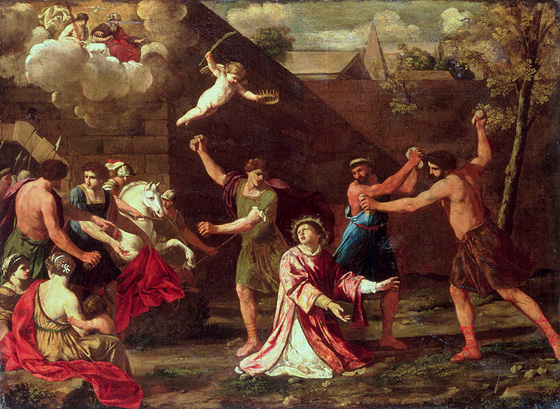
Homily: Tuesday of the 3rd Week of Easter - Stephen's Martyrdom


Yesterday, in our reading from the book of Acts we heard how Stephen, an ordained deacon of the Church, had been working miracles in the name of Jesus, and how he had, like Jesus, been arrested, and brought to trial where false witnesses accused him of blasphemy.

Today we hear how Stephen gives a sort of prophetic indictment against his accusers, who then stone him to death.  Again, notice the parallels between Stephen’s death and Jesus’.

Stephen, before he dies cries out “receive my Spirit”, as did Jesus, and prays for their forgiveness, as did Jesus.

St. Luke emphasizes these parallels to show that the work of the Holy Spirit sent upon the Church at Pentecost is to reproduce in Christians the life of Jesus—to conform us more and more closely to Christ both in life and death.

Stephen, like Jesus, met hatred and lethal violence with understanding, love, and forgiveness.  He stands up for the Christian faith, and also puts into practice Jesus’ command to forgive our enemies.  In the face of death, Stephen’s eyes are set on heaven, upon the eternal reality, granting him strength, courage, and peace.
Stephen models for us Jesus’ own surrender—showing us that all of us are to surrender our lives to the Father.  The more we practice surrendering our daily cares to God our loving Father, the easier it will be to commend our spirit to him at death.


St. Luke tells us, those who listened to his words were stung to the heart, may Stephen’s words and example sting us out of complacency to a greater surrender to God in all things for the glory of God and salvation of souls.

Monday, May 5, 2014

Homily: Monday of the 3rd Week of Easter - Stephen and Jesus


Today’s first reading sees the arrest of St Stephen for proclaiming the message of Christ and the Gospel.  In fact, St. Luke reports many similarities between Stephen’s arrest, trial, and martyrdom, and Jesus’ own arrest, trial, and crucifixion.

First we heard how Stephen was filled with grand and power and working great wonders and signs.  St. Luke records this point to emphasize that the pattern of Jesus’ life is reproduced in his disciples. Just as Jesus performed miracles, so we read in the book of Acts how many disciples, especially the Apostles perform miracles for the building up of the Church.

Secondly, just as Jesus’ teachings could not be refuted, Stephen, when debating members of the synagogue, could not be refuted: “they could not withstand the wisdom and the spirit with which he spoke.”  When we are preaching the Gospel, we can trust that we will be given wisdom that our adversaries are powerless to resist or refute.

Thirdly, when the Jews of the Synagogue become frustrated in arguing with Stephen, they resort to false witnesses, just as occurred in Jesus’ trial.

The powerful witness of the newly ordained deacon Stephen reminds us that successes in Christian ministry, especially in defending the faith against outsider’s attacks, can lead to persecution.  Yet, the Spirit fills us, like Stephen, with grace and power and wisdom and courage, to witness to the truth of the Gospel.


Stephen closely imitated our Lord in proclaiming the Gospel and being rejected and suffering for the prophetic ministry.  Both the teachings of Jesus and the example of Stephen, the first witness to die for him, remind us that with power and wisdom, the Spirit also brings us the courage to endure persecution gracefully in imitation of Christ, for the glory of God and salvation of souls.  

Sunday, May 4, 2014

Homily: 3rd Sunday of Easter - Lessons on the road to Emmaus


These Sundays after easter, the six Sundays between Easter Sunday and Pentecost Sunday are joyful ones, as we continue to celebrate the glory of that first Easter Sunday.

And throughout the Easter Season we read in Scripture accounts of the appearances of Jesus to the disciples after his Resurrection, and we have one of the most renowned of the post-Resurrection accounts today: his appearance to the disciples on the Road to Emmaus. 

It was the first Easter Sunday, late afternoon; two of the disciples were walking away from Jerusalem, pretty down in the dumps, for it appeared that Jesus had been defeated, all their hopes in Jesus had been crushed.  Jesus had died terribly on the cross and had been buried. 

So, they were walking to Emmaus, trying to get away from the bad news, when Jesus himself appeared to them and began to walk with them.

There have been volumes written about this story; I will focus on three points.

Firstly, St. Luke tells us that these two friends of Jesus did NOT recognize him, initially.  Jesus was no doubt the last person they expected; they had witnessed his crucifixion, they knew his body had been entombed.  You can imagine how so absorbed in the apparent defeat, so wrapped up in recounting the bad news, that 
Jesus rising and appearing to them and walking along with them didn’t seem in the realm of possibility. 

They were so wrapped up in the bad news of the past few days, that the good news seemed neither possible nor relevant.  I’d propose that the same temptation exists for us: to become so focused on or overwhelmed by bad news, by our own worries sorrows, that the good news seems neither possible nor relevant. 

Perhaps when faced by a particularly painful circumstance of life to ask, “God, where are you?”  Maybe to wonder if God has abandoned me, or even tempted to believe, when confronted with such evil in the world to doubt if He ever existed in the first place.  To allow the bad news of the world to overwhelm so much that our eyes are prevented from seeing Jesus Christ walking next to me, is a real danger for any Christian.
Secondly, not only did the disciples lose sight of Jesus, but they started to believe erroneous things about him.  The two disciples concluded that because of the cross Jesus was not divine, he was not God.

They had pinned their hopes on him. “We were hoping he would be the one to save us” they said, “but he was crucified.”  They had believed Jesus was the Messiah, the Son of God.   But when because of the cross, and death, and burial, their faith in Jesus as Messiah was shaken.

Then Jesus spoke to them, “How foolish you are being.  Did you not know that God has told us through the prophets that the Christ would have to suffer?” 

This is one of the arguments that Muslims often pose to disprove Christianity; if Jesus was God then he wouldn’t have died because God can’t die.  Christians answer that argument by stating; we believe that That God so loved us that he become like us to suffer for us and really died for us.  Jesus shows us the depths of God’s love for us by taking upon him the sins of the world for us and nailing them to the cross.

We heard this argument during the reading of the Lord’s Passion during Holy Week.  Matthew’s Gospel tells us that while hanging on the cross, the chief priests made the same argument, they said, “if you are really the Son of God, come down from the cross, save yourself.”  Yet, God became man not to save us from the cross, but to save us through the cross. 

Again sometimes we are tempted: whenever the cross enters our life, and does it ever unfailingly, our presumption is that God cannot be there.  Yet, Christian faith is God is precicely on the cross with us,  that as we suffer our crosses we can know, and sense, and experience God’s closeness; we can know his Divine Presence.

Do not be afraid, for I am with you always.  God can be discovered even in terrible agony.

A final lesson: when was it that those two disciples on the road to Emmaus finally woke up and realized Jesus was with them? “And it happened that, while he was with them at table, he took bread, said the blessing, broke it, and gave it to them. With that their eyes were opened and they recognized him.”  They recognized this stranger as Jesus, they recognized him as the Son of God, in the breaking of bread.

He performed those actions once before at the Last Supper, he took bread, blessed it, and gave it to them.  Now again, they recognized Jesus in the celebration of the Eucharist.

In just a few minutes you’ll hear those words again in the Eucharistic prayer, as Jesus becomes present to us here. 

Just as he was truly with at the Last Supper, truly present on the cross, truly present on the road to Emmaus, he becomes truly present here at Mass, so recognize Him once again in the breaking of the bread.

Last week, the Church rejoiced at the canonization of Saint John Paul II.  One of the last letters Pope John Paul II wrote to the Church was called, “Mane Nobiscum Domine” the latin for, “stay with us Lord” the words spoken by the two disciples on the road to Emmaus. 

The disciples urged him, “Stay with us,” Mane Nobiscum Domine, stay with us Lord.” And he went in and he gave them the Eucharist.  That prayer, “stay with us Lord” Saint John Paul teaches us, is answered in the Holy Eucharist.

Christians who have an authentic encounter with Jesus desire that the Lord remain with us.

This is why it is so important for Christians to come to Mass weekly.  When Catholics stop going to Mass they lose sight of God.  Their faith suffers.  And so many other activities and distractions which are not life giving fill in the gaps.

In an article for the Universe Bulletin, Bishop Lennon wrote, where our life is centered on a false God of prosperity, prestige, or mere pursuit of the good life—one will likely reap a harvest of exhaustion and unhappiness.  But, the person and family, who places Christ at the center of life, including God in  their weekly schedules and activities, meals, chores, conversations, parenting, work, vacations, civic responsibilities, decisions, problems, crises, accomplishments, losses—the whole of their lives become changed and charged with God’s presence.

Saint John Paul said, “the Eucharist is a mystery of light.”  When we come here to Mass, light is shed upon our lives; our lives become filled with his light.  It is here that we receive the light to see that God is with us in our darkest hours, to see how to love each other as God loves us.


Upon recognizing the Lord,  the disciple of Emmaus “set out immediately”, in order to report what they had seen and heard.  May we go forth from this Mass with greater urgency and faith to proclaim the Good News and imbue our society with Christian values for the glory of God and salvation of souls.

Friday, May 2, 2014

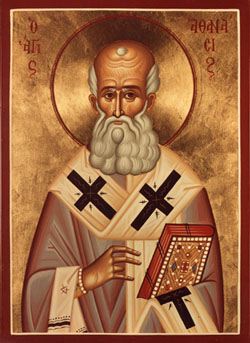
Homily: May 2 - St. Athanasius - Commitment to Truth


Catholics are often called upon by God to make a courageous stand in defense of truth while facing the world’s opposition.  St. Athanasius was one of the great defenders of truth in the Church’s history. 

In the 4th century, Alexandria, Egypt was a major center of Christian activity and thinking.  Around the year 323 a priest named Arius began to teach what is now known as the Arian heresy, that “Jesus, though more than man, was not eternal God, that he was created in time by the Eternal Father, and could therefore be described only figuratively as the Son of God”.  Though this heresy was quickly condemned by the patriarch of Alexandria  and by the Council of Nicaea in 325, Arianism spread like wildfire. 

In 326 Athanasius was made bishop of Alexandria.  As he stridently defended the doctrine of Jesus’ divinity, he faced opposition from emperors, magistrates, and many intellectuals of his day.

As he often seemed to stand alone in his position, his contemporaries said of him, “Athanasius contra mundi”, or “Athanasius against the world.”

Bishop Athanasius was exiled from his diocese by Arian heretics five times—spending 17 years of his life in exile.  Yet, from exile, he continued to write against the heresy and teach the true faith.  He is known in Church history as the hammer of heretics.

There are times when it seems we are standing alone in preaching the Catholic faith.  But we are never truly alone; when we stand up for truth, we are always in communion with the great fathers of the Church, with the Apostles, and the Lord Himself, who called himself Truth.


Commitment to Christ means commitment to Truth.  In an age of cultural relativism and moral error, our world needs the truth of Christ preached clearly, consistently, and courageously.  May we like the great Saint Athanasius, have the fortitude and perseverance to defend the true faith without counting the cost for the glory of God and salvation of souls.

Thursday, May 1, 2014

Homily: May 1 - St. Joseph the Worker


The Feast of Saint Joseph the Worker was instituted in 1955 by Pope Pius XII to be celebrated on May 1 as a sort of alternative to the Communist May Day marches.   The Church wanted to proclaim that Human Labor is transformed into a very good and holy thing, when it is offered to God.

St. Joseph has two feast days on the liturgical calendar. The first is March 19—Joseph, the Husband of Mary. The second is May 1—Joseph, the Worker

Pius XII raised up for us the wonderful example of Saint Joseph, who offers himself totally to God, to remind the world that human labor is not just about building a communist utopia, or making a name for ourselves.  Our labor is to respect God, reflect God, and always be at the service of God.

The Psalmist says, “Unless God is the builder, our building is in vain.”  Saint Paul says, “whatever you do, in word or in deed, do everything in the name of the Lord Jesus, giving thanks to God the Father through him”.
The communists proclaimed the State to be the end which all human efforts should support.  For the atheist communist, eternity does not factor into the equation.  When we take God’s eternal plan out of the equation, in whatever we do, we turn our labor into an idol.

Human work, as we know too well, can become an idol, or a means to support idol worship.  In an article for the Universe Bulletin, Bishop Lennon wrote, where our life is centered on a false God of prosperity, prestige, or mere pursuit of the good life—one will likely reap a harvest of exhaustion and unhappiness.  But, the person and family of faith, who places Christ at the center of life, including their weekly schedules and activities, meals, chores, conversations, parenting, work, vacations, civic responsibilities, decisions, problems, crises, accomplishments, losses—the whole of their lives become changed and charged with God’s presence.

Saint Joseph is a tremendous example for each of us: he put Christ at the center of his life, he served God in all his endeavors, he labored for the good of his family.  He is a reminder for all laborers to keep God as part of your work, and in doing so we become cooperators with God.  God brings about great goodness when we unite our labors with His.

May St. Joseph whose labors continue to touch us 2000 years later, help all workers and all of us to keep Christ at the center of our lives, for the glory of God and salvation of souls.