Monday, December 22, 2014

Homily: Monday of the 4th Week of Advent - Magnificat


After the Annunciation, Mary went out in haste to her cousin Elizabeth.  The mere greeting of Mary, who had in her womb the Word of God made flesh, made the infant in Elizabeth’s womb leap for joy.  Elizabeth proclaimed Mary blessed.  And Mary spoke her beautiful Magnificat. 

Since Seminary, I’ve prayed the Magnificat every day. The Canticle of Mary as it is sometimes called, is part of the Church’s official Evening Prayer, and is prayed every day by priests and religious, all over the world.  No matter what time of day it is, two things are true.  Somewhere in the world, a priest is celebrating Mass, and he is praying his breviary.  So along with the other prayers of the Church, the Magnficat is being sung all day, every day. 

It is always inspiring to pray Evening Prayer with a group of priests.  The Psalms change every day, so for the recitation of the Psalms we hold our prayer books close.  But, when we get to the Magnificat, all or most of the priests close their books, and often close their eyes and recite these words of the Blessed Mother from memory, or should I say, from their hearts.

I’ve known priests to burst into the magnificat at times of great joy in their own lives.  The memorization of a prayer, a pslam, or another line of scripture can be a powerful thing. Carving the words of Scripture upon our hearts, we make a place for God to dwell.

Mary herself must have had some scripture memorized, for her Magnficat echoes the song of Hannah from the first book of Samuel.  After prayering for many years through a time of barrenness, Hannah, conceived in her old age, and offered a song of thanksgiving to God.  She praises God as the helper of the weak, who casts down the mighty and raises up the lowly, and who alone is the source of true strength.  And Hannah’s song was richly inspired by verses from the Torah. So she too, must have known some scripture.

Pope Benedict wrote, “Mary is the great believer who humbly offered herself to God as an empty vessel for him to use in his mysterious plan.  She did not try to live according to human calculation, but put herself completely at the disposal of God’s mysterious, incomprehensible design.  All she wanted to be was the instrument and servant of the Word.  Despite the fear of the unknown, despite all of the inexplicable demands God made on her, she believed, even as she faced a task that no other human being had ever, or would ever have again, to mother the incarnate Son of God.”

May each of us, like Mary, become an empty vessel to be used in God’s mysterious plan.  May we trust in God amidst all of our fears, and be filled with great joy in his service, for the glory of God and salvation of souls.


Saturday, December 20, 2014

Homily: 4th Sunday of Advent - Mary, the Queen Mother


All four candles of the Advent wreath are lit, for we are on the threshold of Christmas.  And it’s important to use these few days the best we can to prepare well for the Christmas mysteries. 
As we get ready to celebrate the birth of Christ our King, on this fourth Sunday of Advent we heard in our First Reading of God speaking to another King— King David.  God tells King David of his desire to make his dwelling place among his people and to establish a kingdom that will last forever.  In this eternal kingdom God’s people will be able to take refuge from their enemies and to have an intimate relationship with God as a Father to a Son.

David is told that his descendent—the King of Kings—will sit on a throne that will last forever.  When a new king would begin his reign, the people would no doubt wonder—“is he the one?”  We can read about the Kings of David’s line throughout the Old Testament books of Kings and Chronicles.  But is it not until the Gospels of the New Testament that we meet this Jesus of Nazareth, a descendent of David, who is the King of Kings and Lord of Lords. 

Throughout the Old Testament, when the Scriptures detail the beginning of the reign of the new Davidic King, always mentioned is the name of the King’s mother. In Israel, the most important woman in the kingdom was not the Kings wife—he may have had many wives, some of whom were not even of Hebrew blood.  The most important woman in Israel was the King’s mother—the Hebrew title for her, the queen Mother is Gebirah.  The Gebirah was the King’s chief counselor.  Her coronation was celebrated all people, and she sat on a throne on the right hand of the king. 

Even when the king died, the Queen mother was not deposed, she continued to exercise an essential role in the political, military, and economic affairs of the kingdom. 

So in the Old Testament, as an introduction to the reign of the new king, we would first focus on his mother.  And how fitting that Saint Luke does the same thing, before writing about the birth of Christ he first mentions several important stories about Jesus’ Mother.  And how fitting it is that we prepare for the celebration of Christmas by focusing our attention as well on his mother.

In the Davidic Kingdom, the Queen Mother sitting beside the King was not only his chief counselor, but also  the primary intercessor between the people and the king.  When the poor had a particular need, they would bring it to the queen mother, and she would present it to the king who loving and respecting his mother’s counsel, would grant the request.

If a humble peasant wished to present a small gift to the king, it would first be given to the queen mother who would polish the gift, put it on a golden plate, surround it with flowers.  The king would never refuse the gift coming from the queen who showed such concern for the poor peasant. 
So too, we do well to bring our humble prayers and good deeds to Mary, to present to our Lord.  She accepts our meager offerings purifies them, beautifies them and presents them to the King.  If you wish to present something to God, no matter how small it may be," says St Bernard, "place it in the hands of Mary to ensure its certain acceptance."

Whenever we begin a charitable work or undergo a difficult trial, we do well to consecrate it to Mary, Our Queen.

Particularly, now, as we prepare for Christmas, we do well to ask our Queen Mother to help us.  That we may come to love the Christ Child as she loved Him—with perfect, burning charity.

Archbishop Fulton Sheen wrote in his autobiography, “the only sorrow in my life, or any life, is not to have loved Christ enough.”  If we are to show our love for Christ at Christmas, we do well to look to the example of the woman whose love for Him surpasses all others. 

St. Alphonus Ligouri talked of Mary’s great love for us and for God.  He wrote, “neither the angels nor saints surpass Mary in loving God” and “no one, after God, loves us or can love us as much as Mary.  If we were to combine all the love that mothers bear their children, all the love of husbands for their wives, all the love of the angels and saints for the souls all earth, all this would not equal Mary's love for a single soul.” 

Her great love and surrender to God can be seen in our Gospel reading today, when she says, “I am the handmaid of the Lord, let it be done to me according to Thy Word.” 

Also, as soon as Mary found out that Elizabeth was with child, Mary was concerned that Elizabeth’s pregnancy would be difficult for she was advanced in years.  So, Mary left the comfort of Nazareth to help. St Luke tells us that, prompted by concern for Elizabeth and love for her cousin, Mary goes in haste to help.  She goes in haste. 

Now think of what this journey meant for Mary.  Elizabeth and Zechariah weren’t just a drive across town.  They lived in the hill country of Judea, outside of Jerusalem.  This would be a difficult journey for the young pregnant teenage Mary of Nazareth. 

But also, Mary had her own problems: she was with child. She was betrothed to Joseph but carrying a child that was not his.  She would have to explain her pregnancy to her parents, to her fiancĂ©.  How was she going to provide for her child if Joseph ended the engagement, as was his right.  What would it be like to be mother to the King of Kings?  She could have stayed at home feeling sorry for herself, worrying, comparing herself to Elizabeth.  At least Elizabeth had a home and a husband. 

The fear of the unknown often paralyzes us.  Our Queen mother shows us to look beyond our own problems and worries to the needs of others.  If we are overly concerned for ourselves, we miss God calling us to help with the needs of others.


To prepare well for Christmas we look to our Queen Mother, we ask her intercession that we may love God and neighbor like her, that we may trust God like her.  Faithful and obedient to God’s commands like her, pure of sin and full of hope like her, may we humbly serve God and celebrate the saving power of God at Christmas like her, for the glory of God and salvation of souls.

Friday, December 19, 2014

Homily: Thursday of the 3rd Week of Advent - Samson and John the Baptist


As we draw ever nearer to the great feast of Christmas, our scripture reading urge us to reflect today on two very important people from Salvation History: Samson from our first reading and John the Baptist in our Gospel. And these two men, these servants of the Lord have a lot in common.

In both readings today, their parents were very old when an angel appeared to them to announce their births.  Elizabeth was 88 years old when Gabriel appeared to her husband to announce the birth of John.

In the readings we heard how both Samson and John were to be especially consecrated to the Lord, they were both to avoid wine and strong drink.  The Spirit of the Lord would be present to both of the boys. 

Both boys would have a role in delivering and saving Israel from their enemies.  Samson was chosen by God among the people to deliver Israel from the evil Philistines, to show and remind Israel that God had not abandon them so they should not abandon God by falling in to sin.  With his life, Samson showed the people that God drew near to save them.

Similarly John the Baptist was chosen to show and remind Israel that God had not abandoned them, that God drew close to save them not just from earthly enemies, but our most ancient enemies, sin and death.  John announced to the people to get ready for the coming of the Messiah by repenting.  The best way to make our hearts ready for the Messiah is by turning away from our sins.

Both Samson and John the Baptist heralded an ear of peace.  Samson heralded the establishment of the Kingdom of David who would bring unity to Israel and the building of the beautiful Temple in which God would be honored and worshiped by his people.  And John heralded the coming of the True King of Kings and Lord of Lords, who is the source of peace for the whole human race and whose Church would be the Temple in which all people could gather to give honor and worship to God until he comes again.

During these final days of Advent, we focus on this chosen men, to remind us that each one of us has been chosen by God for a special purpose: to proclaim with our lives that God is near, that salvation and peace are found in Jesus Christ.  People need to see us coming to Church to give God worship and honor for the good things he has done for us and continues to do in our midst. 


Both Samson and John called people to turn away from sin and be faithful to God’s laws, and we too prepare our hearts well in order to truly welcome Christ when he comes more deeply into our lives for the glory of God and salvation of souls.

Monday, December 15, 2014

Homily: Monday of the 3rd Week of Advent - On whose authority?

On Wednesday, the Church enters into the period of what is called Deep Advent, from December 17-December 24.  During the first two weeks of Advent, our readings concern the prophecies of the coming Messiah, now, during this second half of Advent we begin to focus more intensely on the person, identity, and mission of Jesus Christ.  When we understand Jesus better, we come to understand better what our daily response to him should be.

St. Matthew this morning gives us two very important concepts to consider about Jesus’ person, identity, and mission: his “authority” and his origin—that he comes “from heaven”.

Today’s passage comes very soon after Jesus entrance into Jerusalem.  He had entered the temple and overturned the tables of the money-changers and merchants, teaching that his Father’s temple is to be a house of prayer, not a den of robbers.  He then began to cure the blind and the lame.  He then began to teach about faith with authority.

The elders questioned his authority, and Jesus refused to answer their question directly.  Advent for us requires a choice, for all those who hear of his deeds, for all those who hear about Him, we are called to make a choice, is Jesus going to have authority in our lives or not.  If he is just a man, then no, of course not, his words and teachings are no more authoritative than any other.  Yet, if his authority comes from God, and of course it does, then we must conform our lives completely.  It is not up to us to pick and choose which teachings we like, and just follow those. 

Sadly, many modern-day Catholics have made themselves the authority.  They ignore or reject authoritative teachings of the Church which Jesus founded.  This is somewhat understandable.  After all, in our own time we have seen authorities grossly misuse their power. In recent decades we have seen the authoritarianism of Nazi and Communist regimes. 

Archbishop Fulton Sheen once wrote that “as soon as one mentions the authority of [the Church] there are visions of slavery, intellectual servitude, mental chains, tyrannical obedience, and blind service.”  He said, “There is nothing more misunderstood by the modern mind than the authority of the Church.” 

The authoritarianism of tyrants is altogether different from the authority of Jesus and the Church, the authority that comes from heaven.  The authoritarianism of tyrants does enslave.  The authority of God, rather, comes to free: to free us from the slavery of sin, to free us from the burden of being our own god. 


We do well to consider today the areas of our life that we have not handed over to Christ.  If we are honest we are likely to find a few, if we are very honest, we are likely to find many.  It is no easy task to give up our authority, yet Advent calls us once again to bow the knee to Christ the King, in whom we find true freedom, true peace for the glory of God and salvation of souls.

Monday, December 8, 2014

Homily: December 8 - Immaculate Conception - Potuit, Decuit, Ergo Fecit

About seven hundred years ago, there was a little Franciscan Friar by the name of John Duns Scotus, teaching Theology at the University of Paris, probably the most important school in the world in the 1300s.  One day, one of his students asked him to explain the Doctrine of the Immaculate Conception of Mary, and he said simply, in Latin of course,” potuit, decuit, ergo fecit”.  God could do it, it was fitting that he do it; therefore, he did it.

Could God preserve Mary from all stain of original sin from the moment of her conception? Absolutely.  The Archangel Gabriel in the Gospel today said it perfectly: “nothing is impossible for God”.

Did he do it?  Yes!  When Gabriel met Mary, he greeted her as one already having been made full of grace.  Mary received many special graces from God throughout her life, one in particular which kept her soul clean of sin at the first moment of her life.

Why did God do it?  Friar John Duns Scotus said, it was fitting.

Suppose you had the power to design the soul of your own mother.  Would you not make her the most beautiful woman in the world both on the outside and on the inside?  Would you not make her to radiate every sort of virtue? Every manner of kindness and charity and loveliness? A mother who by the purity of her life and her mind and her heart would be an inspiration not only to you but to everyone?

Knowing that he would come into the world as our Savior, God made Mary’s soul the most beautiful in human history; that when he did come, born as a babe in Bethlehem, he could be in the arms of a mother who loved him completely.

Jesus chose Mary to be his own Mother, and he chose her to be our Spiritual Mother.  All throughout his own difficult ministry, as he was whipped and scourged, and crowned with thorns, and nailed to the cross, Jesus knew that Mary loved him.  So too through all of our difficult journeys, Mary loves us.  She watches over us, prays for us, dispenses graces from God to us.

When you are sick?  We call out to our mothers to bring us medicine.  When we are scared.  We call out to our mothers to bring us courage.  When we are doubtful, we call out to our mothers to give us direction.

So we are meant to do with our perfect spiritual mother Mary, whom God made immaculate for himself and for us.

As we continue this Holy Mass, let’s thank God for blessing us with so beautiful a mother, and let us ask for the grace to be her faithful children, for the glory of God and salvation of souls.

Sunday, December 7, 2014

Homily: 2nd Sunday of Advent - A New Beginning

On this second Sunday of Advent we read the opening lines of Saint Mark’s Gospel.  St. Mark’s Gospel was written between the years 60 and 70, just a few years after the deaths of Peter and Paul at the hands of the Roman authorities.  In fact, St. Mark had been a very close companion to the Apostle Peter, traveling with Him to Rome, where Peter was put to death.  Mark was not an eyewitness to the actions and teachings of Jesus; he learned the details of Jesus’ Ministry which he put into his Gospel from Peter.  Mark composed his Gospel most likely in Rome, in the heart of the city that put his friends to death, while his fellow Christians were being thrown to the lions in the Coliseum.

The Opening Lines of ancient texts, such as the Gospels, are often very important, encapsulating the author’s purpose for writing.  Listen again to Saint Mark’s opening line: “The beginning of the Gospel of Jesus Christ the Son of God.”

The very first word of Mark’s Gospel is the greek word, arche—the beginning, found also in the opening line of the Gospel of St. John.  In arche ho logos, wrote Saint John, in the beginning was the word.  And the first words of both of those Gospels harken back to the very first word of the entire Bible itself in the book of Genesis. The first word of the entire bible is the Hebrew Word, Bereshyth – “in the beginning.”  “In the beginning God created the heavens and earth”—the story of creation.
And Mark uses this word purposely telling us that this Gospel is the story of a new creation—it’s a new beginning.

We know we live in a fallen world, a world torn apart by violence and sin and selfishness and perversity, a place where things are not as they should be, not as God intended.  The world is good, it is not completely fallen, but amidst the goodness of the world, we realize that things are off-kilter, people die before their time, good people suffer, wicked people prosper.

St. Mark’s Gospel isn’t merely a story about an inspiring ethical teacher who performed a few miracles. St. Mark uses this word, arche, intentionally to show that just as God brought creation into existence, through Jesus, God is bringing about a new order, a restoration, a healing of all of creation, and reconciliation between God and man.

The second word in the Greek, is the word euangelion  from which we get the word, evangelize.  The Greek word euangelion means glad tidings or good news, we translate it often, Gospel.  At the time of the birth of Christ, the Romans worshipped Caesar as a God, in fact, a title for Cesar Augustus was “Son of God”.  Caesar’s birthday was called the ‘Good News’ the Gospel.  To use this word in Rome, to apply it to someone other than the emperor, was very dangerous.

Euangelion in Mark’s time was also a word used to announce an imperial victory—when the emperor won a battle, the angeloi—the messengers—were sent around the empire announcing the euangelion—the victory message of the emperor.
And Saint Mark has the audacity to announce from the belly of the beast, from the heart of Rome, the capital of this great empire, that the true euangelion is not the birth of Ceasar, it has nothing to do with an imperial victory—the Gospel that St. Mark was announcing is the victory of Jesus Christ over the powers of sin and death—and the ushering in of God’s kingdom which is greater than any earthly kingdom.

St. Mark had tremendous courage proclaiming that Caesar was not the Son of God, it is not Caesar who is the anointed Christ of God, rather, it is Jesus of Nazareth.  It is his kingdom that will have no end. This is why the symbol for St. Mark’s Gospel by the way is a lion, a symbol of courage.

St. Mark’s opening passage continues, recalling the prophecy of Isaiah which we also heard today, of a voice crying out in the wilderness, in the desert, prepare ye the way of the Lord.  In the first 39 chapters of Isaiah, the prophet explains that the terrible calamity that had befallen the Jewish People is because of their unfaithfulness to God.  Because of their sins, because they did not uphold the ways of the Lord, because they did not teach their children to be faithful, they had become vulnerable to their enemies and had been captured and carried away into exile by the Babylonians.  Jerusalem was destroyed, the temple was destroyed, the people marched into Babylonian captivity.

The 40th Chapter of Isaiah is also a new beginning; it begins Isaiah’s message of Consolation. The prophet describes a time where God will restore, he will rebuild, he will bring the exiles home.  St. Mark draws upon this image to show that the Gospel of Jesus Christ Son of God begins the definitive story of God bringing the exiles home.  Jesus is the consolation for which Israel longed; and all those who are lost in sin, all those who are captive to the powers of the world, will find freedom in Jesus Christ.  This is very good news, so Isaiah says, “Go up on to a high mountain, Zion, herald of glad tidings; cry out at the top of your voice”.

The life of every Christian should involve telling others about the Good News.  Reaching out to people who feel enslaved, caught in the chains of addiction or fear or grief; they feel helpless, hurt by the selfishness of others, frustrated.

There are people out there who don’t know Jesus Christ.  Sometimes even baptized Catholics don’t know Jesus Christ.  Pope Francis and Pope Benedict have called them, baptized pagans: people who have been sacramentalized but never evangelized—who may have been baptized, but never really came to follow Christ.  Catholics who perhaps went to Catholic school for 12 or more years, yet get married outside of the Church, or stop going to Church altogether, or reject certain teachings of Jesus.  I think there have even been priests who make it through seminary without really encountering Jesus as Savior.

The season of Advent is to prepare our hearts for Jesus Christ to come into our hearts in a new way.  We make straight the paths of our hearts, we prepare our hearts to make  place for Him.  Through prayer, repentance, acts of charity we carve out a place in our hearts for Christ to dwell.  During Advent, especially, we need to set aside time every day for quiet prayer, for reflection.  We become quiet, that we may encounter the Lord.  Only then can we truly be filled with the glad tiding of Christmas, the good news of Jesus coming to set captives free.

St. Mark wrote his Gospel for people who feel exiled, captive, alone, afraid, frustrated, oppressed. He wrote his Gospel for the Church and all humanity who long for a deeper knowledge of Christ, who long for him to return again.  As an Advent meditation, I highly encourage you to read the Gospel of Mark, from beginning to end: it’s the shortest Gospel, taking maybe an hour to read.  If you can suffer through an hour of Browns football, you can set aside some quality time for encountering our Savior in the written Word of God. Read it out loud, feel the words of the Gospel on your lips. Believe what you read in the Gospels, and proclaim what you believe for the Glory of God and Salvation of souls.  

Friday, December 5, 2014

Homily: Friday of the 1st Week of Advent - Healing of Spiritual Blindness


During the Advent Season daylight is seen less and less, the darkness comes earlier, the weather grows colder.  Remember back in summer—the long wonderful days of summer, sunlight until 9pm, the warmth?

As we near Christmas the days get darker and darker, the Christians Church calls to mind the promises of God’s light.  We wait for, and watch for “the dawn from on high to break upon us”, we watching for the coming of the Lord, the coming of the Messiah, and Isaiah foretells of there being so much light that “out of the gloom and darkness, the eyes of the blind will see”. 

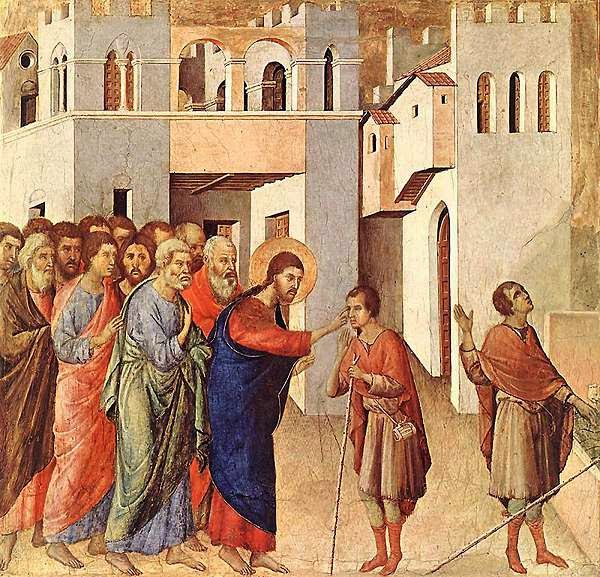
Without God humanity walks in blindness. And in the Gospels, one of Jesus’ most oft repeated miracles was the healing of the blind. 

Yet, the Messiah heals something far worse than physical blindness: spiritual blindness is far, far worse. 

To not have the light of God in one’s life, is far worse than being physically blind.  In our current age, we see in every dimension of society men and women going through life, raising their families as if God did not exist.  They do not know his promises, they do not recognize his presence, they do not walk in his truth.

Spiritual blindness is truly an epidemic—its symptoms are the erosion of the moral fabric of families and cultures, the corruption of children, the neglect of the poor among us.

The blind men in today’s Gospel are wonderful examples of faith.  In a way, though they were physically blindness, they could already see better than most.  They had heard the promises of God—that David’s heir would come bringing true healing, true peace.

Without physical sight, they recognized Jesus to be the Messiah and cried out, “Son of David, have pity on us.”   “Have pity on us.”  They recognized their blindness, they recognized their need for healing, and they recognized that they cannot heal themselves.

During Advent we say to God, like those blind men, “have pity on us.”  Bring us light, bring us healing, “come, that we may see you”.   Jesus proclaims in the beatitudes, “Blessed are the pure of heart, for they shall see God.”  This Advent, may we be purified of all that keeps us from seeing God.  May we be healed of our spiritual blindnesses, that we may bear the light of Christ to all those we meet, for the glory of God and salvation of souls.