Tuesday, September 3, 2013

Homily: September 3 - St. Gregory the Great - Servant of the Servants of God


Today is the feast St. Gregory is one of only two popes formally given the title “the Great”.  Pope St. Leo is the other, although many consider Pope John Paul II deserving of the same title.  Today, reflect on the work of the saintly Gregory, who reigned from 590-604.

Gregory was the son of a Roman senator, and because of his great administrative talents and moral integrity he served as Roman Prefect, the highest civil office in Rome when he was only 30 years old.  Yet, Gregory desired to devote his life more fully to the service of God, and became a Benedictine monk.

Though he desired a more contemplative life, he was sent by the Pope as papal representative to Constantinople.  After performing his duties, he was called back to Rome, and when the Pope Pelagius II died of the plague, Gregory was elected Pope. 

Among his accomplishments as pope, perhaps his three greatest are his sending missionaries to Britain, his administrative organization of the Church, and his contributions to music.  While all three continue to bear fruit today, the most notable may be his efforts on behalf of the form of chant that bears his name—Gregorian Chant.  He is also a doctor of the Church because of his great contributions to teaching Christian Doctrine.

Pope Gregory the Great was  the first Pope the refer to himself as the servus servorum Dei—the servant of the servants of God, a title which Pope John Paul II used for himself many times.  The Christian Life is one of service, and the Pope serves the Church, leading her, guiding her, shepherding her.

And that, in the end, is why Saint Gregory is known as the great, because he wasn’t just a competent administrator, but that he poured himself out in service to Christ.  He knew that true human greatness is found a total and surrender to Christ.  He put into practice all that he preached and became a living example of the Gospel he proclaimed.


Through the intercession of this great servant of the Gospel, may we be led to lay down our lives ever more deeply in humble service for the glory of God and salvation of souls.

Saturday, August 17, 2013

Homily: 20th Sunday of Ordinary Time - "I have come to set the earth on fire"

“I have come to cast fire upon the earth.  How I wish it were already blazing”.

This line tells us so much about Jesus and about his mission.  Especially since the Second Vatican Council there has been a tendency among Catholics to downplay the fiercer, more challenging aspects of the Biblical message. 

The God we meet in the Bible is kind, gentle, and compassionate, but also fierce, demanding, sometimes frightening, and judgmental. 

*Gasp* God is judgmental? Yes, He is!

Another way of saying that is that God makes distinctions.  We see that on every page of the Bible starting with the first.  God distinguishes, he separates light from dark, land from water, animals from humans. When God forms the nation of Israel, he judges them different, he distinguishes them from the other nations, he says, I set you apart from the other nations who do not know me.  When he gives Moses the commandments he makes known his judgment that there is a difference between good and evil, virtue and vice, sin and holiness. 

The prophets tell us over and over how God will judge the nations.  Jesus himself tells us that God will judge us at the end of time, separating the sheep and the goats, the saved from the damned.  St. Paul echoes this same sentiment that at the end of life, each one of us, no matter how virtuous or how wicked, will stand before the judgment seat of God.

In our culture, there is nothing that is tolerated less than appearing judgmental.  Our culture says, if it feels good do it, don’t worry about right or wrong. 

But the God we meet in the Bible, both of the Old Testament and New Testament, is a Judge, he is a demanding Father, not a permissive grandfather, who lets the kids get away with murder.

“I have come to cast fire upon the earth,” Jesus says.  It’s not so much that Jesus has come to light a warm, cozy, fire to make us sleepy and comfortable and complacent, that’s what television is for which numbs are brains and our hearts.  Jesus uses the Greek word, balein, which means to throw or to hurl.  “I have come to hurl fire down upon the earth”.  In the Old Testament we hear how God threw down fire upon Sodom and Gomorrah, how God threw down fire to consume the enemies of Elijah.  And Jesus is using the same imagery here.  Kind of scary, like there are consequences to our actions or something.

Yet we also know that Jesus shows us the face of mercy.  Especially in Luke’s Gospel, we hear of so many miraculous healings, the blind, the deaf, the mute, the leper, they are cleansed.  How can God be both fierce and compassionate?

Because God is Love.  Yes, love comforts the afflicted, but love also afflicts the comfortable.  Love helps someone who is struggling with their faith, but love also challenges someone who has grown complacent.  Love forgives someone who has made a mistake, but it also seeks to correct them so they don’t make the mistake again. 

Love is a parent who is able to say “no” to their children when they want to eat sweets instead of their wholesome dinner.  Love is a mother or father who says “no” when their children want to dress inappropriately or skip mass.  Love is a friend who helps us see the error of our ways when we are being stubborn or irrational or self-centered. 

Sometimes, oftentimes we find the medicine of the divine physician bitter to the taste and hard to take.  Sometimes speaking the truth is unpopular.  Sometimes standing up for the Christian faith leads to division in our own families, even persecution. 

One of the great stories from the early Church is the story of Saint Perpetua.  Perpetua lived in Carthage, in North Africa, around the year 200, before the legalization of Christianity. The Emperor Septimus Severus wished to cripple the growing Christian religion, so he issued a decree that Christians were to be arrested and killed unless they renounced their faith. 

Perpetua was among the first group of Christians who were arrested.  She was separated from her family, her husband and newborn baby son. 

Her father, who was a pagan, visited her in prison.  He pleaded with her, “renounce your faith, save yourself.”  “Father, do you see this pitcher of water?” she said pointing to a pitcher of water on the prison floor.  “Could it be called anything other than what it is?”  “No” he said.  "Well, neither can I be called anything other than what I am, a Christian."

One of Perpetua’s best friends came to her the day before she was to appear before the Roman Judge.  Her friend pleaded with her, "Have pity on your father's gray head; have pity on your infant son. Offer sacrifice to the emperor and you will be spared.”  Perpetua replied simply: "I will not.  I am a Christian”.
So, Perpetua, was sent to the stadium, along with Felicity her servant and the other Christians who refused to deny their faith in Jesus Christ, and they were slain by the sword.  For almost 2000 years we have honored them as Saint Perpetua and Saint Felicity. 

Whenever I hear the words of our Lord from today’s Gospel, “I have come to set father against son and daughter against mother” I always think of the martyrdom of Saint Perpetua. 

Yet, even in our own day, being a faithful Christian is counter-cultural. 

I have a priest friend whose parents kicked him out of the house when he said he was going into the seminary.  “No son of mine will be a priest” they said.  Yet, knowing that it caused division between him and his mother and father, he could not ignore the call to the priesthood.  But in the course of his studies, something wonderful happened.  His family came to accept his calling, his mother returned to the Church, his unbaptized father was baptized because he saw that his son was willing to suffer loss even of family for the faith.

I have another priest friend who received terrible pressure from his own family when he would not attend his cousin’s wedding, a Catholic, who was getting married outside of the Church. 

Standing up for the faith, following the faith is not always the popular thing to do.  Jesus acknowledges that it can even cause division in our own families. 

Because of our fallen natures, sometimes God’s truth appears harsh or fierce or judgmental, but just because the Gospel is unpopular, doesn’t mean it’s wrong.  Archbishop Fulton Sheen said it well when he said, “Wrong is wrong, even if everybody is wrong. Right is right, even if nobody is right.”  

Why are Christians willing to face division, hostility, persecution.  Listen again to the words of Paul to the Hebrews from our second reading: “Since we are surrounded by so great a cloud of witnesses, let us rid ourselves of every burden and sin that clings to us and persevere in running the race that lies before us while keeping our eyes fixed on Jesus, the leader and perfecter of faith. For the sake of the joy that lay before him he endured the cross, despising its shame, and has taken his seat at the right of the throne of God.”
We run the race, we face mockery from our culture, hostility from coworkers and even family, because the truth of Jesus Christ leads to the joy of heaven. 


“I have come to cast fire upon the earth” Jesus says, because he wants to burn away all in us that keeps us from following him with our whole hearts.  May we allow him to perfect our faith, to increase our conviction for working for the spread of that holy fire, for the glory of God and salvation of souls.

Friday, August 16, 2013

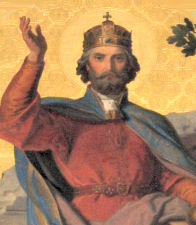
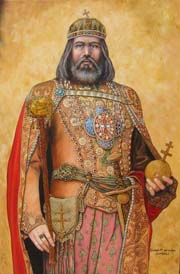
Homily: August 16 - St. Stephen of Hungary


Today’s saint used his considerable political powers and military skills to Christianize Hungary.  His pagan father was the chief of the Magyars, a group of raiders who had come into Hungary the century before.  The family converted to Christianity and was baptized together with Stephen was 10 years old.

When he succeeded his father, his people were given to violence and revolt, but Stephen guided his people toward Christianity by admitting missionaries from Bavaria into his country.  This attempt was initially met with hostility, the people wanted to hang on to their old religion and old pagan ways.  But Stephen fasted and prayed, he established monasteries and built churches.  He also made blasphemy and adultery crimes. 

Through his strict, yet benevolent rule, brought about order and peace.  With Rome’s approval, Stephen was crowned king on Christmas Day in 1000.

Stephen was a true evangelizer of his country.  We can see in the saints how whether one is a king or pauper, one is called to work for the spread of the Gospel.  He consecrated the nation to Mary, whom he called “the Great Lady”, he, himself gave religious instruction to the poor, and in view of his many good works and spread of the faith, the pope bestowed on him the title “Apostolic King.” 

A Hungarian parish here in the diocese of Cleveland, is named after St. Stephen’s son, St. Emeric.  Cleveland, in fact, is a hub in the united states for immigration from Hungary. 

St Stephens 
King - Hungarian cultureListen to these powerful words, St. Stephen wrote to his son, St. Emeric: “I urge you above all things to maintain the catholic and apostolic faith with such diligence and care that you may be an example for all those placed under you by God.”

We are reminded by St. Stephen of Hungary’s example the importance of our Faith in civic life, and the necessity to work for the spread of the faith where it has been abandoned or where it has not taken root, in our towns and in our hearts.    

St. Stephen built his house on the solid rock of the Gospel.  He was not spared hardship or suffering, his evangelical efforts were met with resistance, but he entrusted his work to Our Lady, sought to conform himself with Christ, and fasted and prayed for the spread of God’s kingdom.  In the end, he is not honored for being a king, but being a faithful disciple of Jesus Christ.


By St. Stephen’s example and prayers, may all we do today be for the spread of God’s kingdom, for the glory of God and salvation of souls.

Thursday, August 15, 2013

Homily: August 15 - Assumption of the Blessed Virgin Mary - Past, Present, and Future


When we gather for mass on the special feast days, Christmas, Easter, or during Lent, and Advent, or on the feast days of the saints, the prayers of the Mass contain special insights into what we are celebrating.  So we do well to listen very carefully when the priest chants or prays the opening prayer, also known as the collect, because it collects all of the intentions we have brought to the mass as individuals, the prayer over the gifts often connects the particular feast to the Eucharistic sacrifice, the prayer after communion before the final blessing, often directs us to go out into the world to live what we have celebrated. 

Today, on the feast of Mary’s Assumption, the preface prayer to the Eucharistic prayer expresses the rich themes of this solemnity.  Listen to this wonderful prayer, addressed to God, which I will offer from the altar:

“Today the Virgin Mother of God was assumed into heaven as the beginning and image of your Church’s coming to perfection and a sign of sure hope and comfort to your pilgrim people; rightly you would not allow her to see the corruption of the tomb since from her own body she marvelously brought forth your incarnate Son, the Author of all life.”

There is a lot going on there, but three themes in particular. 

1)      Mary was assumed into heaven
2)      Her assumption brings us comfort and hope
3)      Her perfection is a sign of our perfection to come

These three theme point to the Past, present, and future.

Mary’s Assumption, an event 2000 years ago in the past, gives us, and the Church for all ages, comfort and hope in the present, and shows us, what we hope to become in the future.

What do we mean when we say she was Assumed into heaven?  At the end of her earthly life, Mary’s body was taken directly into heaven.   Earthly remains are normally buried—earth to earth, ashes to ashes, dust to dust.  Yet Mary, her incorrupt body and soul, unstained by sin, was assumed, taken into, brought into the heavenly realm by God. 

There is even historical proof for this.  The early Church had a profound respect and devotion to the earthly remains of the saints.  And It was the practice of the early Church to gather at the places where the relics of the saints where buried; yet, no community every claimed to have the relics of the Mother of Our Lord because she had been taken directly to heaven.

So, why does this give us hope and comfort? 

The Assumption is like the light at the end of a dark tunnel, or a lighthouse guiding into safe harbor.  Where she has gone, we hope to go too. 

And we do say hope, we hope for heaven, because heaven is not a guarantee.  Faithfulness to God’s commandments and the teachings of the Church is so important.  And just as Mary was faithful, every day of her life, so to, faithfulness and obedience to God are imperative to our journey towards heaven.

So the assumption is so comforting to us because we can have real hope amidst all of the difficulties and darkness and temptations of life, real hope that faithfulness leads to heavenly reward.
The passage from the book of Revelation presents a vision of the struggle between the woman and the dragon.  Living the Christian faith, faithfulness to God in the present involves struggle.  We are really struggling against the forces of evil, we struggle against our evil tendencies to remain faithful to God.  Mary knew this struggle.  But she remained faithful to God in the face of that great struggle.

So too, Mary’s life involved terrible suffering and unfathomable challenges.  She at the cross as her Son suffered crucifixion and death.  She knew loss, she knew the hardship of journeying to Nazareth during her pregnancy and fleeing to Egypt when king herod sought the death of the Christ child.  Yet she remained faithful to God, she obeyed God in all things, and we celebrate today, how the faithful are rewarded.  But we call to mind how we can receive Mary’s help, for from heaven she is the most powerful of intercessors.  The saints teach us over and over again to pray the rosary every day for the conversion of the world for the conversion of hearts, to know Mary’s powerful aid in our terrible struggle against the powers of evil and the great sorrows of life.

Finally, her perfection and heavenly destination is a sign of our perfection to come in heaven.  Oftentimes we think of heaven as being a purely spiritual realm.  But Mary’s Assumption reminds us that heaven involves a bodily reality.  Our eternal destiny is not to be merely a spirit in God’s presence, but to be made perfect body and soul in God’s presence.

Where at Easter we celebrate Christ’s Bodily Resurrection and Victory over Death, today’s feast celebrates that victory applied to God’s most obedient creature, Mary, to show us what is in store for the faithful Christian.
Today as we renew our faith in Christ's power to do amazing things, by contemplating the great miracle of the Assumption. Let's ask the blessed Mother to obtain for us all the grace we need to be faithful and obedient to all the Lord asks of us, like her, that we may radiate his goodness and greatness for the Glory of God and salvation of souls.


Tuesday, August 13, 2013

Homily: August 13 - Saints Pontian and Hippolytus - Pope & Reconciled Anti-Pope, martyrs


Today we have two saints, whose feasts are celebrated together, Saints Pontian and Hippolytus.
Pontian was pope from 230 to 235. Meanwhile, Hippolytus was the leader of a schism in the church that began in 217 and continued through three pontificates.  He had himself elected anti-pope by a group of followers that agreed with him that the church was too lenient. 

Much more is actually known about the former anti-Pope Hippolytus than Pope Pontian.  Hippolytus was probably the most important theologian and writer before the age of Constantine.  His writings are the fullest source of our knowledge of the Roman liturgy and the structure of the Church in the second and third centuries.  Many of his works include Scripture commentaries, polemics against heresies and a history of the world.  His influence ripples into our modern day.  Eucharistic Prayer II, which we use almost daily for weekday Mass was authored by Saint Hippolytus  

In 235, the new Roman emperor Maximinus launched a violent campaign against Christian leaders.  And both Pontian and Hippolytus, pope and anti-Pope were imprisoned together in the mines of Sardinia. Imagine being stuck in prison with your bitter enemy!  Yet, the two men became friends and companions in their sufferings for Christ.

Hippolytus admitted his error and humbly reconciled with the Pope and with the Catholic Church. Both of them were worked to exhaustion, and beaten unmercifully, until both of them died in 235, the year of their exile, in that desolate Sardinian prison.  The bodies of both men were brought back to Rome a year later by the new Pope Fabian and were buried with the solemn rites for martyrs who died for the one, Holy, Catholic, and apostolic faith.

Hippolytus wrote: “Christ, like a skillful physician, understands the weakness of men. He loves to teach the ignorant and the erring... he seeks all, and desires to save all, wishing to make all the children of God, and calling all the saints unto one perfect man”  It took being imprisoned with the Pope to bring Hippolytus back into the fold.   It would be fitting to invoke Saints Pontian and Hippolytus on behalf of all those who have fallen away from the Church—if an anti-pope can be reconciled to Christ, so can our fallen away family members.

May the loyal suffering of Saints Pontian and Hippolytus, fill us with the love of God and make our hearts steadfast in faith for the glory of God and salvation of souls.


Saturday, August 10, 2013

Homily: August 10 - St. Lawrence, martyr - "Turn me over, I'm done on this side"


Today’s saint was a deacon of the Church of Rome in the mid 3rd century.  It’s hard to imagine the situation of the Church in Rome during the persecution, which lasted from 64 A.D. to 313 AD— We're talking about a state sponsored persecution lasting longer than America has been a nation.  

In 257 AD, the Roman Emperor Valerian passed a decree that Christian worship was forbidden unto death and that everyone was now forced to practice the pagan religion of the state.  And then, a second decree, a year later in 258 AD, that simply and coldly ordered all bishops, priests, and deacons be put to death.  

The Pope, Bishop of Rome, Pope Sixtus II was arrested and killed on August 7th 258 AD and Saint Lawrence was arrested and killed four days later.

Lawrence was a Spaniard, called to Rome from Toledo by the Pope.  As a deacon in Rome, Lawrence was charged with the responsibility for the material goods of the diocese of Rome and the distribution of alms to the poor.  When Lawrence knew he would be arrested like the pope, he sought out the poor—the widows and orphans of Rome—and gave them all the money he had on hand.

When the prefect of Rome heard this, he imagined that Church must have a considerable treasure hidden somewhere in the city.  He ordered Lawrence to bring the Church’s treasure to him.  So, Deacon Lawrenece  gathered a great number of blind, lame, maimed, leprous, orphaned and widowed persons.. When the prefect arrived, Lawrence simply said, “These are the treasures of the Church.”

In great anger, the Prefect condemned Lawrence to a slow, cruel death. The Saint was tied on top of an iron grill over a slow fire that roasted his flesh little by little, but Lawrence was burning with so much love of God that he almost did not feel the flame. He even joked.  I'm done on this side! Turn me over” Before his death he prayed that the city of Rome might be converted to Jesus and that the Catholic Faith might spread all over the world

Two lessons: first, that the poor are truly the treasure of the Church, and by caring for them we care for Jesus himself . And secondly, we too can laugh in the face of death, because we, like St. Lawrence know that we are made for a life beyond this life.


Almost nothing else is known about today’s saint—yet the greatest fact of his life is certain: he lived and died for Christ.  Through the prayers of St. Lawrence, may we be made worthy of the promises of Christ for the glory of God and salvation of souls.
Friday, August 9, 2013

Homily: August 9 - St. Teresa Benedicta of the Cross - Where is God in suffering?


Today we celebrate Saint Teresa Benedicta of the Cross.  She was born—Edith Stein— the 11th child of a large family of orthodox jews in Germany in 1891.  Her life came to an end 50 years later in a gas chamber at Auschwitz.  By then she was a Carmelite nun who had converted to Catholicism.  Though the Jews were the principle victims of the Nazi’s in World War II, millions of Catholics, including bishops, priests, and nuns were murdered in the concentration camps. 

While attending university, young the young jewish girl, Edith Stein began to develop a strong interest in Catholic belief and thinkers. After reading the autobiography of St. Theresa of Avila, she asked to be baptized.

10 years later she imitated Theresa of Avila by entering the Carmelite convent and took the name Sister Teresa Benedicta of the Cross.  It was 1933, Adolf Hitler was Chancellor of Germany.

In 1942, the Nazi’s arrested Sister Teresa.  She and her sister Rosa, also a Catholic, were transported to Auschwitz in Poland by boxcar.  One week later, Sister Teresa died in a gas chamber.

And as she was sent to Auschwitz and saw those terrible scenes—the destruction of human life brought by man’s inhumanity to man—she must have often asked herself once again, where is God? 

But she answered that question by remaining strong in her faith, by embracing Jesus Christ who leads us through the suffering of life into everlasting life. 

Today, August 9th is the anniversary of her death in Auschwitz, but it is also the day of her birth into heaven.  

Many people leave the Church because they find it burdensome and restrictive.  Some even claim that God must not love them because of their suffering.  Suffering is not a burden that we bear alone. No matter what our circumstances, whether we die homeless on the streets, in a hospital bed, in a concentration camp, the Lord Jesus blesses us and walks with us, reminding us as we heard in the Gospel today: ““Whoever wishes to come after me must deny himself, take up his cross, and follow me.”

Through the prayerful intercession of St. Theresa Benedicta of the Cross and all the Saints, may we bear our crosses with faith and hope and love today and always for the glory of God and salvation of souls.