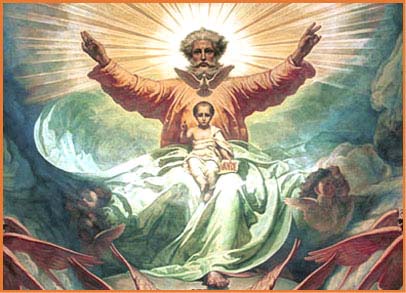
Sunday, June 15, 2014

Homily: Trinity Sunday 2014 - The family business


I am very honored and grateful to be able to celebrate my first weekend Mass here at St. Clare on this Trinity Sunday and on Father’s Day—I’m very happy that my own father is able to join us today, making the trek from Geneva, along with other family members, coming in from Madison, my home town.  After five years assigned to parishes on the west side, I’m so glad to be home.

One of the hallmarks of living in this part of the country, is that you can still see signs of the many great family businesses upon which our country was founded.  Family farms, family-run construction companies, restaurants, funeral homes, landscapers.  In fact, I grew up working alongside my parents, grandparents, aunts, uncles, and cousins in a family business out in Madison. 

Family businesses pride themselves on professionalism, fine-tuned craftsmanship, fidelity to their customers, and extensive experience spanning generations.  It’s not unlikely to see utility vans driving down Mayfield Rd with names of family businesses like “DeFranco and Sons, McBride and Sons, DiCicco and Sons”.

The Father and Son business is one of the great institutions.  The father passes on not only his name, but his trade.  And the son is proud to have the name of his father because that name stands for something great.  I think the happiest moments in a child’s life are when he is able to share in his family’s work: going to the work place, learning the tools and the skills, the meaning of hard work.

Jesus, not only practiced the trade of his foster-Father, Joseph the Carpenter, but the work for which he became one of us, was the trade of his heavenly Father: salvation and holiness.  We heard in the Gospel today: God so loved the world that he gave his only Son, so that everyone who believes in him might not perish but might have eternal life. For God did not send his Son into the world to condemn the world, but that the world might be saved through him.”  From the moment of man’s first sin in the garden, when he rebelled against God, when he took the gifts God gave him for granted, when he disobeyed the heavenly Father’s command, God, in his mercy was at work to redeem man, to restore man’s divine sonship.  And God sent his only Son to bring that work to completion. 

If God’s work is the salvation of souls, what are the tools of his trade?  Truth and charity!  Jesus preaches the Gospel and pours himself out on the cross for our salvation to restore our lost communion with God.
Through the great gift of the Holy Spirit what Jesus won on the cross is available to all men.  Through Christian Baptism, the Holy Spirit brings us back into right relationship with God, making us adopted sons of the heavenly Father through Jesus Christ.  We can truly call God Father because we have been brought back into right relationship with God through Christ by the power of the Holy Spirit.  Saint John Paul II said we are made “sons in the Son.”  Being adopted children of God, John Paul said, “is the culminating point of the mystery of our Christian life. In fact, the name 'Christian' indicates a new way of being, to be in the likeness of the Son of God. As sons in the Son, we share in salvation, which is not only the deliverance from evil” but is also to share in the very goodness and life of God.

Heaven is not just playing golf for all eternity, but sharing in the very life and glory of God, which begins in Christian baptism here on earth.

Yet, baptism is not a guarantee of heaven.  We must remain in right relationship with God through a life of prayer and charity.  Christians get in a lot of trouble when we take our sonship for granted.  We must constantly be about our Father’s work in order to remain in right relationship.  To be a Christian is to work in the family business—the family of the trinity.  The business?  The glory of God and salvation of souls.  Our lives, our work, our daily decisions, are to all be at the service of God’s glory and the salvation of man.

And here’s the real kicker: just as God the Father of love desires us to learn and practice his trade, so too does the Father of Lies.  The enemy, the devil, is all too ready to teach us his trade: arrogance, disobedience, lies, the pursuit of power and inordinate pursuit of possession and pleasure.  “All these things I will give you, if you call me Father.”  He tells us the same lie as he told Adam and Eve in the Garden, “you will be happier if you ignore God, follow your own feelings, be your own person.”  He teaches us to love video games more than prayer, booze more than worship, sin more than virtue.  The enemy is a liar, but his lies are convincing, just look at our culture.  80% of Catholics aren’t coming to Mass because they think what they have to do is more important.  They have swallowed the lie.  They have forgotten the face of their Father.  In the end, the family business of the father of lies brings unhappiness, exhaustion, and if we do not break away from his dysfunctional family, we will inherit not eternal glory and happiness, but damnation, the loss of eternal life with God in heaven.

So we must remain in right relationship with God through prayer, attendance at Mass, study of Scripture, and works of charity.  We must engage in the Lord’s work of going out into the world, filled with the zeal and fervor of the Holy Spirit, to call those who have fallen away back to right relationship with God.  That is what Christ did, that is what we are to do.  He sends us out to draw the fallen back to God.  That’s the family business, that’s the work of the Father, to draw men back to God through the preaching of the Gospel and the embrace of the cross.

In the end, there is nothing that will bring us more earthly joy or eternal joy than being in right relationship with Father, Son, and Holy Spirit, and sharing in his work.

On this Trinity Sunday, let us rededicate ourselves to fervent perseverance in the family trade, and relinquish our disordered desires of doing anything but, for the glory of God and salvation of souls.


Tuesday, June 10, 2014

Homily: Tuesday of the 10th Week of Ordinary Time - Radiating Christ

Today’s gospel immediately follows Jesus’ preaching of the Beatitudes.  Jesus went up the mountain.  Moses also went up a mountain, but where Moses went up to receive the revelation of God, Jesus goes up this mountain in Galilee not receive the law, but to teach it. 

In the passage we heard today, Jesus summons his disciples to be what God’s people were always meant to be: “salt of the earth” and “light of the world”.  Salt was used to flavor and preserve food, of course.  Through living the beatitudes, the disciples of Jesus Christ are to do just that, to preserve God’s goodness in the world and to help others experience that goodness.  And he says that the disciple who does not embody the beatitudes is like salt that loses its taste: good for nothing, basically. 

Similarly, disciple of Jesus Christ, that is, us, are to be light of the world.  In the Jewish tradition Israel was to be a light to the nations.  Jesus calls his disciples to fulfill this role by living the beatitudes in such a way that the world may see our good deeds and give glory to our heavenly Father.  Our good deeds, our works of Charity, our care for the needy, are to point to God.

Saint John Henry Cardinal Newman wrote a beautiful prayer, I prayed often in seminary, which honestly, I would do well to pray more often, called “Radiating Christ”.

 “Dear Jesus, help me to spread thy fragrance everywhere I go.  Flood my soul with thy spirit and life.  Penetrate and possess my whole being so utterly that all my life may only be a radiance of thine.  Shine through me, and be so in me that every soul I come in contact with may feel thy presence in my soul.  Let them look up and see no longer me but only Jesus!  Stay with me, and then I shall begin to shine as thou shinest, so to shine as to be a light to others; the light, O Jesus, will be all from thee, none of it will be mine; it will be thou shining on others through me.”


May we all radiate Christ this day, for the glory of God and salvation of souls.

Monday, June 9, 2014

Pentecost Sunday - Pentecost Lessons from St. Anthony of Padua

As the Holy Spirit brought new birth and new activity to the Church at Pentecost 2000 years ago, the Holy Spirit continues to bring about renewal, new activity, and new birth in the Church today.  We are not always conscious of how God is working in our life, but the Holy Spirit is constantly at work to bring about new life in us; new spiritual growth, new opportunities to pattern our life after our Savior.

It is often helpful to hear how God has worked in the lives of others to learn how God is working in our life.  

So, today, I’d like to draw some Pentecost lessons from a saint whose feast is this coming Friday, June 13: St. Anthony of Padua.

Saint Anthony of Padua has been honored by the Church since the 11th century; he belonged to the first generation of the band of brothers of Saint Francis of Assisi, the Franciscans, also known as the Friars Minor. 

Before meeting St. Francis, St. Anthony entered a community of Augustinian priests who followed the ancient rule of St. Augustine.  Following the rule of Augustine and living in community St. Anthony prayer, moderation and self-denial, and how to safeguard his chastity.

He dedicated himself to the study of the Bible and the Church Fathers, acquiring theological knowledge that would bear fruit in his teaching and preaching activities.  It was while with the Augustinians, that he had a life altering experience.  In 1220, the relics of the first five Franciscan missionaries who had gone to Morocco came to town. Anthony was inspired by their courageous witness, of giving their life for the spread of the Gospel, and it was then that St. Anthony desired to seek out St. Francis to become a Franciscan.
I want to draw three Pentecost lessons from the early years of Anthony’s life. 

Firstly, St. Anthony desired radical holiness.  We see him entering the Augustinians as a way of turning away from the temptations of the world in order to seek the perfection of his soul.  One of the reasons why the Holy Spirit does not set us on fire with radical love for the Lord is because we do not really want it.  Instead of imitating the saints and patterning our life after our Lord, we exhaust ourselves imitating the celebrities and athletes we see on television: their grasp for power, their hoarding of possessions.  We’d rather have the luxery of Lebron than the poverty of Christ.  And that is dangerous and stifling to the Holy Spirit. 

St. Anthony makes a decision, and so must we, to imitate Christ rather than the world.  To be in the world, but not of the world.

So our first Pentecost Lesson: like the Apostles going to the Upper Room, like St. Anthony entering the monastery, we must turn away from worldliness and seek radical holiness.

Secondly, while with the Augustinians, what does Anthony do?  He engages in prayer and study of Scripture and study of Church History and the Church Fathers.

In prayer and study of Scripture the Holy Spirit really does some real fire starting in our hearts.  St. Jerome famously quipped ignorance of Scripture is ignorance of Christ.  And Catholics are often sadly ignorant of Scripture, its structure and contents.

So, we must come to the Lord in the Scriptures daily so that we can pattern ourselves after him.  It is from him that we learn what true care of the poor means, it is from him that we learn what standing for the truth means, it is from him that we learn what suffering our crosses means.  And so we must encounter him in the Scriptures.

Also the study of the Church Fathers.  Cardinal Newman once said, “To be deep in history is to cease to be Protestant.”  We are called to be Vibrant Catholics, and the Church Fathers are so unabashedly Catholic.  They pass on to us a deep Eucharistic Faith, they teach us how to be in right communion with our bishops, and in the end, they are smarter and wiser than us.  And in reading people like St. Polycarp, St. Ireneaus, St. Athanasiaius, we can become infused with their vigor and wisdom for our own proclamation of the Gospel.

So the second principle: read Scripture and the Holy Church Fathers, for we must be infused with knowledge and wisdom to face 21st century challenges.

Finally, when was the great turning point in Anthony’s life?  St. Anthony was inspired to a deeper commitment to Christ when he saw the relics of the first Franciscan martyrs.  He saw those who died for Christ and said, “I want that!”

And that’s our third Pentecost lesson: Pentecost Faith leads us to have hearts of apostolic martyrs.  That first Penecost the Apostles burst forth from the upper room preaching the faith, and carried that message to the ends of the world, and 11 of those 12 died for the faith as martyrs. 

Willing to leave our homes, leave our comfort zones and suffer for Christ.  Dying to the life of comfort, and living for Christian service above all. 

That’s the third lesson: you want to be set on fire with the Holy Spirit?  True Christian Joy, vibrancy doesn’t come from a parish or diocesan program; it comes from willingness to die for Christ—spending our life in generous giving of our time, talent and treasure for the sake of the kingdom.  And that’s pretty hard to do when we’re zoned out on the internet or in front of the television. 

I came across a wonderful quote by St. Augustine that St. Anthony would no doubt have read.  St. Augustine said, “Hope has two beautiful daughters. Their names are anger and courage; anger at the way things are, and courage to see that they do not remain the way they are.”

Sometimes we think of anger as sinful, but there is good holy Christian anger.  It is good for Christians to get angry over evil and injustice: we should be angry that 70% of Catholics aren’t going to Mass on the weekends, and angry that Catholic morality is mocked openly in the media, by politicians. 

I was in an Italian restaurant recently and saw a sign which read, “do not be alarmed at the sound of cursing, pans being thrown, dishes being broken: this is how Italian food is made.”  There is unhealthy sinful anger, which fuels so much violence and pettiness; there is the anger that makes good Italian food,  but there is also a healthy Christian anger over injustice.

Jesus is not as sheepish as he is sometimes made out to be; nowhere in the Gospels does he say, “refrain from preaching the Gospel out of offending someone”.  Remember, he made a whip out of cords and threw out the money-traders from the temple.  His followers are meant to be sheep, yes, in their imitation of him, but also like lions, in our proclamation of His truth.

Christian Anger at how things are is met by Christian courage which works so that things do not remain that way.  It takes courage to teprimand the adult child who is not going to Mass. It takes courage to compose clear and poignant letters to our politicians to represent our Catholic values in public office.  But courage is needed, and the Apostles enkindled with Pentecost fire show us just that.

Come, Holy Spirit, fill the hearts of Thy faithful and enkindle in them the fire of Thy love.
Send forth Thy Spirit and they shall be created. And Thou shall renew the face of the earth.


June 9 - St. Ephrem - Harp of the Holy Spirit


My previous parish assignment was St. Columbkille Parish in Parma.  And we would celebrate June 9, the feast of St. Columbkille, the feast of our parish patron. 

So, this is the first time I get to celebrate the feast of St. Ephrem, a poet, teacher, orator, and defender of the faith born early in the 4th century in Syria.  He is the only Syrian recognized as a doctor of the Church.  He took upon himself the special task of opposing the many false doctrines rampant in his time, always remaining a true and forceful defender of the Catholic Church. 

He wrote beautiful hymns, containing faithful doctrine, in order to catechize the people in amidst all the many errors of the day.  For this he was called “the harp of the Holy Spirit.”  In icons and religious art he is often depicted holding a hymn which he composed.  This is why the opening prayer referred to St. Ephrem as “exulted in singing God’s mysteries.”  He’s sometimes called “Mary’s own singer” and in art is depicted singing to the queen of heaven.

He had such an acute vision of the goodness of God and the sinfulness of man that he become known for being “dissolved in tears.”  He is was in this constant state of weeping because of his insight into God’s love for us. 

He is also known as St. Ephrem the Deacon because he was ordained a deacon by St. Basil the Great, but never a priest.  In fact, the people wanted him to be a bishop, but he is said to have avoided episcopal consecration by pretending to be insane.

He died in 373 while caring for those infected by the plague. 

In popular devotion, St. Ephrem is not as well-known as St. Francis or St. Anthony or St. Patrick, yet Ephrem is a wonderful saint for us.  He was so steeped in God’s word, so in love with God.  Perhaps, of the beatitudes which were proclaimed today, St. Ephrem lived out “Blessed are the pure of heart, for they shall see God.”

Do you want to be enraptured by God?  The pure of heart shall always be the one with the deepest insight, the deepest experience of God’s goodness here on earth. 

In this age of such grave impurity, saints like Ephraim call us, away from the glamours  and perversions of the world, back to the contemplation of the pure beauty of God.  O the beautiful hymns we would compose, if spent more time in Our Lord’s sweet presence.

May St. Ephrem help us in remaining free from all that keeps us from contemplating God’s goodness, truth, and beauty this day for the glory of God and salvation of souls.
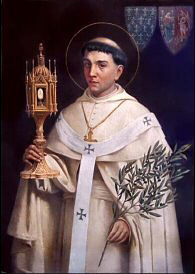
Pour into our hearts O Lord, we pray, the Holy Spirit, at whose prompting the Deacon Saint Ephrem exulted in singing of your mysteries and from who he received the strength to serve you alone.

Friday, June 6, 2014

Homily: June 6 - St. Norbert, Bishop - Called to deeper love of Christ


About a thousand years ago, there lived a man by the name of Norbert who started a religious order called the Premonstratensians.  For some reason, most people know them today as the Norbertines.    Norbert was of noble birth, and when he was ordained a subdeacon he was chaplain to the emperor, and put in charge of dispersing alms to the poor.  However, Norbert began to take on a lot of the bad habits of the emperor’s court, and became very worldly.  Conversion came when, during a violent thunderstorm, Norbert had a close brush with death.  At his ordination to the priesthood in 1115, Norbert gave away all of his possessions and moved to the valley of Premontre in northern France, from which we get the name Premonstratensian.

The opening prayer said that God made Bishop Saint Norbert a servant of the Church outstanding in his prayer and pastoral zeal.  As a priest and later as an archbishop, Norbert spent many hours in contemplation of the divine mysteries.  Consequently, His preaching and teaching were infused with the fruit of his time in prayer.

Part of his plan for renewal and evangelization in his diocese was deep devotion to the Holy Scriptures.  He encouraged the members of his religious order to read the scriptures often, and to pattern their lives after the Gospel of Jesus Christ.  These days when we are talking more and more about evangelization, that means Catholics must become much more familiar and devoted to the Scriptures, so that we can draw people to Christ through them.

Norbert was also devoted to the Blessed Sacrament, and Norbert attributed the conversion of sinners , the reform of the clergy, and the spread of the Gospel throughout his diocese to time spent in adoration of the Blessed Sacrament.  Religious art often depicts him holding a monstrance or kneeling in front of the Blessed Sacrament.

In the Gospel today Jesus asked Peter three times, “Simon Peter, do you love me?”  Jesus calls us over and over to a deeper love.  Though a subdeacon, Jesus called St. Norbert to a deeper love, free from the wealth and trappings of the imperial court.  And Norbert’s love for the Lord continued to deepen through reading scripture and adoration of the blessed Sacrament.

There is a program for renewal that each of us are to follow: to always seek that deeper conversion to the Lord, and to let our words and our deeds infused with the fruit of study and prayer.  May we know the prayers of Saint Nortbert today in our daily conversion and evangelization for the glory of God and salvation of souls.

Thursday, June 5, 2014

Homily: June 5 - St. Boniface - Chopping down false gods


Today we celebrate the feast of Saint Boniface, who is known as the apostle to the Germans.  This English Benedictine monk devoted his life to the evangelization of the Germanic tribes.  He made his first missionary journey to Germany in 719 at the request of Pope Gregory II.

He found the land full of Pagans and many of the Christians there had also lapsed into error, even many of the clergy.

This is one of my favorite stories from the lives of the saints: early on in Boniface’s efforts to uproot the superstition and false worship of the pagans.  The Germanic tribes worshipped gods of Norse Mythology: Odin and Thor and the like.  And many were resisting belief in Christ.  Boniface learned of a giant oak tree where the Pagans gathered to offer false worship to the God Thor.  So Boniface, took an axe and began chopping down the tree.  The pagans cursed Boniface and waited for him to be struck dead by their gods for his sacrilege.  The story says that just when Boniface had chopped a small notch into the tree, the tree was blast apart from above.  And the pagans who had before cursed Boniface now began to belief.  And moreover, Boniface took from the wood of the tree and built an oratory in honor of Saint Peter.  

This is why you’ll often see stained glass windows and statues with St. Boniface, in his bishops attire, with an axe, standing on a tree trunk. 

In a letter written to a Benedictine abbess, Saint Boniface wrote: “Let us stand fast in what is right and prepare our souls for trial…let us be neither dogs that do not bark, nor silent onlookers, nor paid servants who run away before the wolf.”

Here was a man of tremendous courage.  He opposed falsehood, he proclaimed justice, and the Gospel of Christ in the face of grave opposition.  And as a bishop at the age of 80 he was martyred.  He was preparing converts for Confirmation, when he and 53 companions were massacred.  We’re never too old to witness. 

One writer wrote, “St. Boniface had it all: natural brilliance, formidable powers of persuasion, and unstoppable energy and resolve.  He could have had a great career and high status in society, but this saintly man wanted something very different: nothing for himself and everything for Christ and His Church.” 

What are the pagan oaks which need to be chopped down in our culture?  What are the oaks of selfishness which need to be chopped down in our own souls?  Remember that Bonifice only needed to take those first courageous swings with the axe before God did the rest of the work.

As we prayed in the opening prayer: “may the Martyr Saint Boniface, be our advocate that we may firmly hold the faith he taught with his lips and sealed in his blood and confidently profess it by our deeds” for the glory of God and salvation of souls. 


Monday, June 2, 2014

Homily: Monday of the 7th Week of Easter - Did you receive the Holy Spirit?

We are in the final week of Easter and are fast approaching the feast of Pentecost.  During his third and final missionary journey, Paul made his way through the countryside of what is now Turkey.  He came to Ephesus and encountered a group of believers.  Yet, they didn’t seem to know much about Jesus; they had been baptized with the baptism of John the Baptist, rather than Jesus’ Baptism.  Remember John was baptizing with a baptism of repentance, preparing people for the coming Messiah.  John the Baptist even said, I baptize you with repentance, but he who is coming will baptize you with the Holy Spirit and with fire

So when Paul asked them, “Did you receive the Holy Spirit when you became believers?” They answered straight-faced: receive the Holy Spirit?  We’ve never even heard of the Holy Spirit!

So Paul baptized them into the saving death and resurrection of Jesus, and received the outpouring of God’s Spirit.  Immediately God’s Spirit began to transform their lives: they spoke in tongues and prophesied. 

It is good for us to reflect on our own baptism, and in preparation for Pentecost, it is good for us to recall that person of the Trinity that often goes neglected and underappreciated. 

At the Last Supper, Jesus promised his disciples that God would send the Holy Spirit to his followers.  He is the gift giver, the sanctifier, the consoler, the comforter.  When we are faithful to Jesus, the Holy Spirit bears fruits to help us build up the kingdom of God.  He bestows upon us and strengthens us with his seven-fold gifts.   of wisdom, understanding, counsel, fortitude, knowledge, piety, and fear of the Lord

The Holy Spirit brings us to a knowledge of our sins, and guides us to be forgiven by Jesus Christ, and strengthens us to live as his faithful followers, and he sets our hearts on fire with love for God and neighbor.

What is the fruit or gift of the Holy Spirit that you think you need most in your life right now?  To be wiser in prioritizing your life, to be more understanding of the truths of the faith in order to teach them, to be able to give better counsel to those who are struggling or lost, a deeper piety in participating in the celebration of the sacred mysteries?


May we be open to a great outpouring and strengthening of the Holy Spirit this week, for the Glory of God and Salvation of souls.